

Choosing the wrong aluminum grade can lead to casting defects1, part failure, and unexpected costs. This mistake can easily jeopardize your project timeline, budget, and the final product’s long-term reliability.
The most common grade of aluminum for die casting is A380, an alloy known for its excellent balance of castability, mechanical properties, and cost-effectiveness. Other widely used grades include ADC12, a Japanese standard similar to A380, and AlSi9Cu3 (EN AC-46000), popular in Europe.
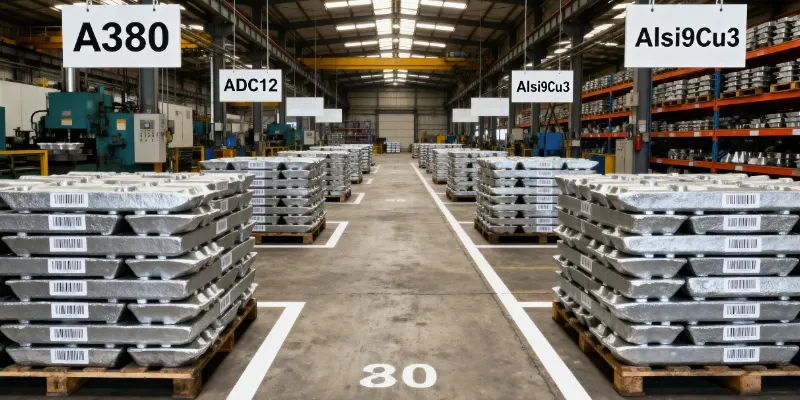
Over my 20-plus years in this industry, I’ve worked with dozens of different metal alloys. But when it comes to high-pressure die casting2 gain3, only a select group of aluminum grades has the right stuff. The process is incredibly demanding; the molten metal is injected into a steel die at extreme speed and pressure. The alloy has to be fluid enough to fill every tiny feature of the mold without solidifying too early. It has to be strong, stable, and predictable. Think of these grades not just as raw materials, but as highly engineered recipes designed specifically for this process. Let’s look at the most common ones we use every day.
Which Aluminum Alloys Are Most Commonly Used in Die Casting?
You’re reviewing a technical drawing that specifies an aluminum alloy you don’t recognize. To properly assess the design and source the part, you need to understand the landscape of common die casting grades.
The most frequently used aluminum alloys are from the aluminum-silicon-copper family. The workhorses are A380 and its close relative A383. The Japanese equivalent, ADC12, is dominant in Asia, while the European standard is often AlSi9Cu3 (also known as EN AC-46000).
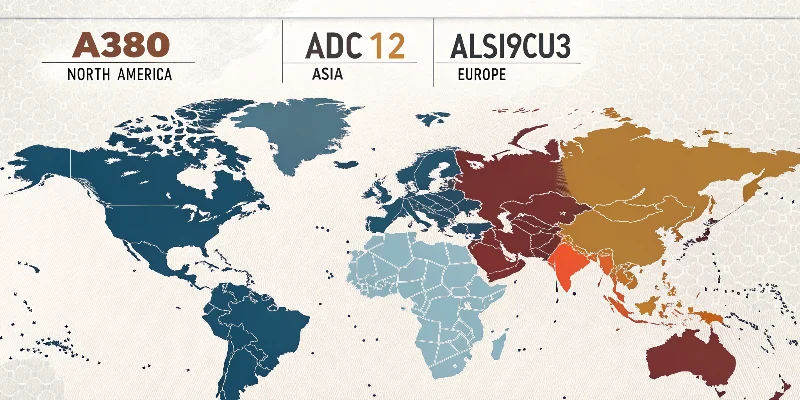
When a customer comes to us with a new project, the material selection4 is one of the first and most important conversations we have. While there are hundreds of aluminum alloys5 out there, for die casting, we almost always start with this core group. The reason is that they all share a key ingredient: silicon. Adding silicon to the aluminum dramatically improves the molten metal’s fluidity. It helps the alloy flow into thin walls and complex shapes, which is a hallmark of the die casting process. The copper content6, on the other hand, increases the material’s strength and hardness. Each of these standard alloys has a slightly different "recipe" of these elements, creating a trade-off between castability, strength, and other properties. Choosing the right one depends entirely on the part’s specific requirements, from its structural load to its operating environment.
Why Is A380 Aluminum the Industry Standard for Die Casting?
You need a reliable, all-purpose material for a new die cast component. You want a grade that is readily available, cost-effective, and has a long track record of proven performance in a wide range of applications.
A380 is the industry standard because it offers the best all-around combination of properties. It has good mechanical strength and hardness, excellent thermal conductivity, and very good castability, all at a competitive price. Its versatility makes it the default choice for many components.
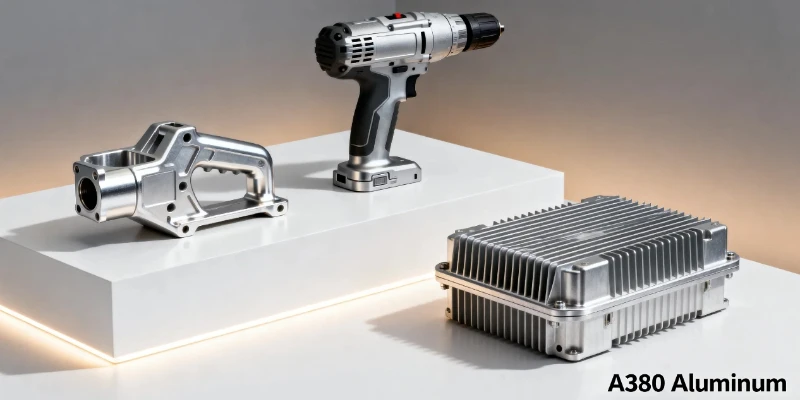
I call A3807 the "workhorse" of our foundry. If a customer doesn’t have a specific, unusual requirement, A380 is almost always our starting point, and for good reason. It just works. It has enough strength for many structural brackets and housings. Its thermal conductivity8 is great for electronic enclosures and motor housings that need to dissipate heat. And most importantly, it flows beautifully in the die, allowing us to produce complex, detailed parts with high reliability and low scrap rates. I once had a client who was designing a housing for an industrial sensor. They had initially specified a more exotic and expensive alloy. During our design review, we ran a simulation and determined that standard A380 would meet all of their mechanical and thermal requirements. By switching to A380, we saved them nearly 15% on the final part cost without any sacrifice in performance. That’s the value of a great standard material.
How Do Alloys Like ADC12 and AlSi9Cu3 Compare in Performance?
Your company sources parts globally, and you see different alloy designations from suppliers in Asia and Europe. You need to know if ADC129 and AlSi9Cu310 are truly interchangeable with the North American standard, A380.
ADC12 and AlSi9Cu3 are very similar to A380 and are often considered equivalents in their respective regions. While their performance is broadly comparable, slight differences in their silicon and copper content can lead to minor variations in fluidity, strength, and ductility.
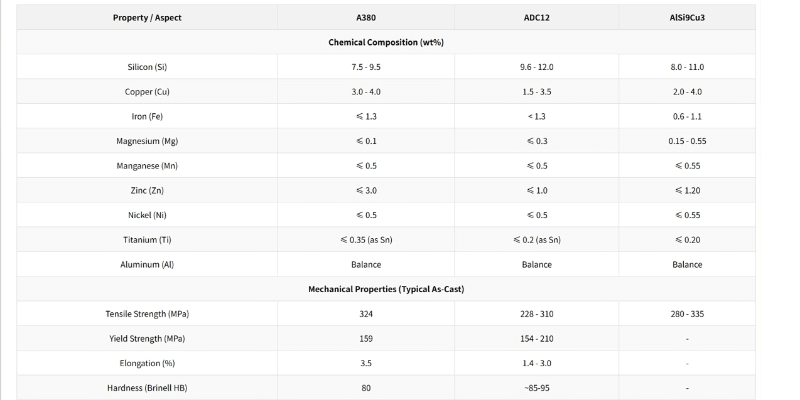
Navigating global standards is a common challenge. A few years ago, we helped a customer move production of a part from a supplier in China to a European facility to shorten their supply chain. The original drawings all called for ADC12. The European facility primarily used AlSi9Cu3. While the two are very close, the customer’s quality engineer was concerned about potential performance differences. We conducted a full analysis. We showed them that while AlSi9Cu3 has a slightly narrower silicon range and ADC12 has a slightly higher copper limit, for their specific application—a non-structural housing—the mechanical and physical properties were well within their required tolerance. We produced the first articles using AlSi9Cu3, and they passed all validation tests without any issues. This experience highlights that while these alloys are very similar, it’s always critical to review the specific application before confirming a direct substitution.
Quick Comparison of Standard Alloys
| Alloy Designation | Primary Region | Key Characteristics |
|---|---|---|
| A380 | North America | The global benchmark; excellent balance of all properties. |
| ADC12 | Asia (Japan) | Very similar to A380, slightly higher copper content allowed. |
| AlSi9Cu3 (EN AC-46000) | Europe | Very similar to A380, often with tighter composition controls. |
What Grades of Aluminum Offer the Best Corrosion Resistance?
Your component will be used in a wet or marine environment. You are concerned that standard alloys may corrode over time, leading to premature failure of the product.
Aluminum alloys with lower copper content, such as A360 or AlSi12 (EN AC-44100), offer superior corrosion resistance. While A380 has good resistance, its copper content makes it more susceptible to corrosion in harsh, salty environments compared to these low-copper alternatives.
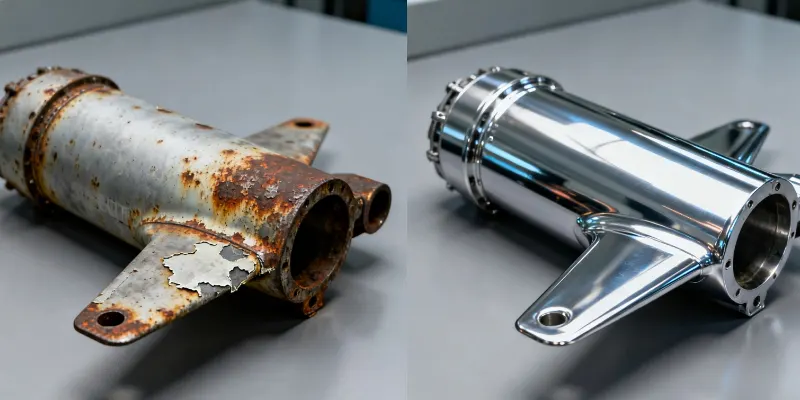
Aluminum naturally forms a protective oxide layer, which is why it resists corrosion so well in the first place. However, the alloying elements we add can change that behavior. Copper, which we add for strength in A380, can unfortunately reduce the alloy’s natural corrosion resistance11. For most applications, this is not an issue. But for a part that’s going to be exposed to road salt or sea air, it’s a critical consideration. For these situations, we would recommend an alloy like A360. It has less copper, which makes it more resistant to corrosion, but this also means it’s not as strong and is more difficult to cast. Often, the most practical solution is to stick with a standard, castable alloy like A380 and then apply a protective surface treatment, such as a chromate conversion coating or a durable powder coat. This often gives the best combination of mechanical performance, castability, and corrosion protection.
How Does Alloy Selection Influence Mechanical Properties and Tolerances?
You are designing a structural component that has critical strength requirements and tight dimensional tolerances12. You need to understand how the choice of alloy will directly impact the final part’s performance and precision.
Alloy selection is a primary driver of mechanical properties like tensile strength, hardness, and ductility. It also influences tolerances, as each alloy has a unique shrinkage rate and solidification behavior that affects the final part’s dimensional stability.

This is where engineering and material science truly intersect. If a customer needs a part that can withstand high loads, we would lean towards an alloy with higher strength, and we might even recommend a secondary heat treatment process to maximize those properties. If the part needs to bend slightly before breaking (ductility13), we would choose an alloy with higher elongation. These choices also affect our process. An alloy with a high shrinkage rate will contract more as it cools in the die. We have to account for this with extreme precision when we design and build the tool, cutting the cavity slightly larger than the final part’s nominal dimensions. Well-understood, stable alloys like A380 allow us to predict this behavior very accurately, enabling us to hold very tight tolerances, often in the range of ±0.05 mm. Choosing the right alloy is a balancing act between the part’s final performance needs and the manufacturability of the design.
What Future Alloy Developments Are Shaping the Die Casting Industry?
You are looking ahead at next-generation products that will be lighter and stronger than what is available today. You want to partner with suppliers who are knowledgeable about emerging material trends.
Looking forward from my perspective in late 2025, alloy development is focused on two key areas: high-performance structural alloys for EVs and sustainable alloys with high recycled content. New grades are being engineered to provide higher ductility and strength, specifically for large, single-piece "Giga Press" castings.
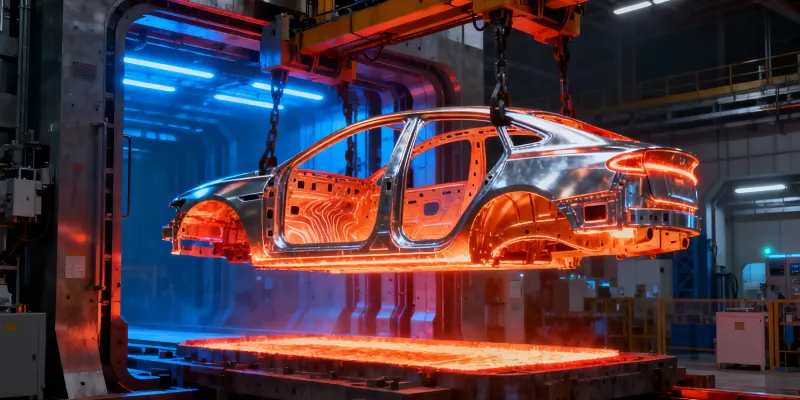
The die casting industry is evolving faster now than at any point in my career, and new alloys are at the heart of this transformation. The rise of electric vehicles and large-scale structural castings is pushing the limits of traditional materials. Automakers want to replace complex, multi-part steel assemblies with single, lightweight aluminum castings. To do this safely, they need alloys that are not only strong but also very ductile, meaning they can absorb energy in a crash without fracturing. This has led to a new family of specialized aluminum-silicon alloys with additions of magnesium or other elements, designed to be heat-treated for maximum performance. At the same time, there is a massive push for sustainability14. Our customers, especially in Europe, are demanding alloys that incorporate a higher percentage of recycled aluminum scrap. The challenge for us and our suppliers is to develop alloys that can use this recycled content while still meeting the incredibly strict performance and purity requirements of the final product.
Conclusion
While A380 remains the universal workhorse, a range of specialized aluminum grades is available for die casting. The right choice depends on a careful balance of mechanical requirements, environmental exposure, and global sourcing strategy.
Learn about common casting defects and how to avoid them in the die casting process. ↩
Explore the high-pressure die casting process and its advantages in producing complex parts. ↩
Gain insights into the die casting process, its advantages, and how different alloys are utilized. ↩
Understand the key factors in material selection for die casting to ensure optimal performance. ↩
Explore the various aluminum alloys used in manufacturing and their specific applications. ↩
Discover how copper content influences the strength and corrosion resistance of aluminum alloys. ↩
Explore the properties of A380, the industry standard for die casting, to understand its versatility and performance. ↩
Understand the thermal conductivity of different aluminum alloys and their applications. ↩
Learn about ADC12, a popular alloy in Asia, and how it stacks up against A380 for die casting applications. ↩
Discover the features of AlSi9Cu3, a European standard alloy, and its suitability for die casting. ↩
Find out which aluminum alloys provide superior corrosion resistance for harsh environments. ↩
Learn about dimensional tolerances in die casting and their impact on part quality. ↩
Learn about ductility in aluminum alloys and its significance in design and performance. ↩
Explore how sustainability trends are shaping the development of new aluminum alloys. ↩


