

Creating complex automotive parts with perfect consistency and precision1 is impossible with manual methods. This leads to quality issues, high scrap rates, and an inability to meet the incredibly tight tolerances2 required by modern engines and vehicle platforms.
CNC, or Computer Numerical Control, in automotive is an automated manufacturing process where computers precisely guide high-speed cutting tools to shape metal parts. It is essential for producing components like engine blocks, transmission cases, and EV motor housings with extreme accuracy, tight tolerances, and flawless repeatability.
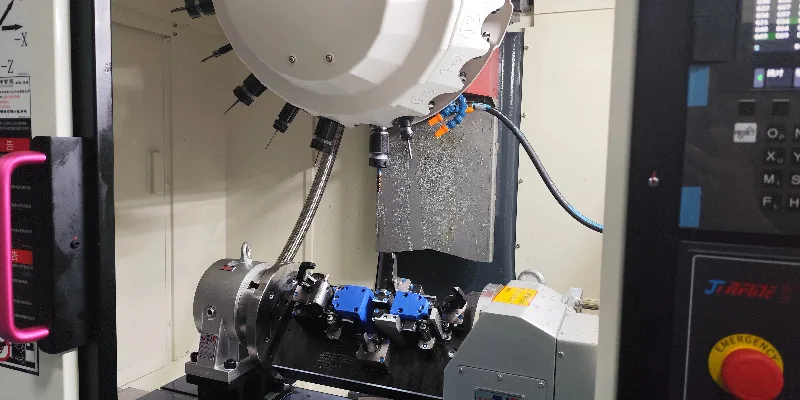
In my work with aluminum die casting3, I often tell clients that we create the "near-net shape." That is, the casting gets the part about 95% of the way there. But it’s that final 5% where perfection is required, and that is the world of CNC. For over 20 years, I’ve seen CNC machining4 as the essential partner to the casting process. It’s the critical final step that takes a raw casting and turns it into a finished, functional component that can be bolted onto a car with complete confidence. It’s the bridge between a good part and a perfect part.
What Does CNC Mean in Automotive Manufacturing?
You often see the term "CNC" on technical drawings and supplier capability lists. To have a meaningful discussion about manufacturing processes, you need to understand what this technology is and how it works.
CNC stands for Computer Numerical Control. In simple terms, it means a computer translates a digital design into a series of precise movements for a machine. A computer program, not a human operator, controls the cutting tool’s exact position, speed, and path.
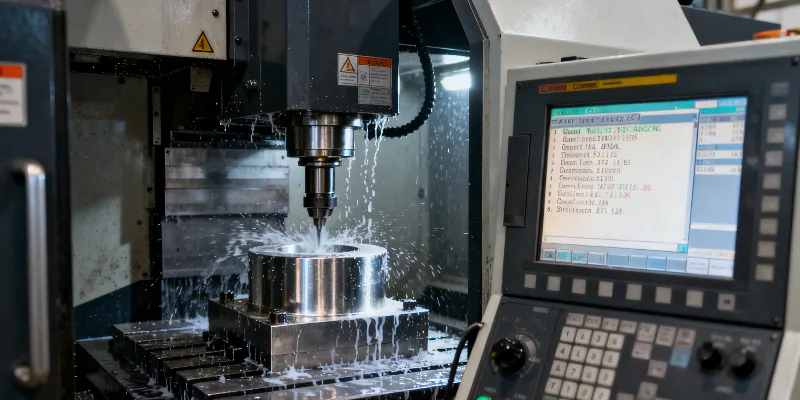
The process is a perfect blend of digital design and physical manufacturing. It starts with an engineer creating a 3D model of the part in a CAD (Computer-Aided Design) program. That digital file is then loaded into another program called CAM (Computer-Aided Manufacturing). A programmer uses the CAM software to define the exact path the cutting tools will take, the speed they will spin, and how deep they will cut. This program is then converted into a language the machine can understand, often called G-code5. When we load this program into the CNC machine and press "start," the computer executes those instructions with a level of precision that is simply not possible by hand. The machine follows the programmed path perfectly, removing material to create a physical part that is an exact match to the original digital design.
How Is CNC Machining Used to Produce Car Parts?
You have a raw casting or a block of metal, but it needs precise holes, flat surfaces, and threaded features. You need a process that can perform these different operations in a controlled and repeatable way.
CNC machining uses various rotating tools to cut and shape parts held securely in a fixture. A CNC mill can create flat surfaces and complex contours, while a lathe is used for cylindrical parts. Operations include drilling holes, tapping threads, and milling sealing surfaces.
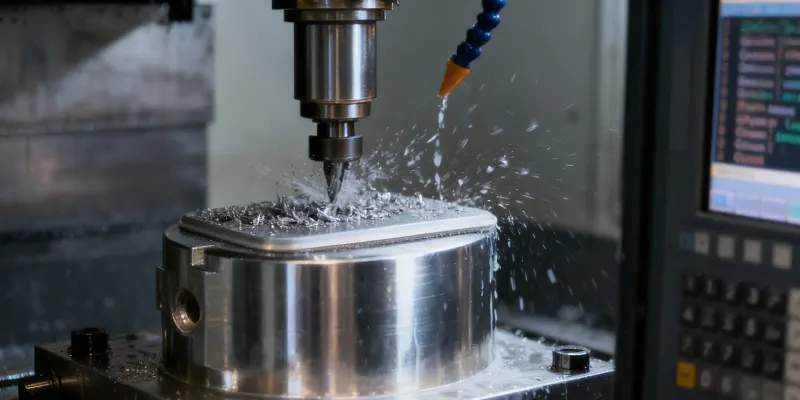
When a part comes to the CNC department, the first step is to lock it into a custom fixture6. This fixture holds the part in a precise and rigid position so it can’t move during the high-speed cutting operations. The machine can then perform a whole sequence of tasks. I remember setting up a complex machining cell for a V6 engine block. The machine had an automatic tool changer with dozens of different tools. In a single cycle, it would first use a large face mill to make the deck surface perfectly flat where the cylinder head attaches. Then, it would switch to a drill to create the bolt holes, followed by a tap to create the threads in those holes. Finally, a special boring tool would finish the cylinder bores to an incredibly smooth and precise diameter. All of these operations were done in one continuous, automated sequence, ensuring every feature was perfectly located in relation to the others. This is the power of CNC: combining multiple precision operations into a single, reliable process.
What Are the Advantages of CNC Machining in the Automotive Industry?
You need to produce thousands of parts that are all identical, meet strict quality standards7, and do it efficiently. You also need the flexibility to create prototypes quickly for new product development.
The primary advantages are precision, consistency, and flexibility. CNC machining can hold tolerances of a few microns, ensuring every part is identical. It is also highly flexible, allowing for rapid prototyping and design changes without the need for expensive tooling modifications.
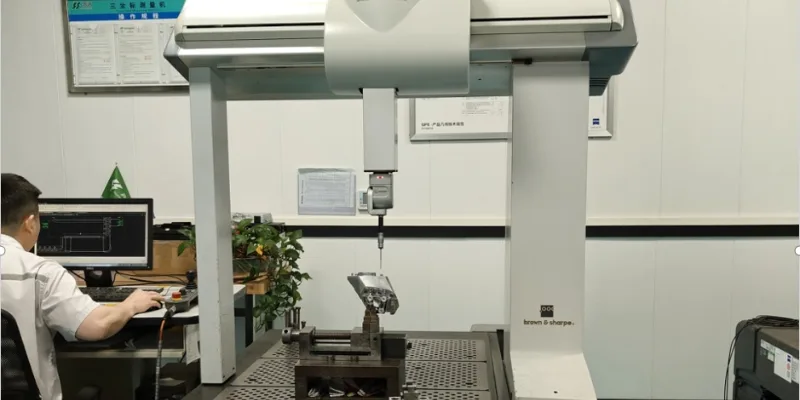
The benefits of CNC are what make modern automotive manufacturing possible. First is the incredible precision. We can machine features to tolerances that are a fraction of the width of a human hair. This is essential for parts that have to seal perfectly or hold bearings that spin at thousands of RPM. Second is the consistency. The 100,000th part we make will be identical to the first part because the computer is running the same program every single time. This is a dream for a quality engineer. But perhaps one of the most powerful advantages is the flexibility it gives us. I once had a client who needed to test three slightly different designs for a bracket. Instead of making expensive casting tools for each, we took a solid block of aluminum and machined all three versions on our CNC mill8 in a single day. They were able to test the prototypes, choose the best design, and move forward with confidence. This ability to make changes quickly and produce parts directly from a digital file drastically shortens development time.
How Does CNC Support Precision in Aluminum Die Casting Components?
Your die cast part has a complex overall shape, but the mating surfaces, sealing grooves, and mounting holes need to be perfectly accurate. You need to understand how the casting and machining processes work together.
CNC machining is the essential finishing step for die castings. While casting creates the complex "near-net shape" efficiently, CNC provides the final precision, machining critical features like flat sealing surfaces, O-ring grooves, and precise bearing bores to tolerances that casting cannot achieve.
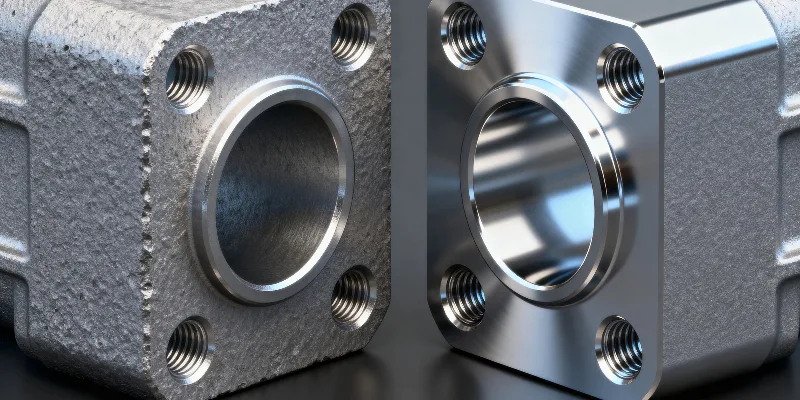
This is the heart of my world: the synergy between die casting and CNC. Think of it as a two-step process to get the best of both worlds. Die casting is incredibly fast and efficient at creating a complex shape. In under a minute, we can produce a detailed part like a transmission housing. However, the casting process has its limits on precision. Due to factors like material shrinkage, you can’t hold tolerances of a few microns. That’s where CNC takes over. We design our castings with a small amount of extra material, called "machining stock9," on the critical surfaces. I recently worked on a complex liquid-cooled housing for an EV power inverter. The main body, with all its cooling fins, was die-cast. But the flat surface where the power electronics mounted needed to be perfectly flat to ensure good heat transfer. We used a large CNC mill to skim just a fraction of a millimeter off that surface, creating a perfectly flat and smooth finish that was essential for the product to function correctly.
What Automotive Parts Are Commonly Made Using CNC Machines?
You are reviewing a supplier’s capabilities and see a list of their CNC equipment. You want to know what kind of automotive parts this technology is typically used to produce.
CNC machining is used across the entire vehicle. Common parts include powertrain components like engine blocks and transmission cases, chassis parts like brake calipers and suspension knuckles, and critical EV components like motor housings and battery trays.
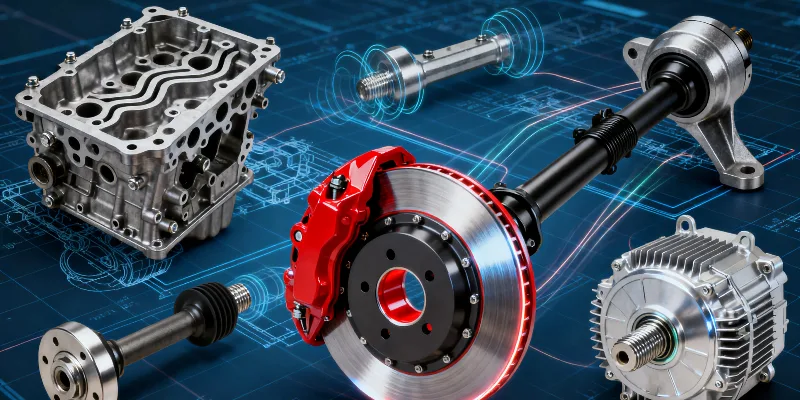
The list of parts that pass through a CNC machine is enormous. If a part is made of metal and has a feature that needs to be precise, it was almost certainly touched by a CNC machine. The process is so fundamental that it’s hard to imagine modern manufacturing without it. In my experience, we can group the most common parts into a few key areas of the vehicle.
Common CNC-Machined Automotive Components
| Vehicle System | Common CNC Parts | Machining Purpose |
|---|---|---|
| Powertrain | Engine Blocks, Cylinder Heads, Transmission Housings | Mating surfaces, cylinder bores, valve seats, bearing pockets |
| Chassis | Brake Calipers, Suspension Knuckles, Subframes | Piston bores, mounting points, bearing surfaces |
| Electric Vehicle | Motor Housings, Battery Trays, Inverter Housings | Bearing bores, sealing surfaces for airtightness, mounting pads |
| Prototypes | Brackets, Housings, Custom Components | Creating functional test parts directly from solid material |
How Is CNC Technology Evolving in the Era of Electric Vehicles?
You are focused on the future of automotive manufacturing. You need to understand how key technologies like CNC are adapting to the demands of electrification and smart factories.
In the EV era, as of October 2025, CNC is evolving to handle larger, more complex aluminum components like single-piece "Giga Press" castings. There is also a major trend toward automation, with robots loading and unloading machines, and the integration of AI to optimize toolpaths for greater efficiency.
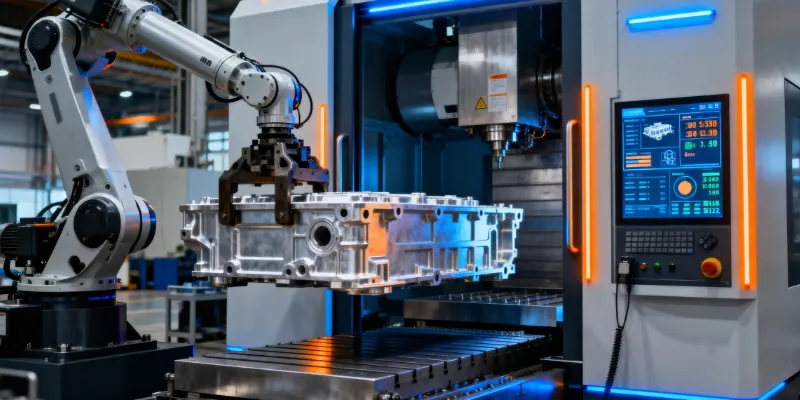
The rise of electric vehicles10 is putting new demands on CNC technology. EV components are often larger and more complex than their internal combustion engine counterparts. For example, machining a massive, single-piece battery tray that forms the entire floor of the car requires much larger CNC machines with advanced multi-axis capabilities11. Precision is also more critical than ever, especially for things like the sealing surfaces on a battery enclosure that must be perfectly waterproof. The biggest evolution I’m seeing right now is the push toward "smart" machining and automation12. We are using software that simulates the entire machining process to prevent errors. We are also implementing robotic systems to load raw castings and unload finished parts, allowing our CNC cells to run 24/7 with minimal human intervention. Looking ahead, AI is starting to play a role, with systems that can automatically adjust cutting speeds and feeds in real-time to optimize for tool life and cycle time. CNC is becoming a smarter, faster, and more integrated part of the automotive factory of the future.
Conclusion
CNC machining is the cornerstone of precision in the automotive industry. It is the essential technology that turns raw metal and near-net-shape castings into the high-performance, reliable components that power modern vehicles.
Explore the critical role of precision in ensuring the quality and performance of automotive components. ↩
Learn about tolerances and their importance in achieving high-quality machined parts. ↩
Find out how aluminum die casting complements CNC machining in automotive parts production. ↩
Explore how CNC machining revolutionizes automotive manufacturing with precision and efficiency. ↩
Understand G-code and its significance in controlling CNC machines for accurate machining. ↩
Learn about the importance of fixtures in securing parts during CNC machining operations. ↩
Explore the quality standards that CNC machining helps meet in automotive production. ↩
Understand the function of CNC mills in shaping automotive components with precision. ↩
Discover how machining stock is used to achieve precise dimensions in CNC machining. ↩
Explore the advancements in CNC technology driven by the rise of electric vehicles. ↩
Understand the benefits of multi-axis machining for complex automotive components. ↩
Learn how automation enhances efficiency and precision in CNC machining processes. ↩


