

Even tiny, microscopic inaccuracies in critical components can lead to poor performance, excessive wear, and catastrophic failures. In demanding industries like automotive, "close enough" is a recipe for disaster, leading to costly recalls and a damaged reputation.
High precision machining is an advanced manufacturing process that creates parts with extremely tight tolerances, often measured in microns (one-thousandth of a millimeter). It focuses on achieving superior dimensional accuracy, a flawless surface finish, and perfect repeatability using technologies like multi-axis CNC machines.
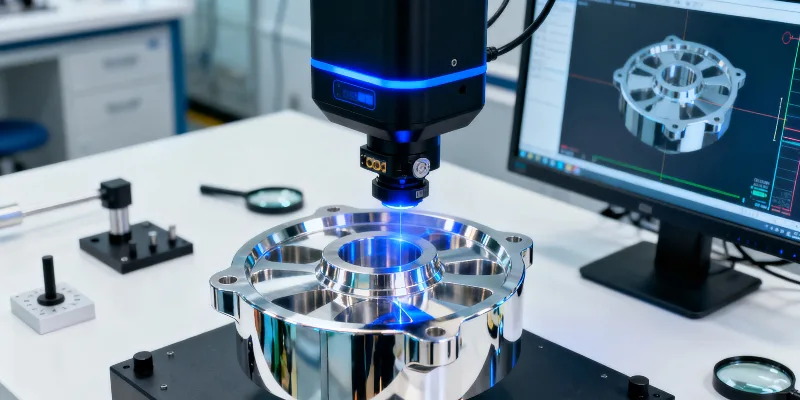
In my 20+ years in manufacturing, the definition of "precision" has changed dramatically. What was considered a tight tolerance when I started is now a standard requirement. High precision machining1 is the next level. It’s a discipline where we control every variable—the machine’s temperature, the vibration in the floor, the sharpness of the cutting tool, the quality of the raw material—to achieve a level of accuracy that is almost difficult to comprehend. This isn’t just about making parts look good; it’s a fundamental requirement for the performance, efficiency, and reliability of virtually all modern technology, from an EV motor to a satellite component.
What Does High Precision Machining Mean in Modern Manufacturing?
You see "high precision" listed as a supplier capability, but the term seems vague. To properly evaluate a supplier, you need to understand what this capability means in real, measurable terms.
In modern manufacturing, high precision means consistently holding dimensional tolerances below 25 microns (0.025 mm) and often as tight as 1-2 microns. For context, a single human hair is about 70 microns thick. It is the practice of creating near-perfect geometries.
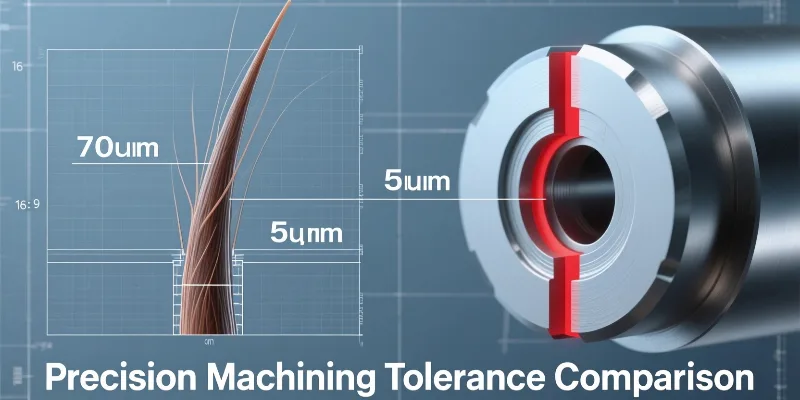
When we talk about high precision, we leave the world of normal measurements behind and enter the world of microns2. To get a feel for this scale, imagine cutting a human hair into 70 individual slices along its thickness—one of those slices is one micron. Operating at this level means that we can no longer just consider the machine’s programming. We have to manage the entire environment. The high precision machining centers in our facility are in a climate-controlled room3 because a small change in ambient temperature can cause the machine’s frame or the part itself to expand or contract by several microns. We use specialized tools and software that can compensate for the microscopic wear on a cutting edge after just a few hours of use. It’s a holistic approach where every single element of the process is optimized and controlled to achieve results that are as close to perfection as physically possible.
How Does High Precision Machining Differ from Conventional Machining?
Most machine shops offer CNC machining. You need to understand what separates a standard CNC shop from a facility that is truly capable of high precision work.
The key difference lies in the tolerances, technology, and process control. Conventional machining typically holds tolerances of ±0.1 mm, while high precision aims for tolerances under ±0.01 mm. It requires more advanced machinery, a controlled environment, and a rigorous quality verification process.
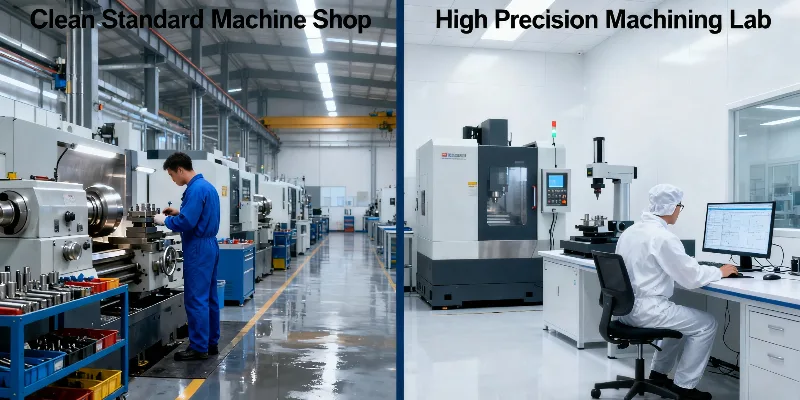
I’ve worked in both environments, and they are worlds apart. A conventional machine shop does fantastic work making parts that are functional and fit for purpose, like general brackets or enclosures. The goal is to get the job done efficiently. In high precision machining, the goal is to perfectly replicate the digital model, no matter the cost or complexity. I remember making a simple mounting plate in a conventional shop; as long as the holes were in roughly the right place, it worked. Contrast that with a recent project making a component for a fuel injection system4. The position and diameter of a tiny orifice had to be controlled to within 3 microns. Any deviation would affect the fuel spray pattern and compromise engine efficiency. This required a machine with active thermal compensation5, a vibration-dampening foundation6, and a laser-based tool setting system.
Conventional vs. High Precision Machining
| Feature | Conventional Machining | High Precision Machining |
|---|---|---|
| Typical Tolerance | ±0.1 mm (100 microns) | < ±0.01 mm (10 microns) |
| Environment | Standard workshop | Climate-controlled, clean room |
| Machinery | Standard 3-axis CNC machines | 5-axis CNC, EDM, advanced sensors |
| Focus | Functionality and speed | Perfect geometry and surface finish |
| Verification | Calipers, micrometers | CMM, laser scanners, profilometers |
What Technologies Enable High Precision Machining?
You are evaluating a supplier’s equipment list. You need to identify the key technologies that are essential for achieving and verifying high precision results.
High precision machining relies on state-of-the-art technologies including multi-axis CNC machines with high-speed spindles and thermal compensation, Electrical Discharge Machining (EDM) for intricate features, and Coordinate Measuring Machines (CMM) for verification.
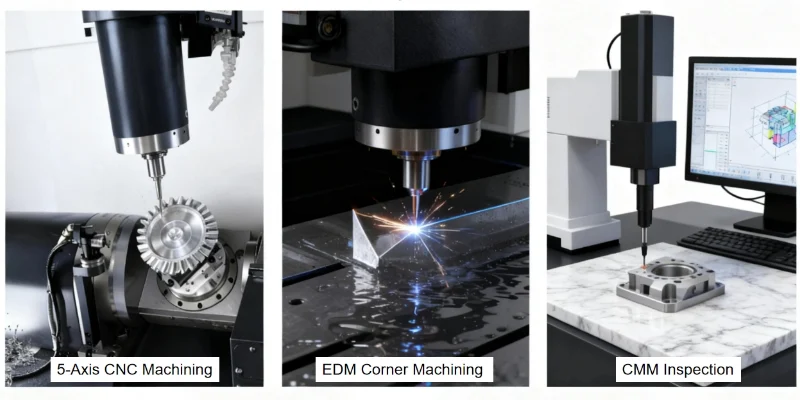
You can’t achieve world-class results with average equipment. The technology is a critical enabler. The foundation is the multi-axis CNC machine. A 5-axis machine can move the cutting tool along five different axes simultaneously, allowing us to machine complex, organic shapes in a single setup, which is inherently more accurate than moving the part between multiple machines. For features that are impossible to create with a traditional cutting tool, we use EDM, or Electrical Discharge Machining. This process uses a controlled electrical spark to erode the metal. It’s how we can create sharp internal corners or machine super-hard materials with incredible accuracy. Finally, and most importantly, you have to be able to measure what you make. That’s the job of the Coordinate Measuring Machine (CMM). A CMM uses a highly sensitive probe to take thousands of measurements across the part’s surface, comparing them to the original CAD model to generate a report that verifies every dimension down to the micron.
How Is High Precision Machining Applied in the Automotive and EV Industries?
You work in the automotive sector and need to understand where this level of precision is not just a luxury, but an absolute necessity for product function and reliability.
In automotive and EVs, high precision machining is essential for powertrain and chassis components. This includes machining the bearing bores in an EV motor housing, the flat sealing surfaces of a battery enclosure, and the complex internal passages of a transmission valve body.
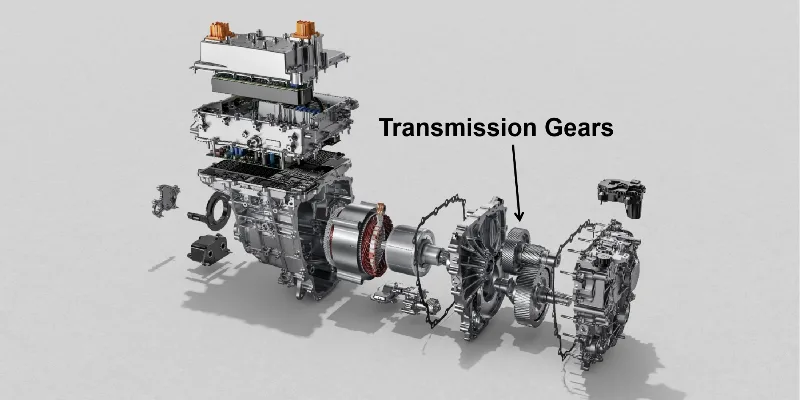
This is where the theory meets the road. In my work, we see these applications every day. Consider an electric motor that spins at 18,000 RPM. The two pockets that hold the main rotor bearings must be perfectly concentric and aligned. If they are off by even a few microns, it will cause vibration, noise, and premature bearing failure. We use high precision CNC boring operations to ensure that alignment is perfect. Another critical application I worked on was a large battery tray for an EV. The main surface, where the lid seals against the tray, had a flatness requirement of just 15 microns over a length of nearly a meter. This was essential to guarantee the enclosure would be 100% waterproof for the life of the vehicle. Achieving this required a massive, high precision milling machine and a carefully planned machining strategy to prevent the part from warping. In these applications, precision is directly linked to safety, performance, and durability.
How Does High Precision Machining Improve Product Quality and Performance?
You need to justify the higher cost of a precision-machined component to your management. You must clearly explain how this investment translates into a better, more reliable final product.
High precision machining directly improves product quality by ensuring parts fit together perfectly, which reduces vibration, wear, and energy loss. This leads to higher efficiency, quieter operation, and significantly longer product life, ultimately lowering the total cost of ownership.
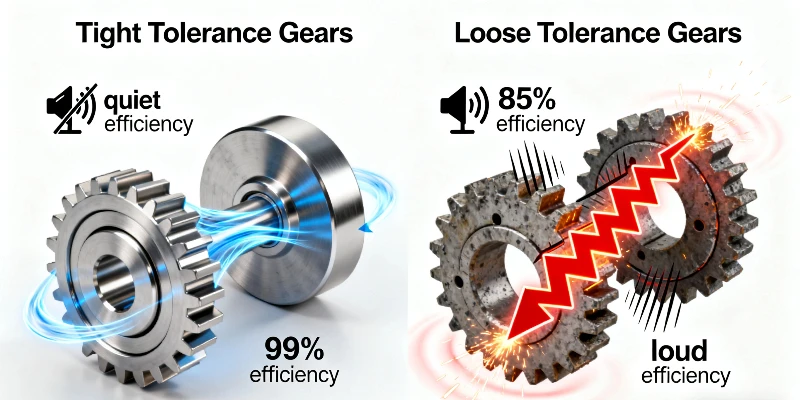
The benefits are tangible and significant. When parts are made with higher precision, everything works better. In a gear set7, perfect tooth profiles mean the gears mesh smoothly with minimal friction. This translates to less noise, less heat, and more efficient power transfer. In a hydraulic system8, a perfectly round and smooth valve bore allows for a tighter seal, preventing leaks and enabling faster, more responsive actuation. I think of it as eliminating "slop" in a system. Every micron of unnecessary clearance between moving parts is an opportunity for vibration, wear, and wasted energy. By minimizing that clearance through precision machining, we create a final product that is not only higher quality out of the box but is also more reliable and efficient over its entire service life. This reduces warranty claims, improves customer satisfaction, and builds a reputation for quality that is invaluable.
Conclusion
High precision machining is the art of manufacturing components to near-perfection. It is a critical enabler for modern technology, turning advanced designs into reliable, high-performance products9 that define the automotive industry and beyond.
Explore this resource to understand the significance and advantages of high precision machining in modern manufacturing. ↩
Understanding microns is crucial for appreciating the level of precision required in high-end manufacturing. ↩
Learn how climate control affects machining accuracy and the quality of finished products. ↩
Explore the critical role of precision machining in enhancing the performance of fuel injection systems. ↩
Discover how thermal compensation improves precision and accuracy in machining processes. ↩
Explore the importance of vibration control in achieving high precision in machining operations. ↩
Learn how precision in gear sets leads to improved efficiency and reduced wear. ↩
Discover how precision machining enhances the efficiency and reliability of hydraulic systems. ↩
Learn about the role of precision machining in creating high-performance products across industries. ↩


