

Choosing the wrong housing material for an electric motor can lead to poor performance, inefficiency, or even premature failure. This mistake can result in a final product that is too heavy, runs too hot, or cannot withstand its operating environment.
The main difference is the trade-off between weight, strength, and thermal performance. Cast iron motors are significantly heavier and stronger with excellent vibration damping, making them ideal for stationary industrial applications. Aluminum motors are much lighter with superior heat dissipation, making them the standard for electric vehicles.
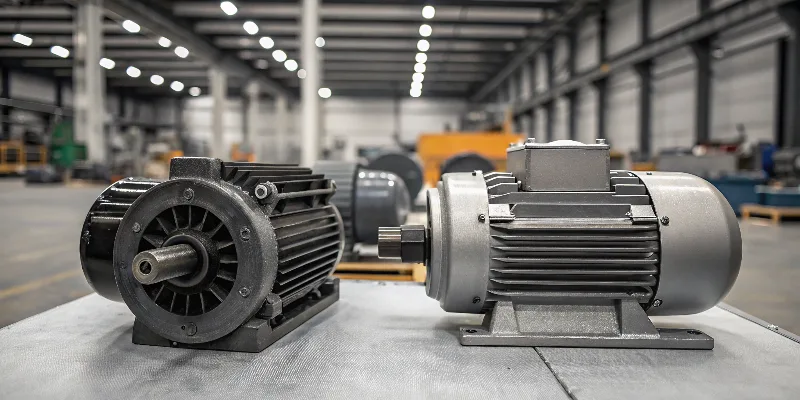
In my career, I’ve seen the motor industry undergo a massive transformation, and much of that story can be told through the lens of these two materials. Early on, nearly everything was cast iron. It’s strong, dependable, and has been trusted for over a century. But as the demand for efficiency and lightweighting has exploded, especially with the rise of electric vehicles1, aluminum has taken center stage. This isn’t a simple case of one material being better than the other; it’s about choosing the right material for the right job. Let’s break down the key differences factor by factor.
How Do Cast Iron and Aluminum Compare in Terms of Weight?
You need to reduce the overall weight2 of your product to improve efficiency or handling. The motor is one of the heaviest components, and its housing material is a primary driver of that weight.
The most significant difference is density. Cast iron is nearly three times heavier than aluminum. An aluminum motor housing can provide the required protection and structural support at a fraction of the weight of an identical cast iron housing.
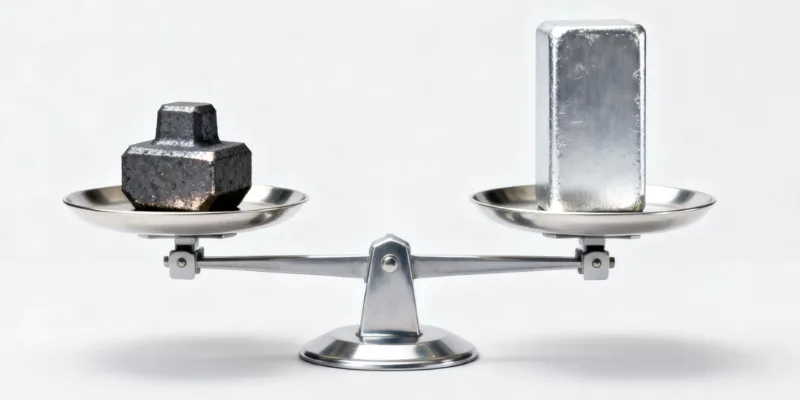
I will never forget the first time I held a prototype die-cast aluminum housing for an EV motor. For years, I had been used to working with industrial cast iron motors that required a hoist to move around the workshop. I picked up this new aluminum housing—a part for a powerful motor—with one hand. The difference was not just noticeable; it was dramatic. Cast iron has a density3 of about 7.2 grams per cubic centimeter (g/cm³), while the aluminum alloys we use are around 2.7 g/cm³. This massive weight reduction has a ripple effect. In a vehicle, less weight means better acceleration, improved handling, and longer range. In a portable piece of equipment, it means less operator fatigue. While the mass of cast iron can be an advantage for vibration damping4 in stationary machines, in any application where mobility or efficiency is key, the lightweight nature of aluminum is an overwhelming advantage.
What Are the Differences in Heat Dissipation Between Cast Iron and Aluminum Motors?
Your motor is running too hot, forcing you to limit its power output to prevent damage. The housing is not effectively removing the waste heat generated by the motor’s windings and electronics.
Aluminum is a far better thermal conductor than cast iron. An aluminum motor housing can transfer heat away from the internal components to the surrounding air much more efficiently, allowing the motor to run cooler and at higher continuous power levels.
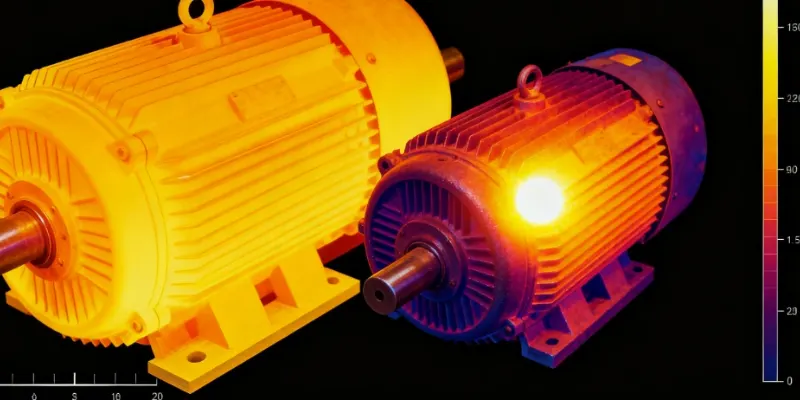
A motor is a machine that turns electrical energy into motion, but no motor is 100% efficient. The energy that doesn’t become motion turns into waste heat. Getting rid of that heat is one of the most important jobs of the motor housing. This is where aluminum has a massive advantage. The aluminum alloys we use have a thermal conductivity of around 150-200 Watts per meter-Kelvin (W/mK). Cast iron is only around 50 W/mK. This means aluminum is three to four times better at moving heat. I once used a thermal camera to show a client the difference on two prototype motors. The aluminum housing showed a smooth, even temperature spread across its surface as it radiated heat away. The cast iron housing had a concentrated hot spot right over the windings because the material couldn’t pull the heat away fast enough. By switching to a finned, die-cast aluminum housing, they were able to increase the motor’s continuous power rating by over 20% without changing any of the internal electronics.
How Do Cast Iron and Aluminum Motors Differ in Terms of Mechanical Strength?
Your motor will operate in a harsh industrial environment with high levels of vibration and potential for impact. You need a housing that can withstand extreme mechanical stress and provide maximum protection and stability.
Cast iron offers superior compressive strength, rigidity, and vibration damping compared to aluminum. Its sheer mass and material stiffness make it the ideal choice for large, heavy-duty motors that need to withstand high torque and intense vibrations without flexing.
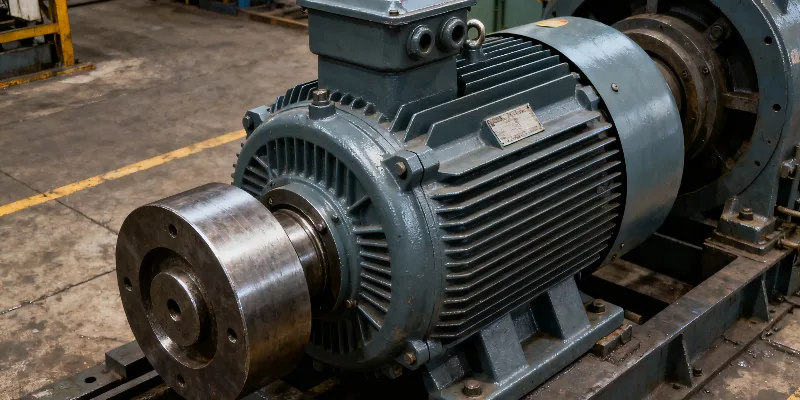
While aluminum is the star in the EV world, cast iron is still the undisputed king of heavy industry, and its mechanical properties are the reason why. I’ve seen cast iron motors run for 50 years in the most brutal conditions imaginable—rock quarries, steel mills, stamping plants. The material’s ability to absorb and dampen vibration is incredible. In a high-torque5 industrial application, a lightweight aluminum housing could be susceptible to flexing or fatigue over time. The rigidity and mass of cast iron provide an incredibly stable foundation for the rotor and bearings, ensuring proper alignment under immense loads. It’s also incredibly tough and resistant to wear and impact. If you need a motor that will be bolted to the floor and is expected to run for decades with minimal maintenance in a punishing environment, the strength, stability, and proven durability of cast iron are almost always the right choice.
What Are the Cost Differences Between Cast Iron and Aluminum Motors?
You are making a sourcing decision and need to balance material costs with manufacturing efficiency6. You need to understand the full cost picture, from raw materials7 to finished parts.
On a per-pound basis, raw cast iron is significantly cheaper than aluminum. However, the total cost of the finished motor housing can be more complex. Aluminum’s lower weight and the precision of the die casting process can sometimes offset the higher material cost.
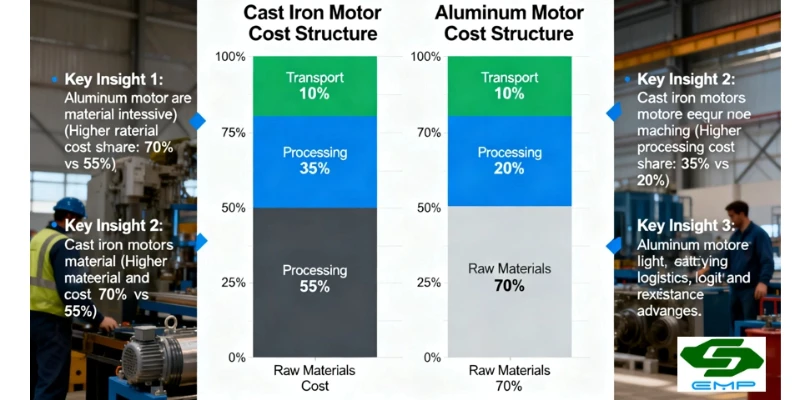
A purchasing director might look at the raw material prices and see that cast iron is much cheaper per kilogram. That’s true. But the story doesn’t end there. First, since aluminum is so much lighter, you need fewer kilograms of it to make the same size part. Second, the manufacturing process matters. Cast iron parts are typically sand-cast, which can have a rougher surface finish and less precise tolerances, often requiring significant secondary machining. The high-pressure die casting process we use for aluminum produces a near-net-shape part with a smooth finish and tight tolerances, drastically reducing the need for post-processing. When you factor in the lower machining costs and even the lower shipping costs due to weight, the total cost difference can narrow considerably. The final decision often comes down to this: for a simple, heavy part made in high volume, cast iron is often cheaper. For a complex, lightweight part that requires precision8, aluminum die casting can be more economical overall.
How Do Aluminum and Cast Iron Motors Perform in Electric Vehicles (EVs)?
You are developing components for the electric vehicle market. You need to choose a material that meets the extreme demands of this sector for efficiency, performance, and range.
In electric vehicles, aluminum is the superior and necessary choice. Its lightweight properties are essential for maximizing battery range, improving acceleration, and enhancing vehicle handling. Furthermore, its excellent thermal management is critical for cooling the high-performance, power-dense motors used in EVs.
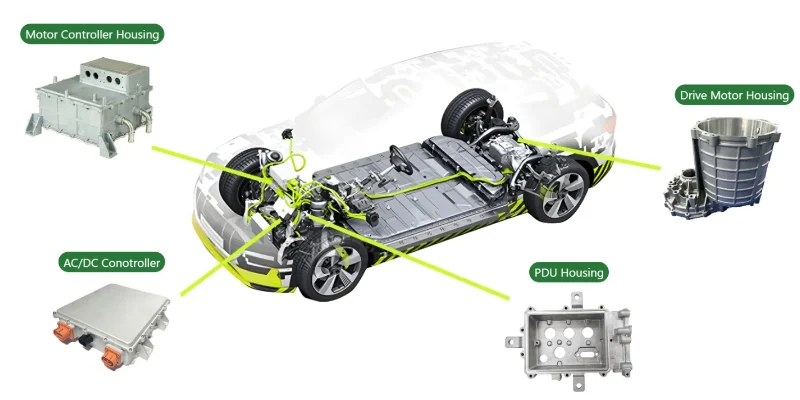
From my vantage point here in late 2025, there is no real debate in the EV industry. Every major automaker and Tier 1 supplier uses aluminum for their motor housings. The reasons are a culmination of all the points we’ve discussed. In an EV, weight is the enemy of range. Every kilogram we can save by using an aluminum housing instead of a cast iron one translates directly into how far the car can go on a single charge. Performance is also key. A lighter motor means the car has less mass to move, improving acceleration and making the vehicle feel more agile. Finally, heat is a major challenge. EV motors are incredibly power-dense, meaning they generate a lot of heat in a very small space. The superior thermal conductivity of an aluminum housing is not just a nice-to-have; it’s an absolute necessity to keep the motor from overheating during high-performance9 driving or fast charging. Cast iron simply cannot meet the combination of lightweighting and thermal demands required by the modern EV.
Conclusion
The choice between cast iron and aluminum motors10 is a choice of application. Cast iron provides unmatched strength for heavy industry, while aluminum delivers the lightweight performance and thermal efficiency required by modern technology, especially electric vehicles.
Discover the critical role of aluminum in enhancing EV performance and efficiency. ↩
Learn how weight impacts motor efficiency and handling, crucial for design considerations. ↩
Explore the significance of density in selecting materials for motor housings. ↩
Find out how vibration damping enhances motor stability and performance in industrial settings. ↩
Learn how torque requirements shape the design and material choices for motors. ↩
Explore how manufacturing processes affect the overall cost of motor production. ↩
Explore the essential raw materials used in motor manufacturing and their implications. ↩
Discover the significance of precision in motor components for optimal performance. ↩
Learn about the features that define high-performance motors in various applications. ↩
Discover why aluminum motors are favored in EVs for their lightweight and thermal efficiency. ↩


