

Two suppliers quoted the same part last month. One said 45 seconds, the other 62. Same alloy, same 1,250-ton machine class, same 2.8 kg housing. Neither was lying. They were counting different things, and the gap between 45 and 62 seconds is the gap between a cell that runs and a spreadsheet that adds up.
I spent a week with a stopwatch on a 1,250-ton cell in 2024, logging forty consecutive shots. The machine’s own cycle counter said 51.2 seconds. My stopwatch, from the moment the ladle touched the shot sleeve to the moment the finished part dropped onto the conveyor, said 58.4. The machine was not wrong. It simply stops counting when the die opens, because that is when its programmable logic stops caring.
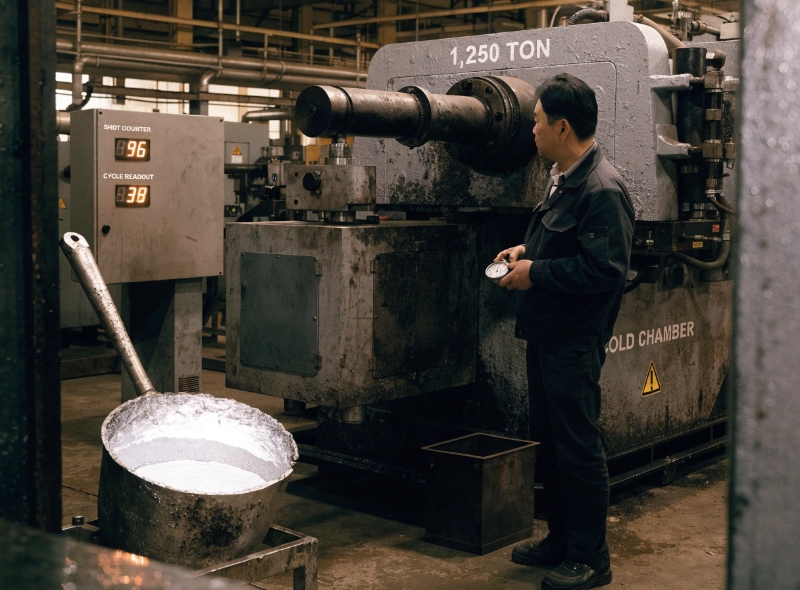
What a full cycle actually contains
Before anyone argues about seconds, agree on the interval. I use gate to gate: first metal into the sleeve, to a finished part on the belt. Anything else is a different question with a different answer.
Here is the budget from that cell, averaged over forty shots. The part was a 2.8 kg ADC12 transmission housing, 2.5 mm nominal wall, 4 mm flange, two slides.
| Element | Measured (s) | What sets it |
|---|---|---|
| Ladle pour into sleeve | 4.6 | Dosing accuracy against pour speed; too fast entrains air |
| Shot and intensification | 1.9 | Plunger velocity profile, 0.35 m/s first stage to 4.2 m/s second |
| Dwell in die | 9.2 | Solidification of the thickest section, not the nominal wall |
| Die open and extraction | 7.1 | Robot path, gripper clearance, whether the part hangs on a core |
| Spray and blow-off | 13.4 | Release agent volume, number of circuits, whether the operator rushes |
| Die close and lock-up | 3.1 | Machine ram and safety gate cycle |
| Pour window and idle | 4.9 | Ladle travel, operator attention, everything nobody logs |
| Transfer to conveyor | 4.2 | Robot return, trim station queue |
| Total | 58.4 |
Look at the fifth row. Spray is 13.4 seconds, more than a fifth of the cycle, and it is also the element operators compress first because it looks like the easiest thing to shorten. It is not free. Cut spray from 13 to 6 seconds and you save 7.4 seconds per shot, then spend them back as die temperature drift, soldering at the gate, and a scrap rate that climbs from 2.1% to somewhere near 7%.
The floor is set by solidification, not by the machine
Every other element can be engineered down. Dwell cannot go below what the metal needs to hold shape at ejection, and that number follows wall thickness squared. Chvorinov’s rule gives the shape of it: solidification time scales with the ratio of volume to surface area, squared. Going from a 2.5 mm wall to a 4 mm flange does not add 60% to the required dwell, it adds closer to 150%.
That is why the flange, not the wall, owned the dwell time above. In this part the 4 mm flange needed 9.2 seconds; the 2.5 mm wall was solid at roughly 5.5. We could have opened the die at 5.5 seconds and produced a part that looked perfect and leaked at the machining centre three days later, because the centre of the flange was still mushy and the shrinkage porosity was subsurface. Thin walls behave the same way at smaller scale — the same trap, different numbers, which is why 1.2 mm thin-wall projects live or die on dwell validation rather than on machine tonnage.
Anyone who quotes you a cycle time below the solidification floor for your thickest section is either not measuring the thickest section, or not counting the parts they scrap.
Five levers, ranked by what they actually return
I have watched plants spend EUR 180,000 on a robot cell to save 4 seconds, and refuse EUR 9,000 on a die insert change that saved 3.1 seconds and four percentage points of scrap. The ranking below comes from projects where I could measure before and after.
| Lever | Typical gain | Cost order | Risk |
|---|---|---|---|
| Spray rationalisation (fewer circuits, fixed recipe, robot path) | 3–6 s | Low, mostly labour | Die temperature drift if the recipe is wrong |
| Dwell reduction after thermal validation | 1–3 s | Low, but needs a trial run | Subsurface porosity you find at machining |
| Extraction path and gripper redesign | 2–4 s | Medium, tooling only | Distortion if the gripper pulls on a hot wall |
| Conformal cooling in the hot spots | 2–5 s of dwell, plus scrap | High, new insert | Needs a real thermal model, not a guess |
| Second machine or higher-cavitation die | Doubles output | Very high | Capital, floor space, new tooling lead time |
The two cheap levers together were worth 6.8 seconds on that cell, and they cost less than the annual electricity of the holding furnaces. The robot did come later, but for ergonomics and consistency, not for the seconds.
What ties all five together is heat. Die temperature decides dwell, spray decides die temperature, and cooling layout decides how much of the cycle you spend waiting for the part to become solid. That loop is the subject of die thermal balance in HPDC, and it explains why two plants can run the identical die at 48 and 61 seconds and both be right about their own numbers.

Cost per good part, not cost per shot
This is where the 45-second quote and the 62-second quote stop being a scheduling argument and become a purchasing decision. Cell cost per hour here is roughly EUR 95, all in: machine depreciation, energy, labour share, maintenance. At 58.4 seconds you get 61.6 shots per hour. At 45 seconds, 80.
Now apply yield. The fast quote assumed 97% first pass. The plant that actually ran a comparable part at 45 seconds was at 89%, because the die never reached thermal equilibrium between spray cycles. Good parts per hour: 59.8 against 71.2. The fast cell wins on paper by 19%.
Then add machining. Castings that pass visual inspection but carry subsurface shrinkage cost you the machining hour anyway, plus fixture time, plus the scrap record. In the 89% plant, 6% of the “good” castings failed at the leak station after machining. Effective good parts per hour fell to 67, and cost per good part went from EUR 1.42 to EUR 1.54.
That 8% is exactly the kind of gap that hidden cost analyses keep finding after the purchase order is signed, and it is invisible if the quotation only carries a cycle time and a piece price.
OEE is the number that decides whether any of this matters
A shift is 480 minutes. A cell running a 58-second cycle for 480 minutes produces 493 shots. The same cell in a plant I audited last year produced 341, because of die changes, waiting for metal, and two stoppages nobody recorded. The cycle time was identical. The output was 31% lower.
So when a supplier quotes cycle time, ask for the last thirty days of: planned production time, actual running time, shots counted by the machine, and good parts counted at final inspection. Four numbers. A plant that cannot produce them is not measuring its own process, and the cycle time on the quote is a wish rather than a plan.
What you will usually find is that availability, not speed, is the constraint. On the cell above, raising availability from 71% to 85% was worth more output than any single cycle-time project, and it cost a die-change trolley and a scheduled preventive window.
None of that arithmetic is ours. Availability x performance x quality is the standard OEE decomposition, and a 2024 study of die casting machines applies it per machine rather than per part, which is why the number that belongs on an RFQ is shots, not pieces.
What I put in an RFQ now
Three lines, added after that 2024 project: the cycle time definition (gate to gate, including spray and extraction), the assumed yield with the inspection stage where it is measured, and the planned availability behind the quoted output. Suppliers who answer all three in the same format are the ones whose numbers survive contact with production.
If the numbers still do not reconcile, simulation is the cheapest place to settle it — one Moldflow run on the cooling circuit costs less than a day of trial shots and tells you where the dwell is really going.
The rest is arithmetic. A die that runs 58 seconds and ships 98% of what it casts beats a die that runs 45 seconds and ships 89%, and the difference shows up in the price of the part, not in the cycle time on the quotation.
Frequently Asked Questions
What is a normal cycle time for aluminium die casting?
For automotive parts between 1 and 3 kg on an 800–1,600 ton machine, 45 to 75 seconds gate to gate is the normal band. Anything under 40 seconds usually means the dwell is set by the nominal wall rather than the thickest section, or the spray is being counted outside the cycle.
Does a shorter cycle time always lower the part price?
No. If shortening the cycle pushes the die away from thermal equilibrium, scrap and downstream machining losses rise faster than machine time falls. Compare cost per good shipped part, including leak test and machining, before accepting a faster cycle.
How much of the cycle is spray?
On parts of this size, spray and blow-off typically take 20–25% of the cycle. It is the largest compressible element and the one most likely to be cut without validation. Cutting it changes die temperature, which changes both cycle time and porosity.
Can dwell time be reduced without changing the die?
Sometimes, by 1–3 seconds, if the thermal model shows the thickest section is already solid and the current dwell was inherited from an earlier, heavier version of the part. Validate with sectioning or CT on the first twenty shots after the change, not with visual inspection.


