

What Is a Custom EV Aluminum Housing Supplier?
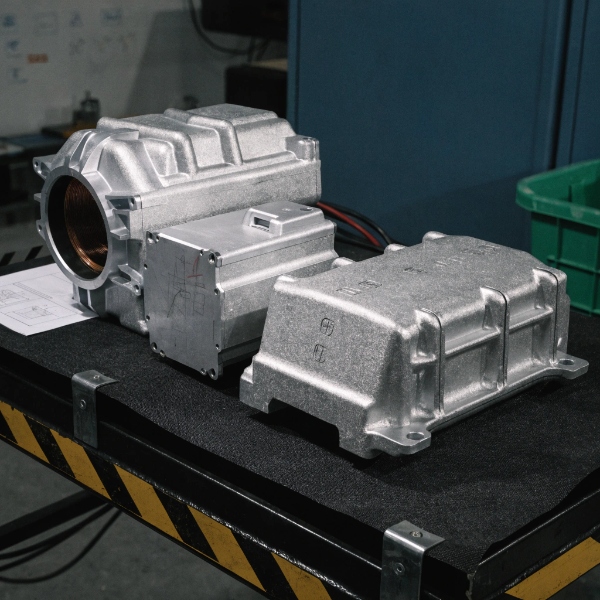
A custom EV aluminum housing supplier is a manufacturer that engineers and produces aluminum die-cast housings — motor housings, inverter housings, battery enclosures, PDU housings — specifically for electric vehicle platforms, to customer designs, under IATF 16949-certified quality systems. Unlike a standard die caster, an EV housing specialist understands the functional requirements unique to electric drivetrains: thermal management through integrated cooling channels, EMI shielding for power electronics, lightweighting for range, and structural integrity for crash safety.
The distinction matters because EV aluminum housings are not generic castings. A motor housing must dissipate 2–5 kW of continuous stator heat through integrated water jackets. An inverter housing must shield against CISPR 25 Class 5 emissions while maintaining flatness ≤0.1 mm for power module mounting. These requirements drive specific process decisions — vacuum die casting for low porosity, 5-axis CNC for single-setup machining, helium leak testing for 100% verification — that a general-purpose die caster cannot deliver.
Why China for EV Aluminum Housings?
Cost Structure at Production Volumes
| Volume (units/year) | China Per-Piece Cost (USD) | Nearshore Per-Piece Cost (USD) | Cost Differential | Break-Even Analysis |
|---|---|---|---|---|
| 10,000 | $18–28 | $28–42 | 35–40% lower | Tooling amortization favors China |
| 50,000 | $12–20 | $22–35 | 40–43% lower | China advantage widens |
| 100,000 | $10–16 | $18–28 | 43% lower | Scale economies dominate |
| 250,000+ | $8–13 | $15–24 | 45–46% lower | Maximum advantage |
Supply Chain Ecosystem
China’s EV supply chain density is a structural advantage unmatched by any nearshore market:
- Aluminum alloy supply: Primary aluminum smelters within 200 km of die casting clusters (Guangdong, Jiangsu, Chongqing) — material cost 8–12% lower than imported alloy in Europe
- Tooling manufacturing: Mold steel (H13, SKD61) suppliers and CNC mold makers co-located — tooling lead time 6–8 weeks vs. 10–14 weeks in Europe
- Secondary processing: Anodizing, e-coating, powder coating, and FSW (friction stir welding) providers within industrial park proximity — total lead time reduction of 2–3 weeks
Quality Convergence
The quality gap between China and Europe/North America has narrowed for IATF 16949-certified manufacturers. The key is selecting suppliers with verified IATF scope, VDA 6.3 "A" ratings, and automotive traceability systems — not commodity die casters. Our EV die casting solutions integrate VHPDC, 5-axis CNC, and in-line testing under one roof, matching Tier-1 European supplier capability at China’s cost structure.
IATF 16949 for EV Aluminum Housings: What the Certificate Actually Proves
The Baseline: IATF 16949 vs. ISO 9001
| Requirement | ISO 9001 | IATF 16949 | Why EV Housings Need It |
|---|---|---|---|
| Statistical Process Control (SPC) | Not required | Cp ≥ 1.33, Cpk ≥ 1.67 on key characteristics | Housing flatness and wall thickness require statistical control |
| Advanced Product Quality Planning (APQP) | Not required | Full APQP with gate reviews | EV platforms have aggressive timelines — no room for uncontrolled launches |
| Failure Mode and Effects Analysis (FMEA) | Risk-based, general | Process FMEA mandatory, design FMEA when design-responsible | EV housing failure = thermal runaway, water ingress — catastrophic |
| Traceability | General | One-up/one-down traceability, plus lot-level batch追溯 | Recall risk for EV housings requires full lot traceability |
| Supplier development | General | Supplier development program mandatory | Aluminum alloy quality variation directly affects casting integrity |
How to Verify IATF 16949 Authenticity
- Certificate lookup: Verify the certificate number on the IATF global oversight database (iatfglobaloversight.org). A scanned PDF without database verification proves nothing.
- Scope verification: The certification scope must explicitly include "aluminum die casting" — not just "machining" or "assembly." Suppliers with scope limited to "trading" have no manufacturing capability.
- Certification body: The certifying body must be IATF-recognized (SGS, TÜV, BSI, DNV, Bureau Veritas). Non-IATF CBs issue non-credible certificates.
- Surveillance audit status: Check the next surveillance audit date and any open major nonconformities. Pending suspension = unresolved quality gaps.
At EMP Tech, our IATF 16949 certificate scope covers aluminum die casting and CNC machining, certified by TÜV with active surveillance status — verifiable on the IATF oversight database. Our quality control system integrates SPC, APQP, and full lot traceability.
EV Housing Types: Manufacturing Requirements by Application
Motor Housing (Drive Motor / Traction Motor)
| Requirement | Specification | Manufacturing Implication |
|---|---|---|
| Cooling channel integration | Spiral or axial water jacket, 3–5 mm channel wall | Core pull design, precision casting, VHPDC for wall integrity |
| Stator bore tolerance | H7 fit, IT7 grade, roundness ≤0.03 mm | 5-axis CNC boring, in-line CMM measurement |
| Surface finish (stator bore) | Ra 1.6 µm | Fine boring or honing |
| Leak integrity | ≤1×10⁻⁶ mbar·L/s (helium) | 100% helium leak testing |
| Weight target | 3–8 kg (passenger EV) | Thin-wall design (2.5–3.5 mm nominal), ribs for stiffness |
Inverter / Converter Housing
| Requirement | Specification | Manufacturing Implication |
|---|---|---|
| Flatness (power module mounting) | ≤0.1 mm / 100 mm | Single-setup 5-axis CNC machining |
| EMI shielding | CISPR 25 Class 5 (30 MHz–1 GHz) | Casting integrity (no through-porosity), surface treatment |
| Thermal interface flatness | Ra 0.8 µm | Machined surface, 100% measurement |
| Wall thickness | 2.0–3.0 mm nominal | Thin-wall VHPDC, vacuum for fill integrity |
| Connector seal | IP67 / IP6K9K | O-ring groove tolerance ±0.02 mm |
Battery Housing / Pack Enclosure
| Requirement | Specification | Manufacturing Implication |
|---|---|---|
| Crashworthiness | Side pole impact, bottom-out | Structural rib design, alloy selection (AlSi10Mg) |
| IP rating | IP67 minimum, IP6K9K for wash | 100% leak testing, FSW sealing |
| Weight | 15–40 kg (pack-level housing) | Large-tonnage press (2500T+), thin-wall (2.0–2.5 mm) |
| Corrosion resistance | 480-hour salt spray (ASTM B117) | E-coating or powder coating |
PDU (Power Distribution Unit) Housing
| Requirement | Specification | Manufacturing Implication |
|---|---|---|
| High-voltage insulation | Dielectric strength per ISO 6469-3 | Material purity, no inclusions |
| Sealing | IP67 | O-ring groove, flatness control |
| Mounting precision | Position tolerance ±0.1 mm | CNC fixture design, in-line CMM |
VHPDC: Why Vacuum Die Casting Matters for EV Housings
Standard high-pressure die casting (HPDC) traps air in the cavity, producing dispersed and concentrated porosity. For EV housings, this porosity is not just cosmetic — it causes:
- Leak paths: Through-porosity in sealed housings causes helium leak test failures at rates of 5–15% with standard HPDC
- Mechanical weakness: Porosity in structural zones (bolt bosses, crash load paths) reduces fatigue life by 30–50%
- Blistering during heat treatment: Any T6 heat treatment (solution treatment at 500+°C) expands trapped gas, causing surface blisters
Vacuum high-pressure die casting (VHPDC) evacuates the cavity before injection, reducing porosity to <0.5% at critical surfaces and <1 mL/100 g overall. This enables:
- 100% leak test pass rate on sealed housings (target: <1×10⁻⁶ mbar·L/s)
- T6 heat treatment capability (for AlSi10Mg, A356 alloys)
- Consistent mechanical properties (elongation >8% for structural housings)
| Porosity Metric | Standard HPDC | VHPDC | Improvement |
|---|---|---|---|
| Overall porosity (mL/100g) | 1.5–3.0 | 0.3–0.8 | 60–75% reduction |
| Critical surface porosity | 1–3% | <0.5% | 80%+ reduction |
| Leak test first-pass yield | 85–95% | 99.5%+ | 5–15% improvement |
| T6 heat treatability | No (blistering) | Yes | Enabling for structural alloys |
The Integrated Factory: Die Casting + CNC + Testing Under One Roof
Why Integration Matters for EV Housings
An EV housing requires three manufacturing stages: casting, machining, and testing. When these stages happen at different facilities, the following risks compound:
| Risk of Outsourced Model | Impact on EV Housings | Integrated Solution |
|---|---|---|
| Transport between casting and machining | ±0.05–0.10 mm dimensional drift on critical features (stator bore, mounting pads) | Single facility, no transport |
| Quality accountability gap | Caster blames machinist for leak failures, machinist blames caster | One quality system, one accountable party |
| Lead time extension | 2–4 weeks additional logistics between sites | 3–5 day casting-to-machining flow |
| Traceability gap | Lot identity lost across facility boundaries | Full lot traceability from melt to shipment |
Our manufacturing facility integrates 13 VHPDC die casting islands (350T–3050T), 150+ CNC machining centers (4/5-axis), and in-line testing (Zeiss CMM, X-ray, helium leak) under one roof — enabling 3–5 day casting-to-machining flow with single-system quality accountability.
Supplier Audit Checklist: 15 Questions for EV Housing Suppliers in China
Quality System (5 questions)
- IATF 16949 certificate number and scope? — Verify on iatfglobaloversight.org. Scope must include "aluminum die casting."
- VDA 6.3 process audit score? — Request the latest audit report. Grade A (<3.0 average) is Tier-1 minimum. Grade B indicates controlled risk; Grade C means significant gaps.
- PPAP Level 3 sample documentation package? — Ask for a redacted sample from a current production part. No PPAP package = no automotive readiness.
- Cpk data for current production parts? — Request SPC charts for 3–5 key dimensions on a current part. Cpk ≥ 1.67 is Tier-1 standard.
- Traceability system and recall history? — How does the supplier trace material lot → melt → casting shot → machining lot → shipment? Any recall events in the past 3 years?
Manufacturing Capability (5 questions)
- VHPDC penetration rate? — What percentage of die casting machines are vacuum-equipped? 100% VHPDC means full vacuum capability; <50% means selective use only.
- Maximum die casting machine tonnage? — EV battery housings often require 2500T+. Motor housings typically need 800–1600T. Verify the supplier has adequate tonnage for your part size.
- 5-axis CNC capability and single-setup machining? — Can the supplier machine all critical features in one setup? Ask for fixture photos and setup sheets.
- In-line inspection rate? — What percentage of parts pass through CMM, X-ray, and leak testing in-line (not sampling)? 100% in-line for critical dimensions and leak integrity is Tier-1 standard.
- Surface treatment capabilities? — Does the supplier offer e-coating, powder coating, anodizing, or FSW in-house or through qualified partners within proximity?
Engineering and Program Management (5 questions)
- DFM analysis process? — Ask for a sample DFM report. A structured DFM review can eliminate 60–80% of potential defects before tooling, as we detail in our article on how DFM analysis reduces die casting defects.
- Moldflow simulation tool and experience? — Which software (Magma, Procast, Flow-3D)? How many simulations per project? Request a sample fill + solidification simulation report.
- Tooling design and ownership? — Who designs the tool? Who owns the tool? What happens to the tool if the contract ends? Ensure tool design ownership and transfer rights are contractually clear.
- Program timeline from DFM to PPAP? — Standard: 12–16 weeks (DFM 3 weeks, mold build 6–8 weeks, T1–T3 trials 2–4 weeks, PPAP 2 weeks). Projects exceeding 3 mold iterations indicate process instability.
- Reference customers and production volumes? — Ask for reference customers at similar volumes. A supplier producing 50,000+ housings/year for a Tier-1 has demonstrated scalability.
Cost Reality: China vs. Nearshore for EV Aluminum Housings
Total Landed Cost Comparison (50,000 units/year, motor housing)
| Cost Element | China (USD) | Nearshore — Mexico (USD) | Nearshore — Eastern Europe (USD) |
|---|---|---|---|
| Per-piece casting + CNC | $14–18 | $22–30 | $20–26 |
| Tooling (amortized over 3 years) | $3–5 | $4–6 | $4–6 |
| Logistics (ocean freight + customs) | $0.50–1.00 | $0.20–0.40 | $0.30–0.50 |
| Quality cost (scrap + rework) | $0.50–1.00 (at <2% scrap) | $1.50–3.00 (at 5–8% scrap) | $1.00–2.00 |
| Inventory buffer (safety stock) | $0.50–0.80 | $0.20–0.30 | $0.30–0.40 |
| Total landed cost | $18.50–25.80 | $27.90–39.70 | $25.60–34.90 |
Key insight: The per-piece cost advantage of China (35–40%) is partially offset by logistics, but quality cost differences amplify the gap. A supplier with 2% scrap rate and 100% in-line testing — typical of IATF 16949 + VDA 6.3 A-grade Chinese manufacturers — delivers 3–5% lower total cost than a nearshore supplier with 8% scrap rate and sampling-only inspection.
The hidden costs of die casting projects — engineering changes, PPAP re-qualification, field returns — often exceed the visible per-piece savings of a lower-cost supplier. We analyze this in detail in our article on hidden costs in die casting projects.
Red Flags: 5 Signs an EV Housing Supplier Is Not Production-Ready
- "IATF 16949 is in progress" — No valid certificate means no automotive quality system. Do not accept "pending" as a substitute for a verified certificate.
- No VHPDC capability — If the supplier cannot show vacuum systems on die casting machines, leak-prone housings will fail at 5–15% rates.
- Sampling inspection only — If leak testing is done on a sample (5–10%) rather than 100% of sealed housings, field leak failures will occur.
- No PPAP documentation — If the supplier cannot produce a sample PPAP Level 3 package, they have never qualified a part for automotive production.
- No moldflow simulation — If the supplier designs tools "by experience" without simulation, expect 3–5 mold iterations and 20+ week timelines.
Frequently Asked Questions
Q: How do I verify a Chinese EV aluminum housing supplier has IATF 16949?
A: Look up the certificate number on the IATF global oversight database (iatfglobaloversight.org). Confirm the scope includes "aluminum die casting," the certifying body is IATF-recognized (TÜV, SGS, BSI, DNV), and the surveillance audit status is active with no open major nonconformities.
Q: What is the typical lead time for a custom EV aluminum housing from a Chinese supplier?
A: For a well-engineered part, 12–16 weeks from DFM to PPAP approval: DFM and moldflow 3 weeks, tool build 6–8 weeks, trial shots T1–T3 2–4 weeks, PPAP documentation 2 weeks. Projects requiring 3+ mold iterations extend to 20+ weeks and indicate process instability.
Q: Are Chinese die casting suppliers competitive for EV housing production at 50,000+ units/year?
A: Yes. At 50,000+ units/year, China’s per-piece cost is 35–40% lower than nearshore alternatives, with total landed cost (including logistics and quality costs) still 25–30% lower. The cost advantage widens at higher volumes due to scale economies and lower scrap rates with VHPDC.
Q: What VDA 6.3 rating should an EV housing supplier have?
A: Grade A (average score <3.0) is the Tier-1 minimum. VDA 6.3 is the Volkswagen Group’s process audit standard, widely adopted by European OEMs and Tier-1s as a supplier qualification benchmark. Grade B (3.0–4.0) indicates controlled risk requiring improvement plans; Grade C (>4.0) means significant quality gaps.
Q: Can a Chinese supplier handle EV housing heat treatment (T6) after die casting?
A: Only with VHPDC. Standard HPDC traps gas that blisters during T6 solution treatment (500+°C). VHPDC reduces porosity below 0.5% at critical surfaces, enabling T6 heat treatment for AlSi10Mg and A356 structural alloys — achieving elongation >8% and tensile strength >280 MPa required for crash-relevant battery housings.


