

Get a Custom Die Casting Quote Within 5 Business Days
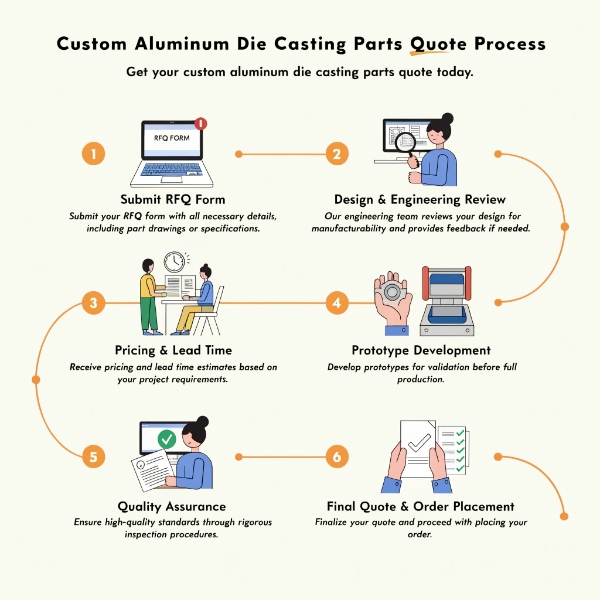
Requesting a quote for custom aluminum die casting parts is the fastest way to move from design concept to production reality. At EMP Tech, we provide detailed, engineering-reviewed quotations within 5 business days of receiving your RFQ package — including DFM feedback, tooling cost breakdown, piece price analysis, and a project timeline tailored to your SOP date.
Whether you need EV motor housings, inverter enclosures, battery trays, transmission cases, or structural brackets, our quote team combines 15 years of VHPDC production experience with Moldflow simulation capability to give you a price that reflects real manufacturability — not a guess. To start your quote, contact us with your 3D model and technical requirements.
What We Need to Quote Your Custom Die Casting Parts
A precise quote requires precise input. The table below lists the minimum information our engineering team needs to produce an accurate quotation. Incomplete RFQ packages are the #1 cause of delayed quotes and revised pricing — see our RFQ guide for OEM buyers for the full checklist.
| Information Category | Required Documents | Why We Need It |
|---|---|---|
| 3D CAD model | STEP or IGES file (native SolidWorks/Creo also accepted) | Determines part geometry, undercuts, draft feasibility, and machining stock |
| 2D drawing with tolerances | PDF with GD&T, critical dimensions, surface finish callouts | Identifies tight-tolerance features that drive machining and inspection cost |
| Alloy specification | ADC12, A380, AlSi10Mg, A356, or custom | Affects material cost, machinability, and heat treatment requirements |
| Estimated annual volume | Pieces per year (and peak monthly demand) | Determines tooling class (prototype vs. production), cavitation, and automation level |
| Surface treatment requirements | Anodizing, powder coating, e-coating, shot blasting, or as-cast | Each finishing process has different cost and lead time implications |
| Testing and quality requirements | Leak test standard, X-ray NDT level, CMM inspection plan, PPAP level | Drives inspection equipment allocation and quality documentation cost |
| Project timeline | RFQ date, tooling kick-off target, SOP date | Determines whether standard or expedited tooling track is needed |
| Machining requirements | As-cast or machined; if machined, which features and tolerances | CNC operations are a major cost driver — knowing upfront prevents underquoting |
How Our Quote Process Works: 4 Steps
Step 1: RFQ Intake and Acknowledgment (Day 0–1)
When you submit your RFQ to contact us, our sales engineering team logs the request and sends an acknowledgment within 24 hours. We confirm:
- All required documents received (3D model, 2D drawing, alloy, volume, finish, testing, timeline)
- Missing information flagged and requested
- Quote deadline confirmed (standard: 5 business days; expedited: 3 business days for simple parts)
- Dedicated project engineer assigned as your single point of contact
Step 2: DFM Review and manufacturability Analysis (Day 1–3)
Before any number is generated, our engineering team conducts a preliminary DFM review:
| DFM Review Item | What We Analyze | Impact on Quote |
|---|---|---|
| Wall thickness uniformity | Transition ratios, minimum/maximum wall, thick sections | Determines fill feasibility, cycle time estimate, porosity risk |
| Draft angles and undercuts | Side core requirements, slider count, parting line complexity | Directly affects tooling cost ($3,000–$15,000 per slider) |
| Parting line location | Flash on functional surfaces, dimensional stability | Determines machining operations needed |
| Gating and overflow concept | Preliminary gate placement, fill time estimate | Affects scrap rate assumption in piece price |
| Tolerance analysis | Critical dimensions vs. as-cast capability (ISO 8062) | Identifies features requiring CNC machining vs. as-cast |
| Surface area and projected area | Shot size, machine tonnage selection | Determines machine allocation and hourly rate |
If the DFM review identifies design modifications that would reduce cost or improve quality, we include these as DFM recommendations in the quote — not as a condition, but as an engineering value-add. This approach is a core element of our automotive die casting capability.
Step 3: Cost Build-up and Quote Generation (Day 3–4)
Our quotation includes a transparent cost breakdown:
| Cost Element | What It Covers | How We Calculate It |
|---|---|---|
| Tooling (one-time) | Mold design, steel (H13/Dievar), machining, heat treatment, first sampling | Based on part size, complexity, cavitation, and slider count |
| Piece price (per part) | Material, die casting cycle, trimming, deburring, inspection | Based on cycle time, alloy weight, machine rate, and scrap rate |
| CNC machining (per part) | 4/5-axis machining of critical features | Based on machining time, tool wear, and fixture complexity |
| Surface treatment (per part) | Anodizing, powder coating, e-coating, etc. | Based on surface area and process type |
| Testing and quality (per part) | CMM, X-ray, leak test, PPAP documentation | Based on inspection plan and PPAP level |
| Packaging and logistics | Custom packaging, barcoding, labeling, FOB/DAP shipping | Based on part size, destination, and packaging requirements |
Step 4: Quote Submission and Technical Review Call (Day 5)
The final quote package includes:
- Commercial quote — itemized pricing with tooling, piece price, and volume tiers
- DFM report — manufacturability findings with recommended design modifications
- Preliminary Moldflow simulation — fill animation and porosity prediction (for complex parts)
- Project timeline — tooling kick-off to SOP, with key milestones (T1, T2, T3, PPAP)
- Technical review call — 30–60 minute call with the assigned project engineer to walk through the quote and answer questions
What Makes a Die Casting Quote Accurate vs. Misleading
Not all die casting quotes are created equal. A quote that looks 15% cheaper can cost 40% more in production due to hidden assumptions. Here are the red flags to watch for:
| Quote Red Flag | What It Means | Cost Impact |
|---|---|---|
| No DFM review mentioned | Supplier skipped manufacturability analysis | Tooling iterations 3–5x, $15,000–$50,000 in modifications |
| Tooling price suspiciously low | Supplier may use lower-grade steel or single-cavity for multi-cavity need | Tool life <50,000 shots vs. >100,000; premature refurbishment |
| Piece price without scrap assumption | No scrap rate factored in | Hidden 4–8% scrap cost passed to buyer during production |
| No CNC machining quoted separately | Machining bundled into piece price without breakdown | No visibility into machining cost; difficult to optimize |
| No PPAP or quality documentation cost | Supplier may not include IATF 16949 compliance | PPAP Level 3 documentation costs $3,000–$8,000; if not quoted, it’s either missing or charged later |
| No project timeline | No commitment to milestones | SOP delay risk; 4–8 week slips are common without timeline |
| Quote delivered in <24 hours | No engineering review was performed | Price is a guess, not an analysis; will be revised after order placement |
We discuss these pricing pitfalls in detail in our article about hidden costs in die casting projects, where we break down how low quotes convert to high total project cost.
Custom Die Casting Parts We Quote Most Frequently
| Part Category | Typical Alloy | Typical Volume | Tooling Range | Piece Price Range |
|---|---|---|---|---|
| EV motor housing | ADC12 / AlSi10Mg | 50,000–500,000/year | $45,000–$120,000 | $8–$25/part |
| Inverter / converter housing | ADC12 / A380 | 30,000–200,000/year | $30,000–$80,000 | $6–$18/part |
| Battery tray / housing | ADC12 / A356 | 20,000–150,000/year | $50,000–$150,000 | $12–$35/part |
| Transmission housing | ADC12 | 40,000–300,000/year | $35,000–$90,000 | $7–$20/part |
| Structural bracket | ADC12 / A380 | 100,000–1,000,000/year | $15,000–$40,000 | $1.50–$6/part |
| Motor controller housing | ADC12 | 30,000–200,000/year | $25,000–$65,000 | $5–$15/part |
| Engine bracket / mount | ADC12 / A380 | 50,000–500,000/year | $20,000–$50,000 | $3–$10/part |
| PDU housing | ADC12 | 20,000–100,000/year | $20,000–$55,000 | $4–$12/part |
Note: All ranges are indicative. Actual quotes depend on part geometry, tolerance requirements, surface treatment, and volume. Submit your 3D model for a precise quotation.
How to Submit Your RFQ to EMP Tech
Option 1: Submit via Website
Send your RFQ package to our contact page. Include:
- 3D CAD model (STEP/IGES)
- 2D drawing with tolerances (PDF)
- Alloy specification
- Annual volume estimate
- Surface treatment requirements
- Testing/quality requirements (IATF 16949, PPAP level, leak test standard)
- Target SOP date
Option 2: Email Directly
Send your RFQ documents to our sales engineering team. Include the project name, your company name, and your role (engineer, purchasing, quality) so we assign the right technical resource.
Option 3: Request a Technical Review Call First
If your project is at an early stage and you are still defining requirements, request a 30-minute technical call with one of our project engineers. We can review your concept design, discuss alloy options, and advise on manufacturability before you finalize the RFQ package.
What Happens After You Receive Your Quote
| Timeline | Activity | Your Involvement |
|---|---|---|
| Day 5 | Quote delivered with DFM report and timeline | Review quote; prepare questions for technical call |
| Day 5–7 | Technical review call with project engineer | Discuss DFM findings, design modifications, timeline |
| Week 2 | Design modification iteration (if applicable) | Provide updated 3D model incorporating DFM recommendations |
| Week 2–3 | Revised quote issued (if design changed) | Review and approve final quote |
| Week 3–4 | Purchase order and tooling kick-off | Issue PO; arrange tooling payment schedule |
| Week 4–14 | Tooling design, manufacturing, first trial shots (T1) | Optional: attend T1 trial at EMP Tech facility |
| Week 14–16 | PPAP submission and approval | Review and approve PPAP Level 3 package |
| Week 16+ | Series production begins | Ongoing: quality monitoring, volume flexibility |
Why Quote with EMP Tech
| Capability | What It Means for Your Quote |
|---|---|
| 13 die casting machines (350T–3050T) | We quote the right machine for your part — not the only machine we have |
| Vacuum high pressure die casting (VHPDC) standard | Porosity assumptions in the quote reflect VHPDC capability, not standard HPDC |
| 150+ CNC machines (4/5-axis) | Machining cost quoted from real cycle times, not estimates |
| IATF 16949:2016 certified | PPAP Level 3 included in quote — not an extra charge |
| VDA 6.3 "A" rating | Quality system audited and approved by Volkswagen Group |
| In-house Moldflow (Magma, Flow-3D) | DFM feedback in the quote is simulation-backed, not opinion |
| Zeiss CMM, X-ray NDT, helium leak testing | Inspection cost quoted from actual testing requirements |
| 15 years of EV platform experience | Timeline and cost estimates based on 40+ EV launches since 2018 |
Frequently Asked Questions
Q: How long does it take to get a die casting quote?
A: EMP Tech delivers detailed quotations within 5 business days of receiving a complete RFQ package. For simple parts, expedited 3-business-day quotes are available. Quotes delivered in under 24 hours typically indicate no engineering review was performed and will be revised after order placement.
Q: What information do I need to provide for a die casting quote?
A: You need to provide a 3D CAD model (STEP/IGES), a 2D drawing with GD&T tolerances, alloy specification, estimated annual volume, surface treatment requirements, testing/quality requirements (PPAP level, leak test standard), and target SOP date. See our RFQ guide for a complete 18-item checklist.
Q: Does EMP Tech charge for DFM analysis during quoting?
A: No. Preliminary DFM review is included free of charge with every quotation. If a full Moldflow simulation is needed before quoting (for complex thin-wall parts), we discuss the scope with you before proceeding — simulation results are then included in the quote package.
Q: What is the minimum order quantity for custom die casting parts?
A: There is no fixed minimum — but die casting economics favor volumes above 5,000 pieces per year due to tooling investment. For lower volumes, we can discuss prototype tooling options or recommend alternative processes. Tooling cost is amortized over volume, so higher volumes yield lower per-piece cost.
Q: Can EMP Tech quote parts that are not yet fully designed?
A: Yes. We frequently engage at the concept stage. Request a technical review call and our engineers will review your preliminary design, advise on manufacturability, and provide a budgetary quote with a range. As the design matures, we refine the quote with updated models.
Q: Does the quote include shipping and packaging?
A: Yes. Standard packaging is included in the piece price. Custom packaging (barcoding, kitting, specific dunnage) and logistics (FOB, DAP, or customer-designated carrier) are quoted as a separate line item based on your destination and requirements.
Q: What happens if the DFM review recommends design changes?
A: We include DFM recommendations as engineering value-add — not as a condition of the quote. You decide whether to incorporate them. If you accept the recommendations, we issue a revised quote reflecting the updated design. If you decline, the original quote stands, and we proceed with your design as-is.


