

Porosity is the most common, and arguably the most challenging, defect in high-pressure die casting (HPDC). For engineers designing structural automotive components—like EV motor housings or battery trays—porosity isn’t just a cosmetic issue; it’s a potential failure point for pressure tightness and structural integrity.
At EMP Tech, we don’t promise "zero porosity"—it’s thermodynamically impossible in standard HPDC. Instead, we manage it. Through advanced process control and simulation, we locate unavoidable porosity in non-critical areas, ensuring the functional performance of your assembly-ready parts.
Here is a deep dive into the types of porosity, why they occur, and how we engineer solutions to mitigate them.
Defining Porosity in HPDC
Porosity refers to voids or cavities trapped within the aluminum casting during the solidification process. These voids vary in size from microscopic (microporosity) to macroscopic (macroporosity/blowholes).
In automotive applications, porosity becomes critical when it compromises:
- Pressure Tightness: Leaks in cooling channels (glycol/water) or oil galleries.
- Structural Integrity: Reduction in tensile strength and elongation, leading to cracking under dynamic loads.
- Machined Surface Finish: Voids appearing after CNC machining, exposing subsurface defects.
The Three Main Types of Porosity
To solve porosity, you must first identify its root cause. We categorize defects into three primary types based on morphology and location.
| Porosity Type | Characteristics | Primary Cause | EMP Tech Mitigation Strategy |
|---|---|---|---|
| Gas Porosity | Spherical, smooth-walled voids. Often bright inside. Found scattered or concentrated in the center of the casting. | Entrapment of air or mold lubricant gases during the shot process. | VHPDC: Utilizing Vacuum-Assisted HPDC to evacuate the cavity before shot. Shot Profile Optimization: Tuning slow and fast shot velocities to minimize turbulence. |
| Shrinkage Porosity | Irregular, dendritic, or angular voids. Darker, rougher interior surfaces. Located in heavy sections or last-to-solidify areas. | Volumetric contraction of aluminum during solidification without adequate feed metal. | Thermal Analysis: Using Moldflow simulation to predict hot spots. Die Thermal Control: EMP Tech uses localized cooling (chill vents, thermal pins) to direct solidification. |
| Blistering | Surface swelling or raised bumps on the as-cast part. | Subsurface gas porosity expands upon heating (e.g., during powder coating or heat treatment). | Process Control: Combines VHPDC (less gas) with strict control over melt cleanliness (reduced hydrogen content). T6 Heat Treatment Avoidance: Designing alloys that achieve structural requirements without post-casting heat treatment that causes blistering. |
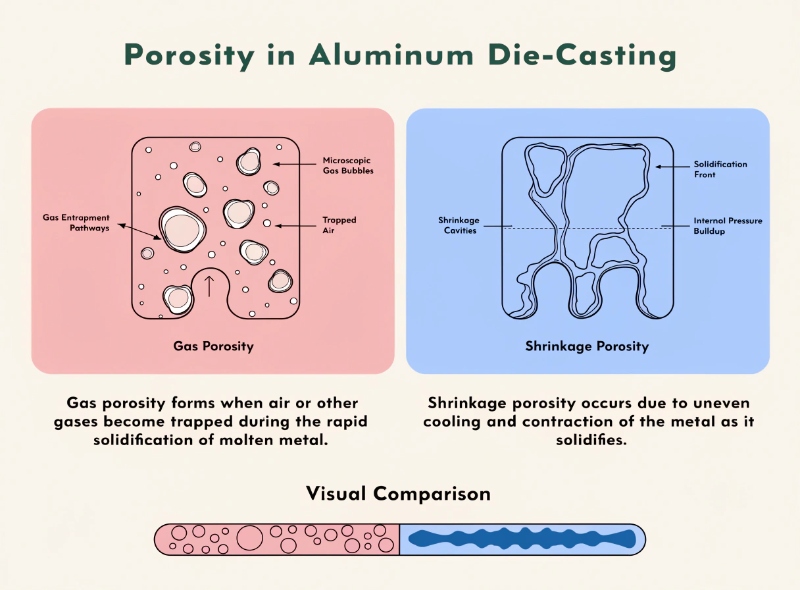
Figure 1: Cross-section schematic illustrating the distinct morphology of entrapped gas porosity (spherical) versus dendritic shrinkage porosity in an aluminum casting.
EMP Tech Engineering Insights: Moving from Detection to Prevention
Merely inspecting for porosity (via X-ray or pressure testing) is a reactive strategy. Our focus is on prevention during the tooling and process design phase.
1. Moldflow is Non-Negotiable
We do not cut steel until the Moldflow analysis is optimized. We simulate the filling and solidification phases to:
- Identify flow fronts that trap air.
- Determine optimal gate velocity to minimize turbulence.
- Design overflow wells and venting systems to capture porosity-laden metal.
2. Vacuum-Assisted HPDC as Standard
For structural EV parts, standard venting is often insufficient. We equip our 350T-3050T presses with active vacuum systems. By pulling a vacuum in the die cavity immediately before injection, we significantly reduce counter-pressure and gas entrapment[^2]. This results in denser castings capable of passing stringent air-decay leak testing for IP67/IP69K requirements.
3. Squeeze Casting Parameters
In extreme cases where local thickening is unavoidable, we utilize squeeze casting techniques. Applying high pressure locally during the solidification phase feeds the shrinkage, virtually eliminating macro-porosity in critical structural nodes.
4. Process Discipline: Melt Quality
Porosity isn’t just air from the shot sleeve; it’s also dissolved hydrogen in the molten aluminum. We maintain stringent melt preparation protocols, including rotary degassing and inline hydrogen analysis, ensuring the aluminum entering the die is gas-free.
Validation: Proving the Solution
How do we prove to our Tier 1 customers that the porosity is managed? We validate our process capability using a multi-step approach:
- Real-Time X-ray: 100% inspection of critical areas on initial pilot runs to confirm porosity is pushed to non-structural, non-sealing zones.
- Destructive Testing: Sectioning of castings and macro-etching to analyze internal integrity against simulation data.
- Pressure Decay Testing: 100% inline testing of housings with cast-in cooling channels on automated test stands.
Conclusion: Collaborate on Design for Castability (DfC)
Porosity control begins not on the shop floor, but at the design table. To achieve a robust, pressure-tight casting, early collaboration between your design engineers and EMP Tech’s casting specialists is vital.
By adjusting wall thicknesses, radii, and gating locations early in the process, we can engineer a solution that manages porosity rather than fighting a losing battle against physics.


