

What Makes Aluminum Die Casting Ideal for Thermal Management Housings?
High thermal conductivity aluminum die casting is the process of manufacturing aluminum alloy housings with enhanced heat dissipation properties using high-pressure die casting (HPDC) or vacuum high-pressure die casting (VHPDC). The thermal conductivity of die-cast aluminum alloys ranges from 96 W/m·K for standard ADC12 to over 170 W/m·K for specialized low-silicon alloys like Castasil-37 — approaching 75% of pure aluminum’s 222 W/m·K thermal conductivity while maintaining the mechanical strength and geometric complexity required for automotive and industrial housings.
The fundamental tradeoff in alloy selection is silicon content: higher Si improves castability and reduces thermal cracking, but each 1% increase in Si reduces thermal conductivity by approximately 8-12 W/m·K. Modern die casting alloys solve this through precise micro-alloying with strontium, manganese, and rare earth elements, maintaining castability at lower Si levels.
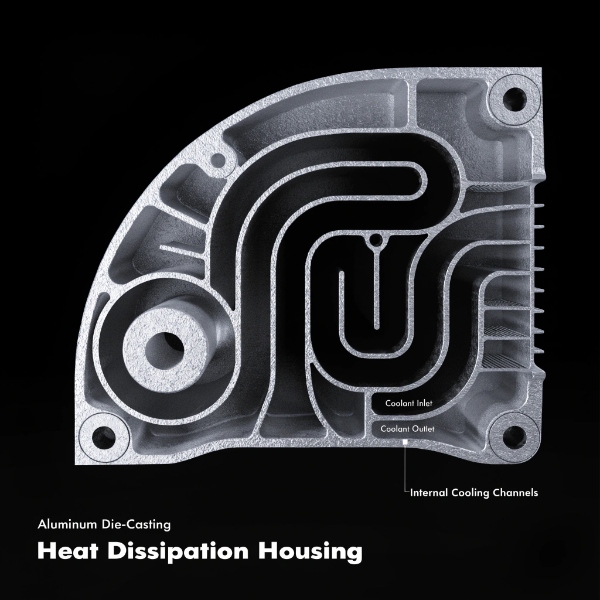
High Thermal Conductivity Die Casting Alloys: Engineering Comparison
Not all die casting alloys perform equally in thermal applications. The table below compares the key alloys used for heat dissipation housings, sorted by thermal conductivity:
| Alloy | Si Content (%) | Thermal Conductivity (W/m·K) | Tensile Strength (MPa) | Elongation (%) | Castability Rating |
|---|---|---|---|---|---|
| ADC12 | 9.5-12 | 96-98 | 228 | 1.5 | Excellent |
| A380 | 7.5-9.5 | 96 | 317 | 3.5 | Excellent |
| A360 | 9-10 | 105-113 | 317 | 3.5 | Good |
| AlSi10Mg (Silafont-36) | 9-11 | 130-150 | 240-310 | 5-12 | Good |
| Castasil-37 | ~7 | 139-173 | 250-320 | 5-10 | Good |
| AlSi7Mg0.6 | ~7 | 155-165 | 280-320 | 6-10 | Moderate |
Key observations from this comparison:
- ADC12 and A380 offer the best castability but the lowest thermal conductivity (~96 W/m·K). These remain the industry standard for housings where moderate heat dissipation suffices.
- A360 provides a 10-15% thermal conductivity improvement over A380 with similar mechanical properties, making it a preferred upgrade for moderately thermally demanding applications.
- Silafont-36 (AlSi10Mg) achieves 130-150 W/m·K after T6 heat treatment — a 35-55% improvement over ADC12 while maintaining die-castable geometries. This is the workhorse alloy for EV thermal management housings.
- Castasil-37 delivers the highest thermal conductivity among commercially die-castable AlSi alloys (up to 173 W/m·K at operating temperature), but requires careful process control to manage its lower Si content during filling.
Application 1: EV Inverter and Converter Housings
EV inverter and converter housings represent the most demanding thermal management application for aluminum die casting. The power semiconductor modules inside — typically SiC or IGBT devices switching at 10-20 kHz — generate heat flux densities of 50-100 W/cm², requiring the housing to simultaneously provide structural support, heat spreading, and EMI shielding.
Our VHPDC process produces converter housing components in AlSi10Mg (Silafont-36) that achieve 145 W/m·K thermal conductivity after solution treatment and artificial aging. The key engineering challenges include:
- Thermal interface management: The housing base plate must maintain flatness of 0.05 mm/100 mm across the power module mounting surface to ensure uniform thermal paste contact. Our 5-axis CNC capability achieves this in a single setup, eliminating re-fixture tolerance stacks.
- Cooling channel integration: Water-cooled inverter housings require integrated coolant galleries with 3-4 mm wall thickness and leak-tight sealing. We employ friction stir welding (FSW) to seal die-cast coolant channels after machining — a process we discuss in detail in our article on how friction welding ensures superior sealing for EV control units.
- EMI shielding compliance: The housing must meet CISPR 25 Class 5 radiated emission limits. Cast aluminum provides 40-60 dB shielding effectiveness from 30 MHz to 1 GHz, but surface treatment selection matters — chromate conversion coating preserves shielding effectiveness while some powder coatings can degrade it at high frequencies.
Application 2: EV Drive Motor Housings
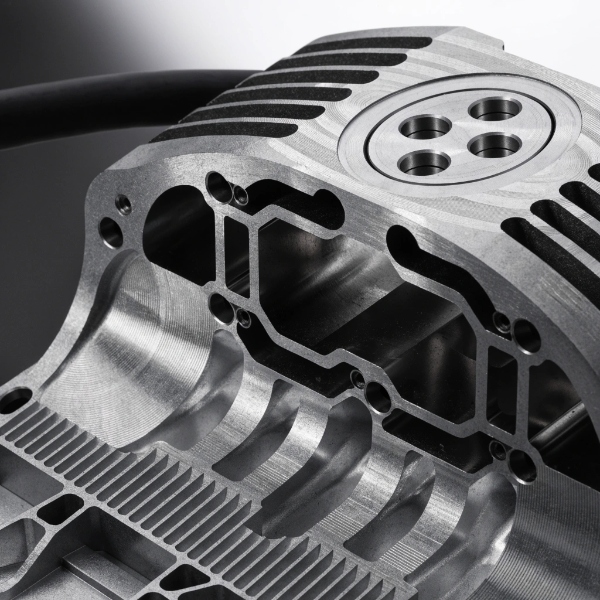
EV traction motor housings face a unique thermal challenge: the stator windings generate continuous heat at 3-8 kW during rated operation, with peak transient loads exceeding 15 kW during acceleration. The housing must transfer this heat to either air or liquid cooling circuits while maintaining dimensional stability for bearing journals with H6/h5 tolerance fits.
For drive motor housing applications, we typically recommend AlSi10Mg or Castasil-37, selected based on the cooling strategy:
| Cooling Strategy | Recommended Alloy | Thermal Conductivity | Key Design Factor |
|---|---|---|---|
| Air-cooled | Castasil-37 | 150-173 W/m·K | Maximize fin surface area, 1.5-2 mm wall thickness |
| Water-cooled (jacket) | AlSi10Mg (T6) | 130-150 W/m·K | Integrated coolant jacket, 3-4 mm channel walls |
| Oil-spray cooled | AlSi10Mg (T6) | 130-150 W/m·K | Internal oil galleries, stator oil contact surfaces |
The stator bore surface — where the stator stack is interference-fitted — requires particular attention. Porosity at this interface creates thermal resistance and can lead to stator overheating. Our VHPDC process, combined with Moldflow-directed venting that channels gas porosity to non-critical surfaces, holds porosity below 0.8% volume fraction at the stator bore. This is critical for the thermal management approach described in our thermal management in EV aluminum housings guide, where we demonstrate that casting porosity — not alloy selection — is often the limiting factor in thermal performance.
Application 3: Battery Pack Thermal Management Components
Battery pack housings and thermal management plates represent a growing application for high-conductivity die casting. While the battery cells themselves are managed by dedicated thermal interface materials, the structural housing and cold plates benefit from die-cast aluminum’s combination of thermal spreading and crash-energy absorption.
For battery housings, the design priority shifts from peak thermal conductivity to through-thickness thermal uniformity. A die-cast battery tray in ADC12 with 96 W/m·K conductivity can maintain temperature uniformity of ±2°C across a 1.5m × 1.2m pack footprint when combined with an integrated liquid cold plate — provided the die-cast wall thickness is controlled to ±0.15 mm tolerance and porosity is managed at the cold plate interface zone.
The crash-safety requirement adds another dimension: battery housings must absorb 60-80 kJ of impact energy in side-pole crash tests per UN R136. This favors ADC12 or A380 for their higher ductility-to-strength ratio, accepting the lower thermal conductivity in exchange for structural performance — a classic engineering compromise.
Application 4: Power Distribution Unit (PDU) Housings
PDU housings in EV architectures manage high-voltage power distribution (400V or 800V systems) with busbar temperatures reaching 90-110°C under continuous load. The housing must dissipate this heat while providing electrical isolation, arc-flash containment, and ingress protection to IP67 or IP6K9K.
Die-cast A360 is the preferred alloy for PDU housings, offering 105-113 W/m·K thermal conductivity — sufficient for the 5-15 W/cm² heat flux typical of busbar contact areas — with excellent castability for the complex internal geometries required for busbar routing and fuse compartments. The housing design should incorporate:
- Heat dissipation ribs on external surfaces (typically 2-3 mm wide, 8-12 mm tall, spaced at 10-15 mm pitch)
- Direct thermal contact pads at busbar mounting locations, machined to Ra 1.6 surface finish
- Venting paths for pressure equalization, protected by Goretex membranes rated for IP67
Application 5: Telecom and 5G Base Station Housings
5G macro base stations generate 2-4 kW of thermal load per sector, with remote radio unit (RRU) housings exposed to ambient temperatures from -40°C to +55°C. The transition from 4G to 5G has increased power density by 60-80%, making thermal housing design a critical reliability factor.
For telecom housings, Castasil-37 is increasingly specified because its 160+ W/m·K conductivity (after annealing to the O temper) enables passive cooling of high-power RF amplifier modules without forced air, reducing site operating costs and improving reliability. The die-cast housing typically integrates:
- External fin arrays optimized for natural convection (fin height 15-25 mm, gap 5-8 mm)
- Internal heat pipe interface pads with flatness of 0.05 mm/50 mm
- Gasket grooves for IP65 sealing at antenna interface
- Corrosion protection: chromate conversion + powder coat, achieving 1000-hour salt spray resistance per ASTM B117
Design Considerations for Thermal Performance in Die-Cast Housings
Achieving the alloy’s theoretical thermal conductivity in a production die-cast housing requires attention to three factors that can degrade performance by 20-40%:
Porosity Control
Gas porosity in die casting creates air pockets with 0.026 W/m·K conductivity — 3,700 times worse than solid aluminum. Even 2% porosity volume fraction reduces effective thermal conductivity by 8-12%. VHPDC (vacuum high-pressure die casting) reduces porosity to <0.5% on critical thermal paths, recovering 90-95% of the alloy’s theoretical conductivity.
Wall Thickness and Heat Spreading
Thin walls (1-2 mm) limit heat spreading distance, creating hotspots under concentrated heat sources. For housings with localized heat inputs (e.g., power module footprints), a minimum wall thickness of 3-4 mm under the heat source area is recommended, with tapered transitions to thinner surrounding walls to manage weight.
Surface Treatment Impact
Surface treatments can help or hurt thermal performance:
| Treatment | Thermal Impact | Recommendation |
|---|---|---|
| Chromate conversion (MIL-DTL-5541) | Neutral (±2%) | Preferred for EMI-critical housings |
| Powder coating | -3 to -8% conductivity reduction | Acceptable for external surfaces only |
| Anodizing (Type II) | -10 to -15% conductivity reduction | Avoid on primary heat transfer surfaces |
| None (machined surface) | Baseline | Best for thermal interface surfaces |
Frequently Asked Questions
Q: Which aluminum die casting alloy has the highest thermal conductivity?
A: Castasil-37 achieves 139-173 W/m·K (depending on operating temperature and annealing condition), the highest among commercially die-castable AlSi alloys. It approaches 75% of pure aluminum’s thermal conductivity while maintaining sufficient strength for structural housings.
Q: Can ADC12 be used for heat dissipation housings?
A: Yes, ADC12 with 96-98 W/m·K thermal conductivity is suitable for housings with moderate thermal loads (under 20 W/cm² heat flux), such as ECU housings and battery trays. For higher heat flux applications like EV inverter or motor housings, upgrading to AlSi10Mg or Castasil-37 is recommended.
Q: How does die casting porosity affect thermal conductivity?
A: Gas porosity reduces effective thermal conductivity proportionally — 2% porosity volume fraction can degrade conductivity by 8-12%. VHPDC (vacuum die casting) mitigates this by reducing porosity to below 0.5% on critical thermal paths.
Q: What is the difference between A360 and A380 for thermal applications?
A: A360 offers 105-113 W/m·K thermal conductivity compared to A380’s 96 W/m·K — a 10-15% improvement. Both have similar mechanical properties (317 MPa UTS), but A360 has slightly lower castability due to higher silicon content with lower iron, requiring tighter process control.
Q: Should I choose die casting or CNC machining for thermal housings?
A: Die casting is preferred for production volumes above 5,000 units annually, offering complex geometry integration (cooling channels, fins, mounting bosses) at lower per-unit cost. CNC machining from billet may be preferred for prototyping or very low volumes, offering ~5-10% higher thermal conductivity due to zero porosity, but at 3-5x the cost.


