

In the world of electric vehicles (EVs), the motor housing1 is often seen as a simple shell. However, for an automotive engineer or a purchasing director, this component is one of the most critical engineering challenges. It’s far more than a protective cover; it is the unsung hero that directly dictates the motor’s performance, efficiency, and lifespan.
As a technical engineer with over 20 years in aluminum alloy die casting2 and EV components, I’ve seen firsthand how a well-designed housing can make or break a project. The Tier 1 and Tier 2 suppliers we partner with in Germany, the US, and Canada all face the same triad of challenges: aggressive lightweighting targets, complex thermal management3 needs, and tight project schedules. This guide breaks down the critical aspects of motor housing design and manufacturing from an expert’s perspective.
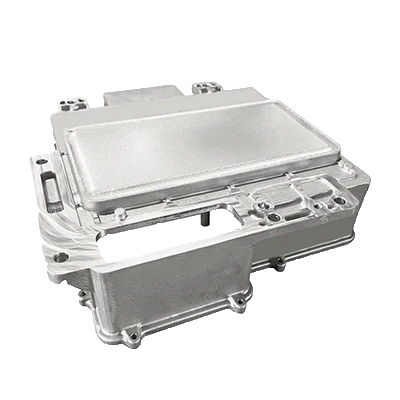
More Than Just a Shell: The Critical Functions of a Motor Housing
The motor housing is an integrated solution that performs several vital functions simultaneously. For a Supplier Quality Engineer (SQE), understanding these functions is key to auditing a supplier’s capability.
- Structural Support and Protection: The housing provides a rigid frame for the motor’s core components (stator, rotor, bearings). It protects these sensitive parts from road debris, moisture, vibration, and impact, ensuring the motor’s mechanical integrity.
- Precision Alignment: It maintains the microscopic air gap between the rotor and stator with extreme precision. Any deviation can lead to significant drops in efficiency, increased noise (NVH), and eventual failure.
- Thermal Management: It acts as the primary heat sink, dissipating the immense heat generated by the motor during operation. In modern EVs, this often involves complex, integrated liquid cooling channels.
- Electromagnetic Shielding (EMC): The housing helps contain electromagnetic interference generated by the motor, preventing it from disrupting other electronic systems in the vehicle.
- Sealing and Contamination Prevention: A properly designed housing, often requiring an IP67 or IP6K9K rating, prevents contaminants like water and dust from entering the motor, which is critical for long-term reliability.
The Engineer’s Balancing Act: Strength, Weight, and Cooling
Designing a motor housing is a constant negotiation between competing requirements. For a sourcing director, finding a manufacturing partner who understands this balance is crucial for achieving both performance and cost targets.
1. Material Selection: Aluminum vs. Steel
While various materials can be used, die-cast aluminum alloys have become the gold standard for high-performance EV motor housings. Steel is strong and cheap, but its weight and manufacturing limitations are significant drawbacks in an EV application where every gram matters.
| Feature | Die-Cast Aluminum (e.g., A380, AlSi10Mg) | Stamped/Fabricated Steel |
|---|---|---|
| Weight | Excellent. Roughly 1/3 the density of steel, directly improving vehicle range and efficiency. | Poor. High density adds significant weight. |
| Thermal Conductivity | Excellent. Naturally dissipates heat far more effectively than steel. | Poor. Requires additional, often heavier, cooling components. |
| Design Complexity | Excellent. Die casting allows for the integration of complex features like cooling channels, mounting bosses, and thin walls in a single part. | Limited. Complex geometries require multiple parts to be stamped, welded, and assembled, increasing cost and potential failure points. |
| Corrosion Resistance | Good. Forms a natural protective oxide layer. Can be further enhanced with coatings. | Poor. Requires extensive coating or plating to prevent rust. |
| Cost | Higher raw material cost but lower total cost for complex designs due to parts consolidation and reduced assembly labor. | Lower raw material cost but higher assembly and tooling costs for complex shapes. |
| Production Volume | Excellent. Ideal for high-volume, automated production with high repeatability. | Suitable for various volumes, but consistency can be a challenge with multi-part assemblies. |
2. Thermal Management: The Science of Keeping Cool
As motors become more power-dense, managing heat is the number one challenge. An overheated motor loses efficiency and risks permanent magnet demagnetization. Modern EV motor housings tackle this with integrated liquid cooling.
This is where the precision of high-pressure die casting4 (HPDC) shines. We can design and cast housings with intricate, leak-proof water jackets directly into the part. This one-piece design eliminates the risks associated with multi-part cooling assemblies (like leaks at joints) and maximizes the surface area for heat transfer.
Our process involves:
- DFM (Design for Manufacturing) Analysis: We work with you in the early design stage to ensure the cooling channels are optimized for both thermal performance and manufacturability.
- Mold Flow Simulation: We simulate how molten aluminum will flow and solidify to predict and eliminate potential defects like porosity, which is critical for ensuring the water jacket is 100% leak-proof.
- Rigorous Testing: Every housing with integrated cooling undergoes stringent pressure testing to guarantee its integrity and meet the OEM’s specifications.
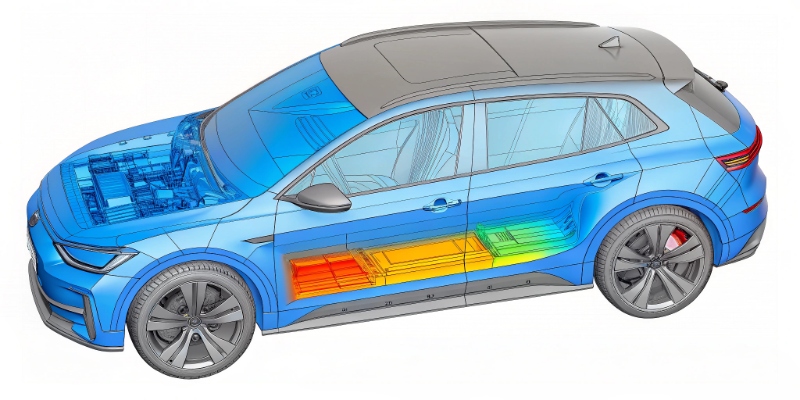
3. Manufacturing Process: Why High-Pressure Die Casting (HPDC) Wins
For the complex, lightweight, and high-performance demands of EV motor housings, HPDC is the superior manufacturing process.
Key Advantages:
- Part Consolidation: Features that would require dozens of individual parts in a fabricated assembly can be integrated into a single, robust casting. This drastically reduces assembly time, cost, and potential points of failure.
- Thin Walls & Complex Shapes: HPDC allows for the creation of very thin (down to 2-3mm) yet strong walls, further reducing weight without compromising structural integrity.
- Net-Shape Manufacturing: Parts are cast very close to their final dimensions, minimizing the need for costly and time-consuming secondary CNC machining.
- Consistency & Quality: The automated nature of die casting ensures high repeatability and consistent quality across hundreds of thousands of units, a requirement for automotive standards like IATF 16949.
Your Partner for High-Performance Motor Housings
The shift to electric mobility has transformed the motor housing from a simple component into a highly engineered system. Meeting the demands for lightweighting, thermal performance, and cost-efficiency requires a deep understanding of materials science, advanced simulation, and precision manufacturing.
At EMP Tech, our team lives and breathes these challenges. We provide a one-stop solution—from collaborative DFM and simulation in the design phase to flawless mass production and factory inspection. If your project demands a manufacturing partner who can deliver complex, leak-proof, and lightweight aluminum motor housings on a tight schedule, we are ready to help you succeed.
Contact us at [email protected] to discuss your engineering challenges and how we can solve them together.
Understanding the functions of motor housing is essential for optimizing EV performance and reliability. ↩
Explore how aluminum alloy die casting enhances the performance and efficiency of EV components. ↩
Learn about innovative thermal management techniques that improve EV motor efficiency and lifespan. ↩
Find out why high-pressure die casting is preferred for producing complex and lightweight EV parts. ↩


