

Modern auto parts die casting is at the heart of lightweight, durable, and high-performance automotive manufacturing. From motor controller housings to EV battery enclosures, precision die casting ensures every component meets strict mechanical and dimensional standards.
The Role of Die Casting in Automotive Component Manufacturing
Aluminum die casting enables the production of complex-shaped automotive parts with tight tolerances and excellent surface finishes.
Compared with stamping or forging, it offers:
- Reduced weight (up to 25% lighter)
- Excellent dimensional accuracy (±0.05 mm)
- Repeatability over 350,000 shots per mold
- Superior corrosion resistance
Die casting is widely used in:
- Powertrain housings
- EV motor housings
- Transmission cases
- Battery and inverter enclosures
- Suspension and structural brackets
Common Automotive Parts Made by Die Casting
Automotive aluminum die casting is applied to both EV and ICE vehicles.
Key examples include:
| Category | Example Components |
|---|---|
| EV Power Electronics | Motor Controller Housing, Inverter Enclosure, Charger Housing |
| Powertrain | Gearbox Case, Oil Pump Cover, Transmission Housing |
| Chassis | Crossmember, Mount Bracket, Steering Housing |
| Thermal Management | Cooling Plate, Heat Sink, Battery Cover |
Each part requires vacuum die casting to achieve gas porosity < 0.1%, ensuring IP67 sealing reliability.
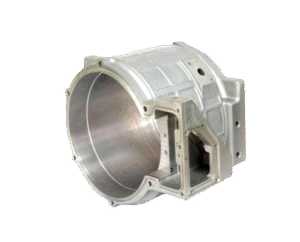
Advantages of Aluminum Die Casting for Auto Parts
🔹 Lightweight and High Strength
Aluminum alloys (e.g. ADC12, AlSi10Mg, A380) combine high strength-to-weight ratio with excellent machinability.
🔹 Tight Dimensional Tolerance
Advanced tooling and real-time process control ensure ±0.05 mm tolerance for sealing and assembly surfaces.
🔹 Excellent Thermal Conductivity
Ideal for EV housings and inverter covers, improving heat dissipation and component lifespan.
🔹 Cost Efficiency in Mass Production
High-pressure die casting supports large volume runs with minimal machining needs.
Die Casting Process Flow for Automotive Components
The automotive die casting process typically includes:
- Mold Design & Simulation (DFM + Moldflow Analysis)
- High-Pressure Vacuum Die Casting
- Trimming & Shot Blasting
- CNC Machining & Surface Treatment
- Leakage Testing & X-ray Inspection
🧩 Internal link: Learn more about CNC Machining for Die Cast Parts →
🧩 Internal link: Quality Control in Die Casting Process →
A closed-loop control system ensures injection speed, melt temperature, and vacuum level are within ±2% of the target.
Quality Standards and Certifications in Automotive Die Casting
Every automotive casting must comply with IATF 16949 and PPAP requirements. EMP Tech also maintains:
- IP67 sealing tests
- CT & X-ray inspections for porosity
- CMM measurement reports
- Salt spray corrosion tests (720h+)
These certifications ensure compatibility with Tier 1 and OEM quality systems.
🧩 Internal link: Explore EMP Tech’s Quality Assurance System →
EMP Tech’s Capabilities in Precision Automotive Die Casting
EMP Tech Co., Ltd. specializes in high-precision aluminum die casting for automotive and EV components.
Our core technologies include:
- High-Pressure Vacuum Die Casting: Porosity < 0.1%
- Thin-Wall Casting: Wall thickness down to 1.2 mm
- Friction Stir Welding (FSW): Al–Cu joint strength ≥ 90% of base material
- Intelligent Smelting: 160+ IoT parameters monitored, composition deviation ≤ ±2%
Our parts are supplied to European Tier 1 suppliers and EV innovators in North America.
🧩 Internal link: See our EV Motor Controller Housing Project →
Case Study: EV Motor Housing for European Tier-1 Supplier
Challenge:
Client’s prototype housings failed air leakage tests under 0.6MPa due to micro-porosity.
Solution:
EMP Tech applied vacuum die casting + FSW sealing technology, achieving:
- Gas tightness verified under 0.8MPa
- Dimensional accuracy within ±0.05 mm
- 99.2% production yield
Result:
Client successfully passed PPAP Stage 3 and entered SOP within 3 months.
🧩 Internal link: More Die Casting Case Studies →
How to Source Reliable Die Casting Manufacturers
When sourcing automotive aluminum die casting suppliers, engineers should evaluate:
- Process Capability: Vacuum casting, real-time monitoring
- Engineering Support: DFM, mold simulation, FMEA
- Certifications: IATF 16949, ISO 9001, ISO 14001
- Testing Capabilities: Leak test, CMM, CT scan
- Experience in Automotive Projects: Especially EV components
🔗 External reference: Automotive Die Casting Standards – NADCA Official Site
FAQs About Automotive Die Casting
Q1: What aluminum grades are commonly used in auto parts die casting?
A: ADC12, AlSi10Mg, and A380 are most common due to excellent casting fluidity and mechanical strength.
Q2: How much does it cost to produce die-cast auto parts?
A: Costs depend on mold complexity, alloy type, and part volume. Typically, tooling ranges from \$10,000–\$80,000.
Q3: What’s the difference between aluminum and zinc die casting in automotive use?
A: Aluminum offers better thermal performance and weight reduction, while zinc is used for small precision parts.
Why Choose EMP Tech as Your Die Casting Partner
With 20+ years of experience, EMP Tech provides:
- Full project support from DFM → Tooling → Mass Production
- One-stop precision machining and assembly
- IATF 16949, ISO 13485, and AS9100 certified production lines
- Proven record with German and Italian Tier 1 clients
🧭 Call-to-Action:
📩 Submit Your RFQ →
🌐 Visit EMP Tech Official Website


