

For a Purchasing Director or a Supplier Quality Engineer (SQE) at a Tier 1 or OEM, the term "automotive die-casting parts" covers a vast and critical category. From complex motor housings and battery trays in electric vehicles to lightweight structural components like shock towers, these are not commodity items. They are engineered solutions where a single flaw can lead to catastrophic failures, costly recalls, and damaged reputations. The challenge isn’t just finding a supplier who can make the part; it’s finding a partner who can guarantee its integrity from the first sketch to final delivery.
With over 20 years of hands-on experience in aluminum alloy die casting, I’ve seen the industry evolve, especially with the rise of e-mobility. The demands from our Tier 2 clients in Germany, the US, and Canada have become more stringent: aggressive lightweighting, absolute airtightness for electronics housings, and ever-tighter project timelines. Sourcing these parts successfully requires looking beyond the price per piece and evaluating the supplier’s engineering depth and process control.
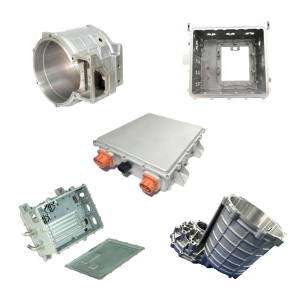
What Defines a "High-Integrity" Automotive Die-Casting Part?
A high-integrity part is one that consistently meets every engineering requirement throughout its service life. This goes far beyond simply matching the CAD model. For a discerning buyer or SQE, quality is defined by these four pillars:
Dimensional Accuracy & Stability: The part must conform to all Geometric Dimensioning and Tolerancing (GD&T) specifications. This ensures perfect fit-up during vehicle assembly, eliminating line-down situations. Critical dimensions must be stable across hundreds of thousands of parts, a hallmark of a robust and well-controlled process.
Material Integrity (Internal Soundness): What you can’t see is often what matters most. The part must be free from internal defects like porosity (tiny gas bubbles), shrinkage, and inclusions. These flaws compromise structural strength and, critically for EV components like OBC and controller housings, create leak paths that violate IP67/IP6K9K airtightness requirements.
Mechanical Performance: The finished component must exhibit the specified mechanical properties, such as tensile strength and elongation. This is a direct result of using certified aluminum alloys and employing precise process control (especially during heat treatment, if required) to achieve the desired metallurgical structure.
Surface Finish: While sometimes cosmetic, surface quality is often functional. It’s critical for sealing surfaces, mating faces, and areas requiring special coatings. A flawless finish indicates a well-maintained tool and a mastered process.
The Process is the Product: From DFM to Final Inspection
The final quality of a die-cast part is determined long before the first shot of molten aluminum is injected. The most common and costly failures we help new clients solve often originate from a disconnect between the part’s design and the realities of the die-casting process.
A strategic partnership starts with a transparent and collaborative engineering process. Here’s what you should demand from your die-casting supplier:
| Process Step | Why It’s Critical for Quality & Cost | Your Key Takeaway |
|---|---|---|
| Design for Manufacturing (DFM) Analysis | This is the single most important step for cost avoidance. A DFM expert analyzes the part design to optimize wall thickness, add draft angles, and refine radii. This prevents defects, improves castability, and often reduces part weight and cycle time. | Insist on a collaborative DFM review before any tooling is made. A supplier who just takes your file and quotes is a red flag. This step prevents expensive late-stage engineering changes. |
| Mold Flow Simulation | Advanced software simulates how molten aluminum will flow and solidify inside the mold. This powerful tool predicts the exact location of potential porosity and air entrapment, allowing engineers to modify the mold design (gates, runners, overflows) to eliminate these defects before cutting steel. | Ask to see the mold flow simulation report. It’s your best guarantee against the internal porosity issues that cause leaks and structural failures. A supplier who skips this is gambling with your quality. |
| High-Integrity Tooling | The die-cast mold is a precision instrument. It must be built from high-grade tool steel (e.g., H13) and engineered with robust cooling channels and venting systems to ensure dimensional stability and part quality over a long production run. | Inquire about the supplier’s tooling standards, maintenance program (PPM), and expected tool life. A cheap tool is the fastest way to get inconsistent, low-quality parts. |
| Process Control & Automation | A modern die-casting cell is a symphony of automation. Robots for spraying, extraction, and trimming ensure every cycle is identical. Real-time monitoring of pressure, temperature, and velocity is crucial for consistency. | During a supplier audit, focus on the level of automation and process monitoring on the shop floor. Consistency is the foundation of quality for high-volume automotive production (IATF 16949). |
| In-house Machining & Testing | Many parts require secondary CNC machining for critical features. An integrated supplier who performs this in-house maintains full control over quality and lead times. Likewise, essential testing like leak-testing (for airtightness) or X-ray (for internal soundness) should be part of the standard production flow. | A one-stop-shop supplier simplifies your supply chain, reduces logistical complexity, and takes full ownership of the final part quality, from raw casting to finished component. |
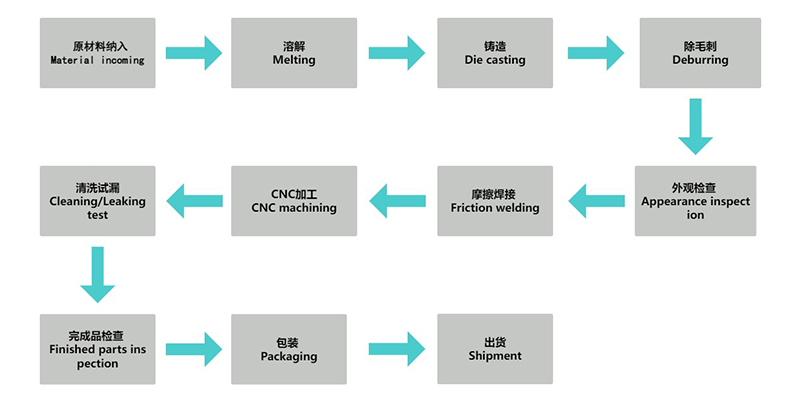
Your Partner in Automotive Excellence
In today’s automotive landscape, your suppliers are an extension of your engineering and quality teams. The integrity of their process directly impacts the integrity of your final product.
At EMP Tech, we have built our reputation on being more than just a die-caster. We are engineering partners. We leverage our deep experience in automotive applications to provide a seamless, one-stop solution from initial DFM analysis to factory-inspected, ready-to-assemble parts. We thrive on solving the tough challenges—lightweighting, high airtightness, and complex geometries—that define the next generation of vehicles.
If you are looking to de-risk your supply chain and source high-integrity automotive die-casting parts with confidence, reach out to my team and me. Let’s discuss your project at [email protected].


