

Aluminum oil sump die casting earns its tooling when the pan stops being a cover and becomes a structural member: a rail between block and bellhousing, a cast-in windage tray, a base for the heat shield. If the pan only holds oil, a 0.9 mm stamped steel part is cheaper below about 20,000 a year, and usually lighter.
The dimensional envelope for an engine oil pan sits on the product page; the process argument is here.
Why do OEMs switch from stamped steel to die cast aluminum?
They switch for stiffness, parts consolidation and noise, in that order. Weight is fourth, and against steel it is often a loss.
Bending stiffness scales with E·t³, and aluminum’s modulus is 69 GPa against 200 GPa for steel, per the Engineering Toolbox. At 3.5 mm of cast wall against 0.9 mm of steel the cast panel is about 20 times stiffer, at 1.35 times the mass: 9.45 kg/m² against 7.07. That is a trade a powertrain engineer takes when the pan is in the load path.
A flat 0.9 mm steel pan of 350 × 250 mm puts its first mode near 150-250 Hz by our own estimate, where four-cylinder firing orders sit. The cast panel moves it to roughly 600-700 Hz. A mode at 700 Hz can radiate more efficiently than one at 200, so the gain is not automatic; it arrives when the mode leaves the band that excites it.
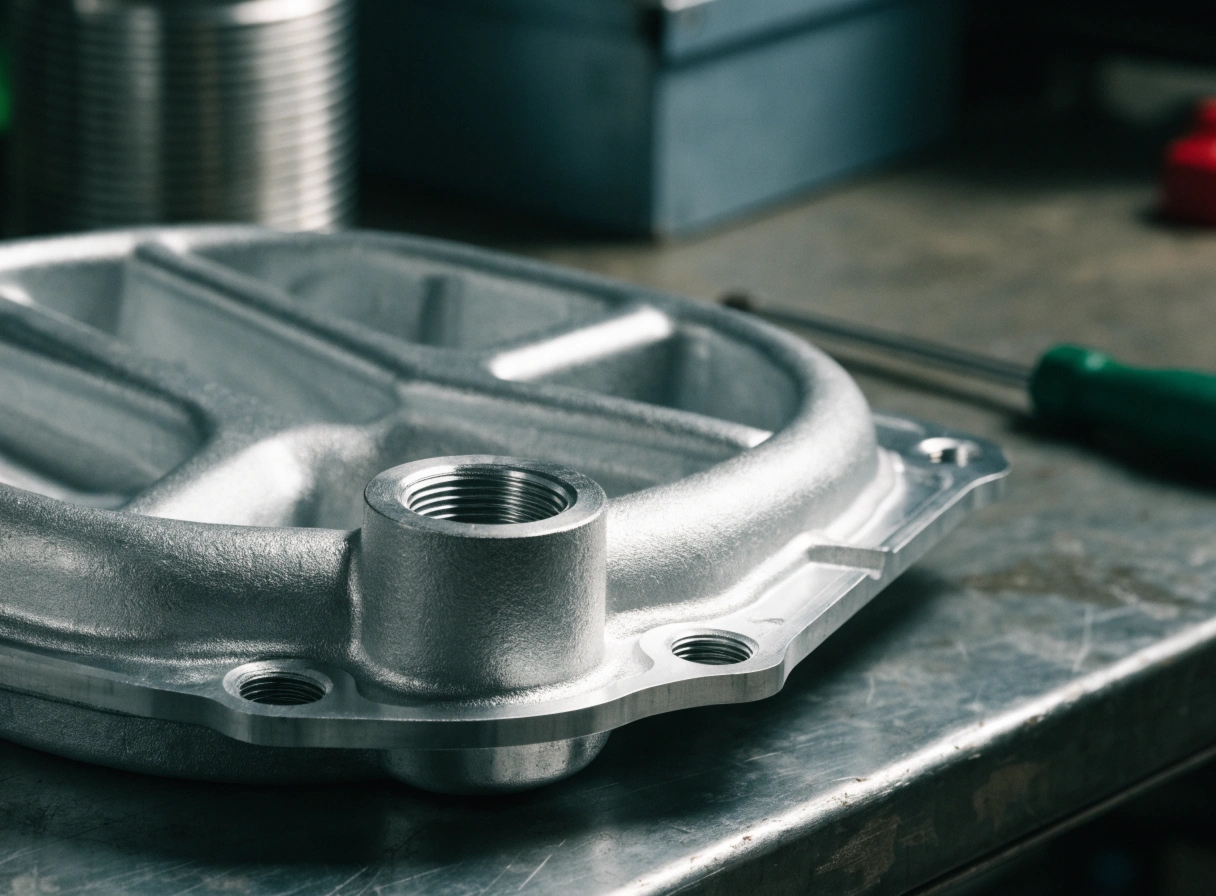
Consolidation is where the money is. One casting carries the windage tray, drain-back channels, pickup boss, level sensor pad, drain plug boss and shield standoffs. A stamping needs a welded baffle, a stiffener, two gaskets and 12-20 fasteners to do half of that, and every weld is a leak path.
| Criterion | Stamped steel, 0.9 mm | Die cast aluminum, 3.0-4.0 mm | What decides |
|---|---|---|---|
| Mass per m² | 7.1 kg | 8.1-10.8 kg | Wall thickness |
| Bending stiffness | 1 | 13-30 | E·t³ |
| Parts in the assembly | 4-8 | 1 | Consolidation |
| Joints that can leak | Flange, baffle weld, drain boss | Flange, drain boss | Design |
| Tooling | $50,000-70,000 | $90,000-140,000 | Volume |
| Piece price at 50,000/yr | $10-12 | $14-17 | Machining stock |
| Impact | Dents | Cracks | Elongation |
| First panel mode | 150-250 Hz (est.) | 600-700 Hz (est.) | Geometry |
Which alloy should an oil pan use?
ADC12 for a pan that only holds oil, AlSi10Mg when the pan is in the load path or has to bend before it breaks, and A356 almost never in high pressure die casting.
Elongation decides more than strength. ADC12 runs 230-310 MPa at 1-3%, AlSi10Mg 250-280 MPa at 8-12%, A356 230-280 MPa at 5-8%. A pan that cracks when a stone hits it at -20 °C is a warranty claim, and 2% against 10% elongation is the difference between a crack and a dent.
A356 is the reflex choice for ductility and the wrong one here: it is normally gravity or low-pressure cast, its high-pressure window is narrow, and T6 on a die casting means blister risk. AlSi10Mg gets most of the ductility without that argument. ADC12 stays the default because it is the cheapest of the three and the most forgiving on fill.
ADC12 is not heat-treatable, so any strength quoted for it is as-cast.
What wall thickness and flange flatness can be held?
1.5-2.5 mm is the general band; an oil pan usually runs 3.0-4.0 mm on the walls and 4-5 mm at the flange, because stiffness and bolt load set the number, not fill.
1.2 mm is achievable locally when vacuum and die thermal balance are set up for it, and below that the alloy freezes before the cavity fills; our notes on thin wall die casting at 1.2 mm cover where the limit moves. A pan wall at 1.2 mm would also ring like a drum.
Sealing-face flatness is 0.3-0.5 mm depending on face size; anything over 400 mm across needs a conversation before the quote. A stamped flange holds 0.2 mm as formed and loses it under bolt load. That is the difference that shows up as seepage at 40,000 km.
How is the sealing face machined?
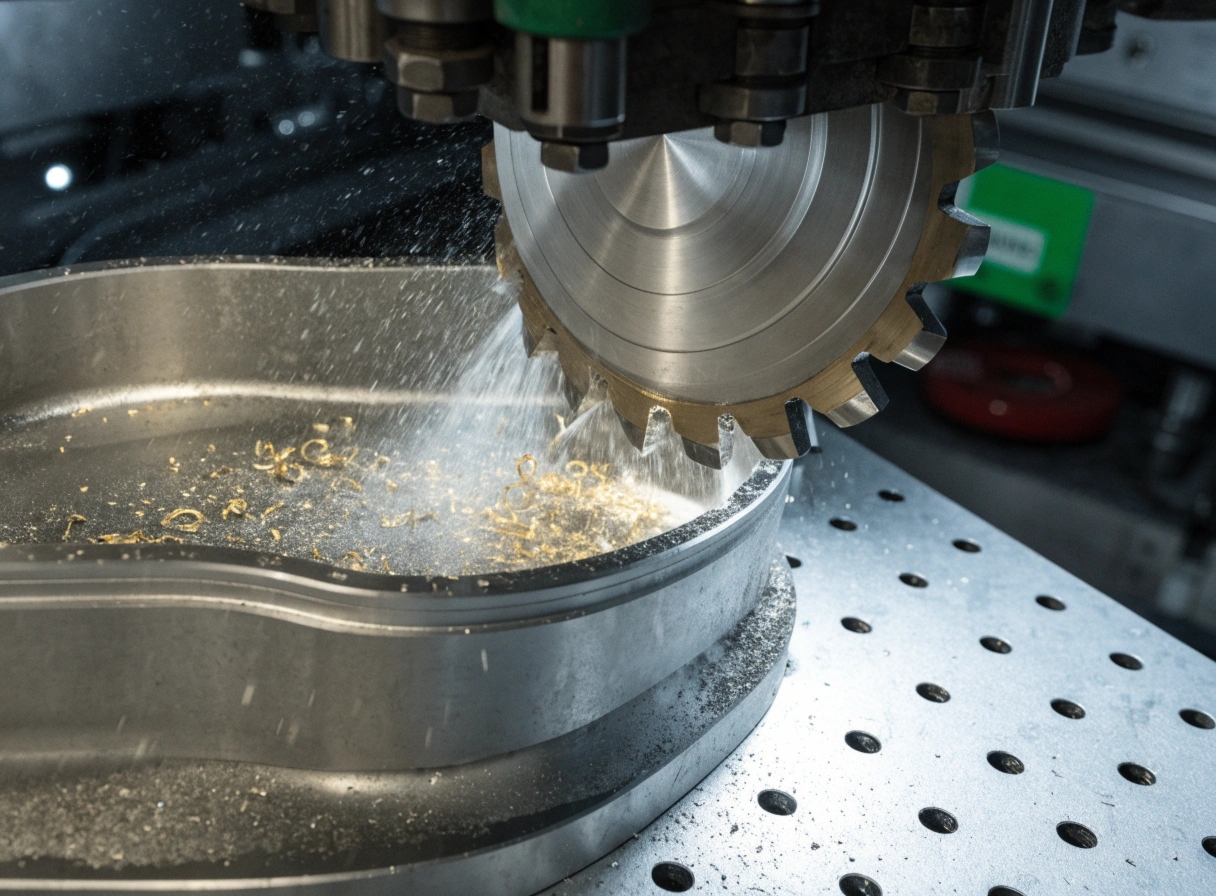
In one setup: flange, drain boss face, pickup face and sensor pad cut in the same fixture, because a second setup is where flatness goes.
The cut takes 0.5-1.0 mm of stock. More removes the dense skin and opens porosity; less leaves cast scale that will not seal. The face runs at Ra 1.6-3.2 µm for a formed-in-place gasket, with a 0.5 × 3.0 mm groove if the drawing calls for one, and each bolt hole gets a spot face flat to 0.1 mm.
A formed-in-place gasket needs a 4-6 mm wide, dry flange and 30 minutes of cure before oil fill. A cut gasket tolerates a rougher face but needs more bolt load than a 0.9 mm steel flange can take.
Where does oil seepage come from?
Most seepage is porosity that the flange machining opened, not a gasket that failed.
Gas porosity comes from air trapped at the last-filled corner and responds to vacuum at 50-200 mbar plus an overflow there. Shrinkage porosity forms at isolated thick sections such as the drain boss, and responds to a squeeze pin, local cooling and gate position more than to vacuum alone. A CT study of vacuum die cast Al-8.5Si-0.6Mn-0.25Mg in the Journal of Physics: Conference Series found that raising vacuum and fast shot speed cut the count and equivalent diameter of both pore types, and that shrinkage pores hurt mechanical properties more than gas pores.
Pressure is the other lever. A 2025 study in the International Journal of Metalcasting ran a large Al-Si part at 260, 300 and 390 bar, found porosity falling as pressure rose, and reported yield strength 5.6% and 12.3% higher at 390 bar than at the lower levels. Pressure does not fix a hot spot that has nothing to feed it.
A 0.8 mm finish cut through a 1.5 mm dense skin can expose connected porosity that passed X-ray as specks. Keep stock at 0.5 mm, keep the seal groove off cored areas, and test 100% by pressure decay at the customer’s pressure, hold time and reject value. Impregnation seals interconnected porosity, but it is not a substitute for a sound casting.
| Defect | Cause | Control that works |
|---|---|---|
| Gas porosity on the flange | Air trapped at the last-filled corner | Vacuum to 50-200 mbar, overflow, vent |
| Shrinkage in the drain boss | Isolated 20 mm section fed through a 4 mm wall | Squeeze pin, local cooling, gate closer |
| Seepage, no visible pore | Connected porosity opened by a 0.8 mm cut | 0.5 mm stock, groove off cored area, impregnation |
| Cold shut on a 1.5 mm rib | Die at 180 °C, fill over 60 ms | Die at 220-260 °C, faster shot, vent |
| Flange out of flat | Uneven ejection and cooling | Ejector timing, thermal balance, straighten |
| Thread strips at 35 N·m | Cut thread, 12 mm engagement | Roll-formed thread, taller boss, torque spec |
| Blisters after coating | Subsurface gas porosity at 200 °C bake | Vacuum, impregnation, lower bake |
How strong is the drain plug boss?
An M14 × 1.5 plug at 25-30 N·m needs 21 mm of engagement and a boss 20-24 mm tall, at least 1.75 times the thread diameter at the base and tied into a rib.
A 4 mm pan wall cannot give that engagement, so the boss is a local column with a 24-26 mm base and a 2-3 mm fillet where it meets the floor, fed from the gate side rather than sitting at the end of fill. Roll-form the thread: a rolled thread in Al-Si resists strip better than a cut one.
The failure is rarely the plug. It is the boss cracking at the root after a 40 N·m impact wrench, or the thread pulling out at the third oil change because engagement was 12 mm.
Does an aluminum pan need a heat shield?
Yes if the downpipe or catalyst runs within about 100 mm of the pan, which on a transverse powertrain is most of them.
ADC12 conducts roughly 96 W/m·K, so the pan is a heat path both ways: radiant heat from an unshielded downpipe warms the oil, and at speed the same conductivity makes the pan a cooler. The shield is an 8-12 mm air gap and an aluminized steel plate on standoffs, and the standoffs are free in a casting. On a steel pan they are welded nuts, which is a corrosion site above a part that must not seep.
Without a shield, sump oil in traffic can run 10-20 °C hotter; that figure is our own comparison, not a published one.
What does it cost at 5,000 and 50,000 units a year?
At 50,000 a year the casting needs to replace about $4 of parts and assembly to break even; at 5,000 it needs about $12, which is a different argument.
This is budget arithmetic on one pan: 350 × 250 × 130 mm, 3.6 kg in ADC12, single-cavity die, three-year program, aluminum at $2.60/kg, machining at $45/h, tooling at $110,000 for the die and $60,000 for the stamping tools. It is not a quote.
| Line item | 5,000/yr | 50,000/yr |
|---|---|---|
| Die, one-time | $110,000 | $110,000 |
| Die per part over 3 years | $7.33 | $0.73 |
| Casting, machining, wash, leak test | $24.00 | $15.50 |
| Cast total per part | $31.33 | $16.23 |
| Stamping tools, one-time | $60,000 | $60,000 |
| Tools per part over 3 years | $4.00 | $0.40 |
| Stamped pan, baffle, gasket, assembly | $15.50 | $11.90 |
| Stamped total per part | $19.50 | $12.30 |
| Cast premium per part | $11.83 | $3.93 |
Tooling per part falls tenfold between the volumes. The stamped assembly is cheaper at both volumes, so the casting never wins on piece price. It wins when the $3.93 at 50,000 is covered by the windage tray, stiffener and gasket it deletes, plus the leak warranty on the welded assembly. At 5,000 the deleted content would have to be $11.83, which only happens when the alternative is a cast-iron ladder frame.
Above 50,000 the argument moves to cycle time and machining stock, which is automotive die casting territory rather than a materials question.
Where does each route fail?
Stamped steel fails at the flange and the joints; die cast aluminum fails at porosity, impact and volume.
On the steel side, a 0.9 mm flange deflects between bolts, the gasket takes a set, and the seep appears at the bolt nearest the front cover. Baffle welds crack, condensation rusts the pan from the inside, and the panel mode sits in the firing-order band. None of it is fatal, and all of it is cheap to fix one item at a time, which is why steel holds the low-volume end.
On the aluminum side the failures are concentrated:
- Porosity opened by machining, which is the dominant reject and why the leak test is 100%.
- Impact. At 1-3% elongation the pan cracks where a steel pan would dent, usually at the drain boss or a mounting ear.
- Thread repair. A stripped drain plug in aluminum is a helicoil job or a new pan.
The joint fails more often than either part: wrong gasket, wrong torque sequence, a flange wiped with the wrong solvent.
Frequently asked questions
Is a die cast aluminum oil pan lighter than a stamped steel one?
Usually not by much, and sometimes not at all. A 3.5 mm cast wall carries about 1.35 times the mass of a 0.9 mm steel wall over the same area, so the saving has to come from the parts the casting deletes. Where the pan replaces a cast-iron ladder frame, system weight falls.
Can a cracked die cast oil pan be repaired?
Not to a standard we would put on a production part. TIG welding with a 4047 filler and preheat can close a crack for a field repair, but 1-3% elongation and porosity next to the weld mean the crack usually moves rather than stops. Seepage through interconnected porosity is a different case, and impregnation is the fix for it.
Why does an aluminum oil pan leak at the flange?
Three causes, in order of frequency: the flange lost flatness in machining or installation, the formed-in-place gasket went onto a contaminated face, or porosity was opened by the finish cut. The first two are assembly issues, the third is a casting issue.
How many units a year justify a die cast oil pan?
About 20,000 is the floor for a pan that is only a pan, and 50,000 is comfortable. At 50,000 the casting has to replace roughly $4 of parts and assembly, at 5,000 roughly $12. If the pan is structural, the comparison uses a different baseline and the threshold drops.
The decision rule
Cast when at least two are true: the pan is in the load path, it deletes three or more parts, the NVH target cannot be met by steel with a stiffener, and volume is above 20,000. Stamp when the pan is a cover, volume is below 15,000, or underbody impact rules out a 1-3% elongation alloy.
Between 15,000 and 30,000 it is a costing exercise that starts with the parts the casting deletes, not the piece price. If the pan is already cast, the porosity argument is in porosity in die casting.


