

Aluminum wins the radiator material argument on three properties at once: thermal conductivity high enough that the metal stops being the limiting resistance, about a third of copper’s density, and the castability that lets fins, a tank, ports and mounting bosses come out of one die. Where the radiator is a single part, with fins on one face and a cored coolant path or a gasket face on the other, high pressure die casting also removes two operations from the extruded-and-welded route: the extrusion press and the braze or weld. It removes the joints those operations create as well, and every joint is a leak path that has to pass a pressure test.
That is the short answer. What follows is the boundary around it: which radiators should be cast, which should stay brazed, and the numbers that decide between them. For the same argument applied to a housing rather than a core, our notes on high thermal conductivity aluminum die casting cover the heat-spreading case.
Why does aluminum win against copper and steel?
Aluminum wins because in an air-cooled radiator the air-side film, not the metal, sets the thermal resistance; once the wall is thin, copper’s extra conductivity has almost nothing left to improve.
Put numbers on that. A 2 mm aluminum wall at 96 W/m·K has a conductance of roughly 48,000 W/m²·K. The air film on the same wall, at 3-5 m/s, is 20-60 W/m²·K. The two resistances sit in series, so the wall contributes about one part in a thousand to the total, and swapping in copper at 390 W/m·K moves the total by under 0.1%. Copper earns its price in cold plates and liquid-cooled bases, where the metal path is thick and the flux is high. A cast radiator is not that part.
| Material | Thermal conductivity (W/m·K) | Density (g/cm³) | Conductivity by volume, vs ADC12 | Raw material cost per kg, vs aluminum | Castable in a steel die |
|---|---|---|---|---|---|
| Pure aluminum (99.5%) | 236 | 2.70 | 2.5× | 1.0 | Not as a die-cast alloy |
| ADC12 / A380 | 96 | 2.70 | 1.0 | 1.0 | Yes |
| Pure copper (ETP) | 390 | 8.96 | 4.1× | 3.5 | No |
| Carbon steel (0.5% C) | 50 | 7.85 | 0.5× | 0.4 | No |
| Stainless steel (304) | 16 | 7.9 | 0.17× | 1.2 | No |
Conductivity and density are handbook values at room temperature, of the kind tabulated by Engineering Toolbox; the cost column is a 2025-2026 LME average ratio, not a quote.
Read the table down the columns, not across the rows. Copper conducts four times what ADC12 does per unit volume, at 3.3 times the density and three to four times the material price. The cast alloy gives up more than half of pure aluminum’s conductivity to buy fluidity, and that trade is precisely what makes a 1.2 mm fin fillable at all. Steel and stainless are in the table only to close the argument: five to twenty times worse per unit volume, with no compensating advantage a radiator can use.
Where does die casting beat extrusion plus welding?
Die casting wins when the radiator is one part, because it deletes the extrusion step and the joining step and leaves a single perimeter to seal instead of hundreds of millimetres of braze fillet.
| Route | Steps from billet to tested part | Joints that must seal | Fin thickness | Geometry it can make | Tooling |
|---|---|---|---|---|---|
| Extruded and brazed | Billet heat, press, quench, stretch, cut, braze core and tanks, test (7) | Three classes, hundreds of contacts | 0.2-0.4 mm | Constant section only; bosses welded on | Extrusion dies plus braze fixture |
| Skived or bonded fin on a machined base | Skive, bond, machine, anodize, test (5) | One bond line | 0.3-0.5 mm | Flat base, no ports or tanks | Skiving machine or bonding line |
| Aluminum HPDC | Fill, solidify, eject, trim, machine faces and ports, test (5) | One perimeter plus port seals | 1.0-1.5 mm | Fins, tank, ports, bosses, cored passages in one shot | One die |
Two operations is the headline; the leak path is the reason it matters. A brazed core has a joint at every fin-to-header contact and at both tank seams, and those joints are inspected by sampling because testing every one is not economic. A casting has one perimeter seal, two port seals and a gasket face, and all of them can be tested in line, 100% of parts, by pressure decay or by helium where the customer’s limit is tighter.
Joining also constrains the design before the cost ever appears. An extrusion is a constant section, so every boss, thermostat pad and mounting ear becomes a welded or bolted addition, and each addition is another operation and another leak candidate. A die produces them in the same shot. That is where the cost difference usually lands, in the operations after the metal rather than in the metal, and our overview of automotive heatsink die casting walks through the same trade on smaller parts.
What fin geometry can a die casting hold?
A die-cast aluminum radiator holds 1.0-1.5 mm fins at 3-6 mm pitch and 20-25 mm height; past roughly 8:1 height-to-thickness the tips fill last, run cold, and short-fill before the cavity is full.
The mechanism is thermal rather than hydraulic. Each fin is a dead-end channel, and the metal at the tip has only the fin itself to conduct heat into the die, so it freezes while the rest of the cavity is still filling. Vacuum removes the gas that would otherwise be trapped at the tip; it does nothing about the freezing, which is why die thermal balance matters more than intensification pressure on a tall fin stack.
| Parameter | Practical cast value | Pushed limit | What fails first |
|---|---|---|---|
| Fin thickness | 1.2 mm | 1.0 mm on fins under 15 mm tall | Tip short-fill |
| Fin pitch | 4-6 mm | 3 mm | Die steel between fins heat-checks |
| Fin height | 20-25 mm | 30 mm with vacuum | Tip runs cold |
| Height-to-thickness | 6:1 | 8:1 to 10:1 | Gas entrapment at the tip |
| Draft per side | 0.5-1.0° | 0.25° | Ejection tears the fin |
| Root fillet | 0.5-1.0 mm | 0.3 mm | Cracking at ejection |
| Base thickness | 2.5-3.5 mm | 2.0 mm | Short fill and warpage |
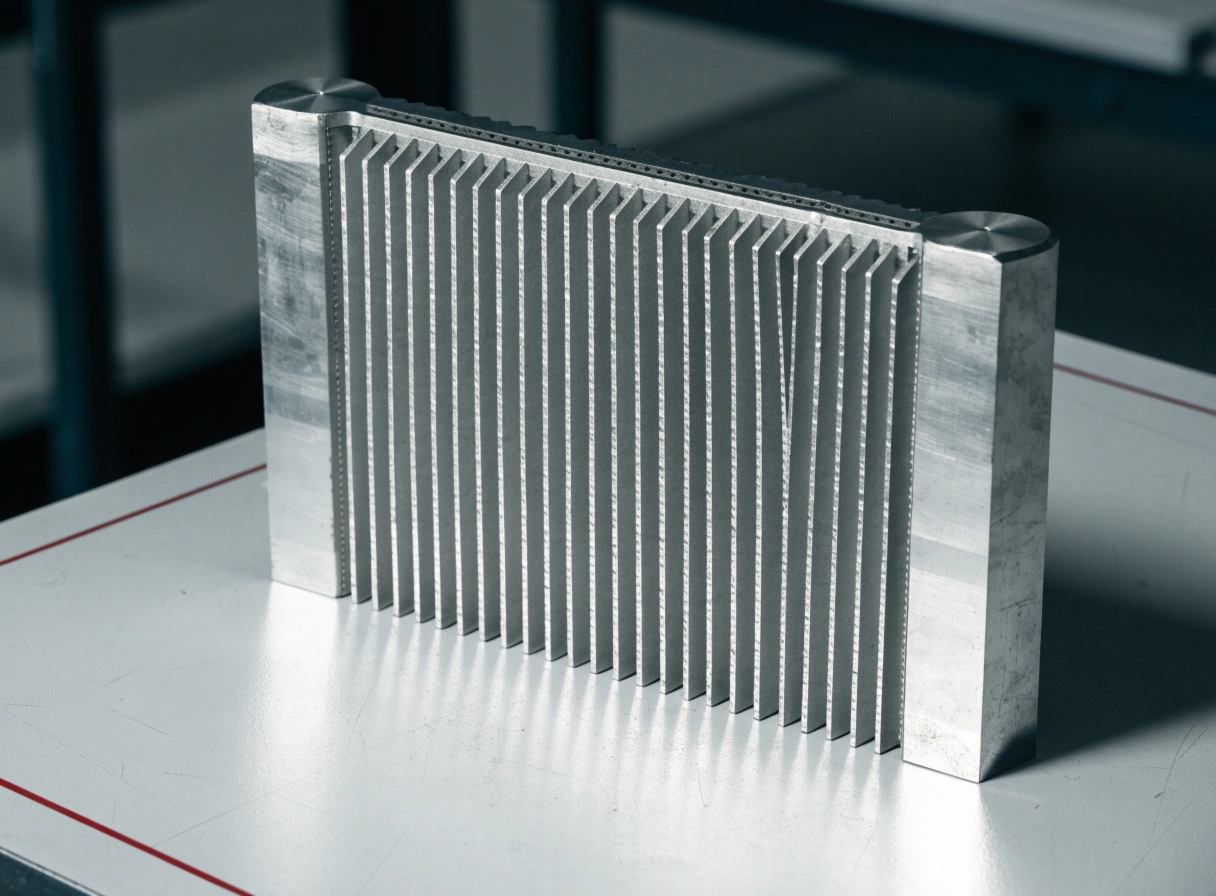
These are typical windows for aluminum HPDC, not a promise about any one part. Our published wall band is 1.5-2.5 mm for general walls, with 1.2 mm possible locally when vacuum and die thermal balance are set up for it; a fin is a local feature and follows the same rule. If the drawing asks for 0.8 mm fins on a 2 mm pitch, the answer is not a tighter die. It is a different process, and saying so at the quote stage is cheaper than saying it after the first trial.
Which alloy should a radiator use?
ADC12 or A380 carries a standard air-side finned radiator; A360 when the part sees road splash and has to bend before it cracks; AlSi10MnMg only when the radiator is also a structural node.
Our alloy table is short enough to quote. ADC12 runs 230-310 MPa with 1-3% elongation, A380 315-325 MPa with the same ductility, A360 300-317 MPa at 3-5%, and AlSi10MnMg 250-280 MPa at 8-12%. Elongation decides more of these choices than strength does, because a radiator is a thin-walled pressure part and ejection damage at the fin root becomes a crack under thermal cycling.
Conductivity moves with the alloy as well. Silicon and iron, the elements that make a die-casting alloy castable, are also the ones that scatter phonons and pull conductivity below pure aluminum. Heat treatment recovers part of it: a 2024 study of AlSi10MnMg published in Materials found conductivity rising with heat-treatment temperature, with the largest gain in the high-pressure die-cast samples. That matters for a structural housing; for a radiator it usually is not worth the blister risk. If the choice is between the two workhorses, ADC12 versus A380 comes down to die life and thin-wall fluidity rather than to strength.
What has to be inspected before a radiator ships?
Three measurements decide acceptance: leak rate at the customer’s test pressure, flatness of the gasket face, and wall thickness at the fin root. A conductivity certificate will not save a core that weeps.
Leak comes first because it is the failure the customer sees. The line tests 100% of parts by pressure decay between 0.3 and 1.0 bar and switches to helium where the limit is tighter, but the test specification has to come from the drawing, with pressure, hold time and reject value written down. Without that, two reasonable people will disagree at the acceptance meeting, and the argument is always about the specification rather than the part.
Flatness on a cast radiator is a die and fixture problem before it is a machining problem. We hold 0.3-0.5 mm on seal faces depending on face size, and anything over 400 mm across needs a conversation before the quote, because warpage grows with the span while the tolerance does not.
Behind those three sit CMM checks on the gasket face and port positions, X-ray on a sample to ASTM E505 for internal porosity, and VDA 19.1 cleanliness where the coolant circuit is sensitive to chips. The paperwork is PPAP Level 3 on request inside an IATF 16949:2016 system. The sequence is the same one we describe in incoming inspection of aluminium die castings, read from the other side of the transaction.
Where casting is the wrong answer
Casting loses when the product is fin density itself: a brazed bar-and-plate core fits 0.2 mm fins on a 2 mm pitch, and a casting needs 4-6 mm between fins, so the same envelope carries roughly a third of the surface area.
It also loses at the edges of the machine. Thirteen cells from 350T to 3050T cover most radiator sizes, but a core whose projected area exceeds the largest platen is a different conversation, and a 1.5 m wide radiator for a genset is not a die-casting part no matter how the fins are drawn. Low volume is the third limit: tooling is a fixed cost that has to be divided by annual pieces, and below a few thousand a year the extrusion route usually wins on total cost even after the welding.
Repair is the fourth. A casting at 1-3% elongation does not weld cleanly, and a welded patch on a leaking core is a temporary fix that moves the leak rather than closing it. If the service model requires field repair, a bolted or brazed assembly is the more honest choice, and we will say so before taking the order.
Frequently asked questions
Can a die-cast aluminum radiator be repaired if it leaks?
Rarely, and not reliably. Welding an Al-Si casting with 1-3% elongation tends to open porosity next to the repair, so the leak moves instead of closing. Vacuum impregnation seals interconnected porosity across the whole part and is the better route for a weeping core, but it is a process fix, not a field repair.
Is a die-cast radiator less efficient than a brazed one?
Per unit of frontal area, yes, because brazed cores pack finer fins. Per unit of cost and assembly work, often no: the casting arrives with its tank, ports and mounting faces, and the air-side film dominates the thermal resistance in both designs.
What is the minimum fin thickness for a cast radiator?
1.2 mm is the working number, 1.0 mm is possible on fins under about 15 mm tall, and 1.5 mm is the safer call on anything above 25 mm. Below 1.0 mm the tip freezes before the cavity fills, whatever the intensification pressure.
How many parts make die casting worth the tooling?
There is no universal number, because it depends on part size, cavity count and how much machining the casting removes. As a rule of thumb, below a few thousand pieces a year the extruded route usually wins, and above that the die is amortised quickly. The arithmetic needs a drawing and an annual volume, not an industry average.
The decision rule
Cast the radiator when it is one part with fins, a tank and ports, when annual volume can carry a die, and when the fin stack stays inside the 8:1 window. Extrude and braze when the core’s whole job is maximum surface area in minimum volume, or when the annual volume is too low to amortise tooling.
Everything between those two is a costing exercise, and it starts with the drawing. Send fin height, pitch, base thickness and the leak specification, and the answer becomes arithmetic rather than opinion.


