

When reviewing Tier 1 RFQ drawings, purchasing engineers often treat "ADC12" and "A380" as interchangeable material callouts. That’s a common misconception. While both alloys share a similar Al-Si-Cu chemistry, they differ in measurable ways across vacuum high-pressure die casting (VHPDC) process windows, leak-tightness performance, and post-CNC machining consistency. This breakdown is based on production data from EMP Tech’s 13 die-casting islands, focused on real selection logic for EV drive housings and structural brackets.
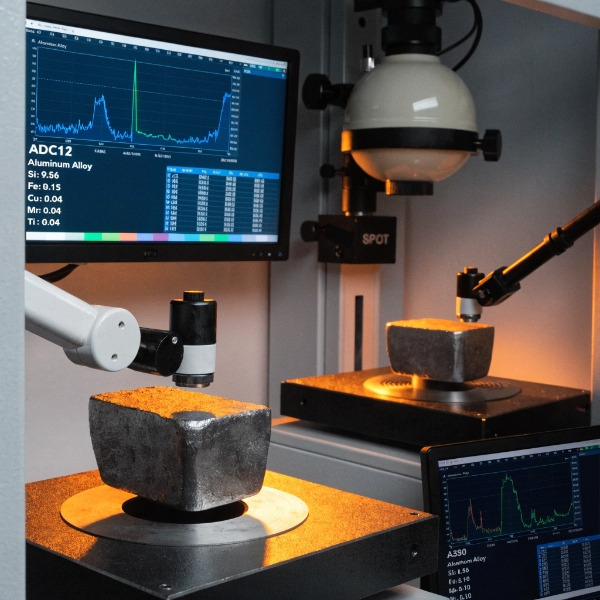
Chemical Composition: The Devil Is in the Tolerances
ADC12 (JIS H5302, Japanese Industrial Standard) and A380 (ASTM B85 / NADCA, North American standard) look nearly identical on paper, but their Cu, Zn, and Fe tolerance bands differ — and that directly affects corrosion resistance and castability.
| Element | ADC12 (JIS) | A380 (ASTM) | Engineering Impact |
|---|---|---|---|
| Si | 9.6–12.0% | 7.5–9.5% | ADC12’s higher Si gives better fluidity, favoring thin-wall complex geometries |
| Cu | 1.5–3.5% | 3.0–4.0% | A380’s higher Cu ceiling means slightly higher strength but reduced corrosion resistance |
| Fe | ≤1.3% | ≤1.3% | Nominal limits match, but ADC12 is typically held at 0.8–1.0% in practice, easing die release |
| Zn | ≤1.0% | ≤3.0% | A380’s looser Zn ceiling allows higher recycled-content compatibility |
| Mg | ≤0.3% | ≤0.10% | ADC12 permits higher Mg for select grades targeting increased hardness |
Shop-floor insight: In actual melt charging, A380’s wider Cu/Zn ceiling tolerates a higher proportion of secondary (recycled) ingot — this is part of why North American die casters historically favor A380; the scrap-cost advantage is real. But for programs requiring full IATF 16949 traceability, or end applications sensitive to chloride-induced corrosion (coastal or Nordic-market EV drive housings, for example), we typically recommend either locking in ADC12 or tightening the internal Cu control window — usually to 2.0–2.8% — rather than defaulting to the upper edge of the standard tolerance band.
Mechanical Properties and Castability Comparison
| Metric | ADC12 | A380 | Notes |
|---|---|---|---|
| UTS | 240–310 MPa | 230–320 MPa | Close range; dependent on wall thickness and cooling rate |
| Yield Strength | 140–170 MPa | 140–160 MPa | Comparable |
| Elongation | 1–3.5% | 1–3.5% | Both are relatively brittle as-cast; not first choice for structural load-bearing |
| Brinell Hardness | 80–90 HB | 75–85 HB | ADC12 slightly harder — expect marginally faster CNC tool wear |
| Fluidity (spiral flow length) | Favorable (high Si) | Moderate | ADC12 favors thin-wall (<2.0mm) complex flow-channel geometries |
| Hot-tearing tendency | Lower | Moderate-to-higher | Higher Cu content increases solidification shrinkage stress and hot-crack risk |
| Leak-tightness / density | Good (high Si suppresses shrink porosity) | Moderate | Requires vacuum-assist process to compensate |
It’s worth stating plainly: neither alloy delivers high elongation as-cast — that’s an industry-wide reality, not a design flaw. We don’t promise "zero porosity"; instead, Moldflow simulation is used to steer shrink porosity and gas porosity toward non-machined, non-pressure-bearing zones, combined with VHPDC (vacuum level held below 50mbar) to keep internal gas content within acceptable thresholds. For large thin-wall parts like battery trays, ADC12’s high-Si fluidity advantage is especially pronounced — on our 3050T island running a battery tray program, the ADC12 solution showed roughly 30% fewer end-of-fill defects than an equivalent A380 tooling configuration, based on X-ray NDT sampling data.
Typical Application Fit
| Application | Recommended Alloy | Selection Logic |
|---|---|---|
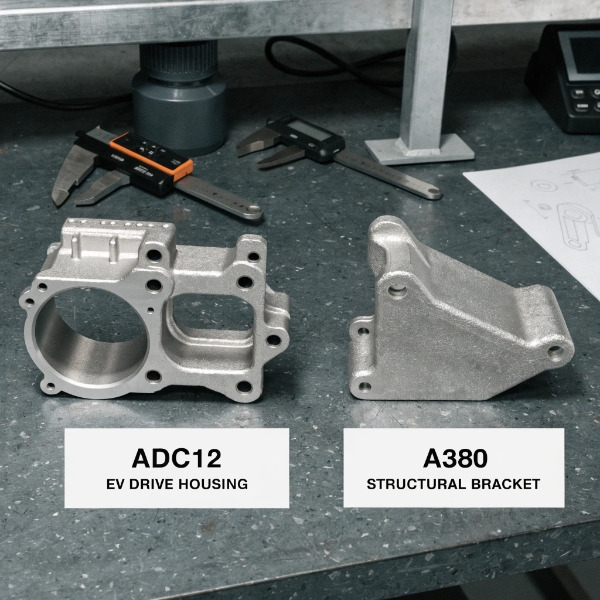
| EV motor housing / drive unit housing | ADC12 | Thin walls, complex coolant channels, strict leak-testing requirements (helium/air leak) |
| Inverter housing | ADC12 (preferred) / A380 | Needs both heat-dissipation surface precision and light weighting; ADC12 gives more stable post-machining finish |
| Battery tray | ADC12 | Large-format thin wall, high fluidity demand, hot-tear resistance priority |
| Structural bracket (non-sealed) | A380 | No leak-tightness requirement; A380 offers better cost and recycled-content fit |
| North America–sourced supply chain programs | A380 | Aligns with NADCA industry norms and local secondary-alloy supply chains |
Downstream Impact on Quality System and Machining
Alloy selection isn’t an isolated decision under a VDA 6.3 "A" rating framework — it propagates into downstream 5-axis single-setup CNC machining and VDA 19 cleanliness control:
- CNC tool life: ADC12’s slightly higher hardness typically shortens carbide tool change intervals by roughly 8–12% versus A380 on precision bearing-bore operations — this needs to be reflected in the machining cost model at quoting stage, not discovered after the fact.
- Cleanliness performance: High-Si ADC12 castings tend to shed fewer residual particles during ultrasonic cleaning, linked to a denser grain structure — a meaningful advantage for VDA 19-compliant drive housing programs where internal oil galleries require particle-free surfaces.
- PPAP Level 3 documentation: Regardless of alloy, material certificates and spectral analysis reports are mandatory PPAP submission items. We recommend locking the alloy grade and internal tolerance band at the DFM stage, avoiding a mid-program alloy switch that triggers PPAP resubmission.
Engineering Conclusion
ADC12 versus A380 isn’t a question of "which is better" — it’s a question of application fit. For EV drive-system parts requiring tight leak-tightness, thin walls, and complex geometry, ADC12’s higher-Si fluidity and superior density performance make it the safer default. For non-sealed structural components — particularly programs needing compatibility with North American secondary-alloy supply chains — A380 offers a stronger cost and standards-alignment position. At EMP Tech, alloy grade and internal composition range recommendations are made during DFM review based on actual wall-thickness distribution, leak-tightness class, and target-market supply chain — not by defaulting to the standard tolerance table.


