

As the automotive industry accelerates toward electrification and autonomous driving, thermal management has become a critical engineering challenge. From high-power LED headlights to battery management systems (BMS), electronic components are generating more heat than ever before.
Automotive heatsink die casting is the most efficient manufacturing process for producing complex, lightweight, and cost-effective thermal solutions in high volumes. As an IATF 16949 certified manufacturer, EMP Tech specializes in high-pressure aluminum die casting (HPDC) to deliver heatsinks that maximize surface area and thermal performance.
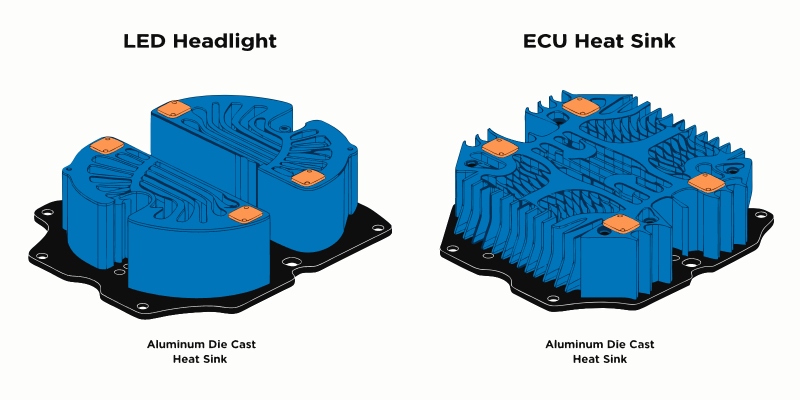
Why Die Casting is Superior for Automotive Heatsinks
While extrusion and machining are common for prototyping, aluminum die casting is the standard for mass production in the automotive sector.
Here is why engineers prefer die-cast heatsinks for critical components:
- Complex 3D Geometries: Unlike extrusion (which is limited to 2D profiles), die casting allows for the creation of pin fins, staggered fins, and integrated mounting bosses in a single shot. This maximizes the surface area within a limited packaging space, improving air-cooling efficiency.
- Weight Reduction: By optimizing wall thickness and integrating features (like connector housings) directly into the heatsink, we reduce the total part count and weight—essential for EV range optimization.
- Cost Efficiency: For production volumes exceeding 5,000 units, die casting offers the lowest cost per part due to fast cycle times and minimal material waste.
Comparison: Die Casting vs. Extrusion vs. Cold Forging
Choosing the right process depends on your thermal requirements and volume. Below is a comparison to help you select the best method for your project:
| Feature | Die Casting (ADC12 / AlSi10Mg) | Extrusion (AL6063) | Cold Forging (AL1070) |
|---|---|---|---|
| Design Flexibility | High (3D shapes, pin fins) | Low (2D profiles only) | Medium (Round pins mostly) |
| Production Volume | High (Ideal for Mass Production) | Low to Medium | Medium |
| Unit Cost (High Vol) | Low | Medium | High |
| Thermal Conductivity | Good (~96-120 W/m·K) | Excellent (~200 W/m·K) | Excellent (~220 W/m·K) |
| Integration | Excellent (Can be part of the housing) | Poor (Requires assembly) | Poor |
Note: While extruded aluminum has higher raw thermal conductivity, die casting allows for significantly more surface area in a smaller footprint, often resulting in better overall system cooling.
Optimizing Heatsink Design for Manufacturing (DFM)
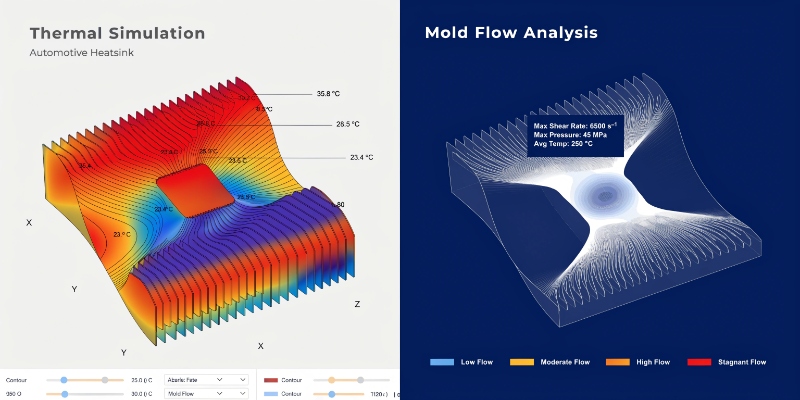
To ensure high thermal performance and manufacturability, we utilize advanced Moldflow simulation and thermal analysis before cutting steel.
Key DFM Considerations:
- Draft Angles: Fins require a specific draft angle (usually 1° to 2°) to eject from the mold without dragging.
- Fin Height-to-Gap Ratio: We optimize the spacing between fins to prevent "air choking" while maximizing surface area.
- Porosity Control: Air pockets act as insulators. We use Vacuum-Assisted High-Pressure Die Casting to minimize porosity, ensuring a dense material structure for optimal heat transfer.
Precision Post-Processing: The Key to Interface Contact
A heatsink is only as good as its contact with the heat source (PCB or Chip). A warped surface creates air gaps, leading to thermal failure.
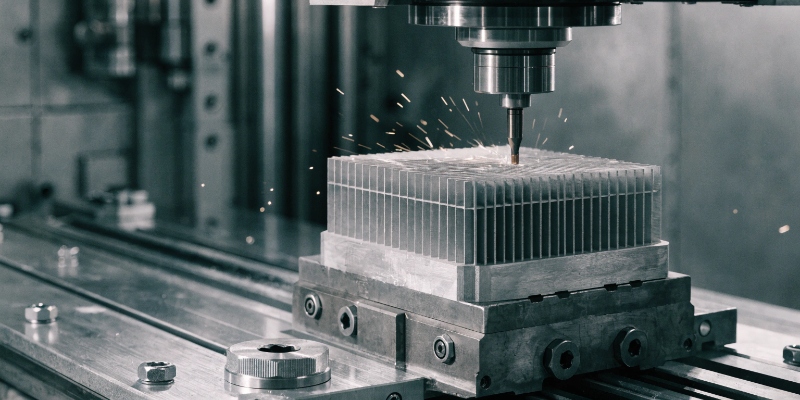
At EMP Tech, we employ CNC Machining to mill the mounting interface with micron-level flatness. This ensures 100% contact with the Thermal Interface Material (TIM), guaranteeing maximum heat dissipation.
Applications in Modern Vehicles
Our automotive heatsink die casting capabilities cover a wide range of applications:
- LED Headlight Heatsinks: Managing heat for high-lumen low/high beams to prevent fogging and LED degradation.
- ECU & ADAS Housings: Integrated housings where the body acts as the heatsink for processors.
- EV Battery & Inverter Components: Cooling plates and covers for power electronics (IGBTs).
- Infotainment Systems: Rear chassis cooling for digital cockpits.
Your Partner for Automotive Thermal Solutions
When sourcing automotive heatsink die castings, you need a partner who understands both thermodynamics and metallurgy.
EMP Tech provides a one-stop solution: from DFM and Moldflow analysis to casting, CNC machining, and surface finishing (Anodizing, E-coating, Sandblasting).
Ready to cool down your electronics?
Contact our engineering team today for a free design review and quote.
Email: [email protected]


