

Modification is a few minutes of work in the melting area, and it decides whether an aluminum die casting bends before it breaks. Strontium, sodium and antimony are the three modifiers in commercial use, each with its own holding window; Ti-B is a grain refiner, not a modifier, and the two are routinely confused in RFQs.
We cast aluminum parts on 13 cells from 350T to 3050T, all vacuum-assisted, and the modifier question comes up on every program that carries an elongation callout. Automotive die casting is where that usually starts, because powertrain and structural drawings specify A % and not only UTS.
What an aluminum alloy modifier changes
A modifier changes the shape of the eutectic silicon, not the grain size of the aluminum. That distinction explains most of the mistakes made with these additions.
In a hypoeutectic Al-Si alloy such as ADC12 or AlSi10MnMg, the last liquid to freeze is the Al-Si eutectic, and unmodified it grows as coarse plates and needles. Each plate is an internal notch, so ADC12 sits at 1–3% elongation and 230–310 MPa tensile, and the fracture surface shows bright facets where plates pulled out.
Strontium and sodium adsorb on the silicon growth front and force it to branch. The eutectic becomes fine and fibrous, and elongation moves before tensile strength does. Antimony refines the lamellae without producing a fibrous structure, so its ductility gain is smaller.
At die-cavity cooling rates the eutectic is already fine in a 2 mm wall, so a modifier buys little there. It earns its cost in the slow-cooling regions: thick bosses, rib junctions, the section around a bearing bore. That is where the plates would have been coarse, and where a leak path or a crack will start.
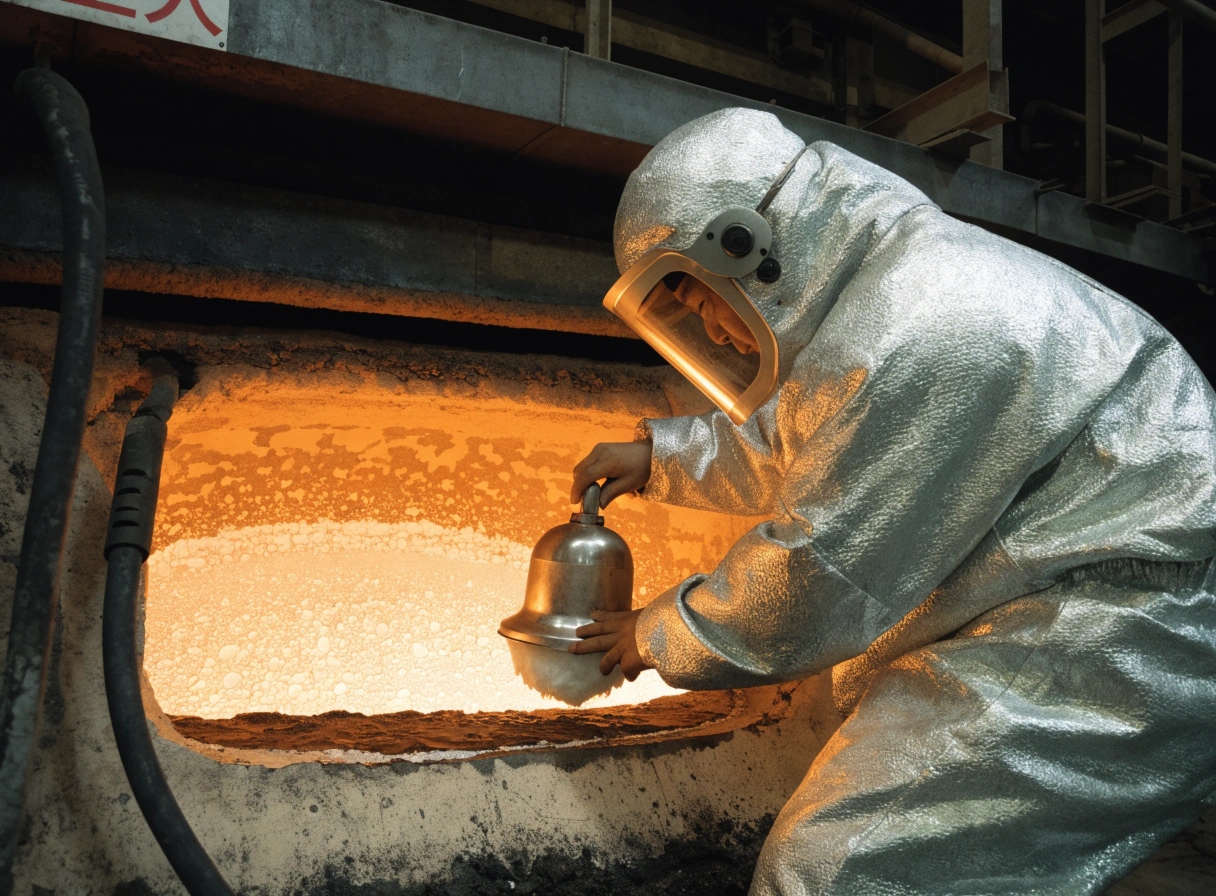
Sr, Na or Sb: which modifier fits the cell
Strontium is the default for high-pressure die casting; sodium suits short holding times in gravity work; antimony is for long holding and for metal that travels.
The deciding variable is fade. Sodium is the strongest modifier per unit and the shortest-lived, because it oxidizes and vaporizes from the surface within minutes to tens of minutes. Strontium survives for hours, which is what a central holding furnace and a fast cycle demand.
Antimony does not fade once developed, but it needs two to four hours at temperature to develop at all, and it refines lamellae rather than converting them to fibrous silicon. That suits a foundry receiving treated ingot or holding metal for a long shift; it rarely suits a structural part that needs the last two points of elongation.
| Agent | Effect on eutectic Si | Typical residual | Fade / hold behavior | Where it fits | Main risk |
|---|---|---|---|---|---|
| Strontium (Sr) | Flake to fine fibrous | 0.015–0.035% (150–350 ppm) | Hours; lost mainly by surface oxidation | HPDC with a holding furnace, structural and sealing parts | More distributed porosity; needs degassing and feeding |
| Sodium (Na) | Flake to fine fibrous | 0.005–0.015% | 15–40 minutes | Gravity and low pressure, cast close to treatment | Fume, refractory attack, unpredictable recovery |
| Antimony (Sb) | Lamellar refinement, not fibrous | 0.10–0.20% | No fade after development; 2–4 h to develop | Pre-treated ingot, long holding, remelt operations | Heavy addition; stays in the scrap loop |
| Ti-B (not a modifier) | None | Ti 0.03–0.15% typical | Settles, does not fade chemically | Grain size, feeding, hot tearing | Boron interferes with Sr |
Read the table by holding time first, then by the property the drawing calls. A cell that treats in the launder and casts within ten minutes can use sodium; one that holds a tonne for a shift cannot.
Dose to a residual, not to an addition
Only the spectro reading taken after the addition tells you what is in the bath; the addition log tells you what you meant to do.
Strontium goes in as Al-10Sr waffle or rod. Two to four kilograms per tonne puts roughly 200–400 ppm Sr into the bath before losses, and the useful window is about 150–350 ppm. Those are industry-typical figures rather than a fixed recipe, because section thickness, cooling rate and holding time all move the number.
Recovery of Sr is high when the waffle is held under the surface until it dissolves, commonly 85–95%. Sodium recovery is low and erratic because much of it leaves at the surface while it is being added. That is one reason Sr became the die casting standard: it is the additive you can still measure an hour later.
Fade is the part that surprises people. A study that quantified modifier loss during furnace holding attributed most of the loss of both Na and Sr to oxidation at the melt surface rather than vaporization, and derived a surface reaction rate that predicts the decline (Crystals, 2023). In the plant that reads as a simple rule: every skim, every top-up and every hour at temperature costs Sr, and the loss is invisible on the addition record.
| Agent | Form | Typical addition | Target residual | Typical recovery | Re-check |
|---|---|---|---|---|---|
| Sr | Al-10Sr waffle or rod | 2–4 kg per tonne | 150–350 ppm | 85–95% | Each heat, and after every top-up |
| Na | Flux or salt addition | Not reliably dosed by weight | 50–150 ppm | Low and variable | Within minutes of treatment |
| Sb | Al-5Sb | 20–40 kg per tonne | 0.10–0.20% | Around 90% | Once per shift, after the hold |
| Ti-B | Al-5Ti-1B or Al-3Ti-1B | 1.4–2.8 kg per tonne | Ti 0.03–0.15% | High; losses are settling, not chemistry | Once per shift, plus a grain-size check |
The Sb row explains why antimony usually arrives in the ingot. A 0.10–0.20% means 20–40 kg of Al-5Sb per tonne of melt, which few foundries want to handle in a ladle.
Ti-B is a grain refiner, not a modifier
A Ti-B addition controls the size of the primary aluminum grains and leaves the eutectic silicon untouched, so it cannot do a modifier’s job.
Al-5Ti-1B and Al-3Ti-1B introduce TiB2 particles and solute titanium. The particles nucleate α-aluminum, so the columnar zone shrinks and the casting freezes equiaxed, with better feeding and less hot tearing, and porosity spreading out instead of concentrating in one hot spot.
How much to add is a grain-size question, not a weight question. A TMS comparison of foundry refiners tested Al-5Ti-1B and Al-1.6Ti-1.4B at 1.4, 2.0 and 2.8 kg per tonne in A356 and found grain size falling sharply at the first level, then flattening near 600 µm (Boot et al., TMS 2002). An extra 0.1% Ti produced no measurable change in that alloy, a useful corrective to topping up titanium whenever the structure looks coarse.
The same study argues against simply adding more: raising the refiner reduced hot tearing at a spoke-rim junction but increased localized porosity, while removing it brought hot cracking back. It also notes that a laboratory test such as TP-1 does not predict behavior in a shaped casting, which matches what we see when a supplier certificate looks perfect and the part still tears.
Two shop-floor cautions apply. TiB2 settles and agglomerates, so refiner added an hour before casting has partly left the bath; and coarse agglomerates that stay in suspension appear later as hard spots on a machined face.
Where Sr and Ti-B cancel each other
Boron ties up strontium, and phosphorus ties up both strontium and sodium, so a heat can lose its modifier without anyone changing the dose.
Sr and B form SrB6, which is stable in the melt and useless for modification. The interaction has been studied directly in Al-Si casting alloys (Liao and Sun, Chinese Journal of Nonferrous Metals, 2003), and the foundry consequence is that a boron-rich refiner added to a Sr-modified melt reduces the strontium available to modify the silicon. Published thresholds vary with alloy and holding time; treat 20–30 ppm B as the range where the loss becomes visible, then measure rather than assume.
Phosphorus is the other scavenger. AlP nucleates silicon efficiently, which is why P is added to hypereutectic piston alloys, and why a few ppm of P in a hypoeutectic melt coarsens the eutectic and consumes modifier. P arrives with scrap, with some refractory coatings and with dirty returns; calcium and lithium behave similarly.
Order of addition matters more than most work instructions admit. Degas first, refine second, modify last, cast inside the holding window, and use a low-boron refiner such as Al-3Ti-0.15B or Al-5Ti-0.2B on a Sr-modified melt.
How to prove the treatment on the shop floor
Three checks prove modification: a spectro reading taken at the die, a metallographic sample from the slowest-cooling section, and elongation measured on that same section.
X-ray will not show it. Radiography finds gas and shrinkage porosity, and a casting with a fully modified eutectic can still fail a leak test while an unmodified one passes. The two defects live in different places.
Take the pin sample at the die, not at the furnace, and read Sr on a calibrated OES program. The gap between furnace and die is the fade, and it is the number worth trending.
For metallography, polish a section from the thickest wall, etch lightly and look at 200–500×. The rating runs from a continuous flake network through mixed structures to a fine fibrous eutectic with rounded ends. Photograph the section and keep it with the heat record, because a verbal confirmation is not evidence.
| Condition | Metallography | Elongation | Porosity | What to change |
|---|---|---|---|---|
| Under-modified | Mixed flake and fibrous; angular plates still connected | Low end of the alloy band, wide scatter | Normal to low | Raise Sr dose; check B and P in the melt |
| Correctly modified | Fine fibrous network, rounded ends, uniform across the section | Top of the alloy band, tight scatter | Dispersed, no through-wall path | Hold the dose and the holding time |
| Over-modified | Coarsened, widely spaced Si particles; Sr-rich phases | Falls back, scatter widens | Rises, especially in hot spots | Cut the dose; improve degassing and feeding |
Tensile testing is the check a customer will accept. Cut specimens from the loaded section, or cast them in a test-bar cavity in the same shot, and record where they came from; an elongation figure without a location is not a specification.
What to write on the drawing
“Modified” is not an inspection criterion; a residual range with a sampling point is. The note that survives an audit reads: Sr 0.015–0.035% by OES, pin sample at the die from each heat, with metallographic acceptance defined on a section from the thickest wall.
Add the elongation zone and the specimen location, and a Ti or grain-size requirement only if refinement is genuinely part of the function. On a sealing housing the modifier matters because a coarse eutectic opens a leak path; on a bracket the refiner matters more because hot tearing decides whether the part can be cast at all.
The material cost is small: two to four kilograms of master alloy per tonne is a minor line next to the ingot. The expensive consequence is porosity, because a Sr-modified melt is less forgiving of poor degassing and weak feeding, so the treatment belongs with vacuum and die thermal control rather than instead of them. Every cell we run is vacuum-assisted, and the leak test is helium-based because a modified structure with a shrink pore still leaks.
For an EV drive motor housing in AlSi10MnMg at 8–12% elongation, the modifier is not a garnish. Choose Sr for the holding window you have, keep boron low, and prove the result at the die.
FAQ
Is strontium a grain refiner?
No. Strontium modifies the eutectic silicon; grain refinement needs Ti-B or Ti-C. Adding Sr to fix a coarse grain structure wastes money and can add porosity.
How long does strontium modification last in the holding furnace?
Hours, not days, and the level falls fastest at the surface where oxidation occurs. Re-check every heat and after every top-up; a bath held overnight needs a new reading in the morning.
Can you over-modify an Al-Si alloy?
Yes. Above roughly 0.05–0.06% Sr the eutectic stops improving, Sr-rich phases appear and porosity tends to rise. The metallographic signature is coarsened, widely spaced silicon particles instead of a fine fibrous network.
Does modification increase tensile strength?
Barely. UTS moves within the scatter of the alloy; elongation and impact energy are what change. A drawing that specifies only UTS cannot tell whether the melt was treated at all.
Which modifier should an ADC12 die caster use?
Strontium, at 0.015–0.035% residual, checked by OES at the die. Sodium fades too quickly for a central holding furnace, and antimony needs hours to develop and delivers a smaller gain in elongation.
For the alloy side of the same decision, see how ADC12 and A380 differ in practice, and how porosity is identified and controlled once the melt is treated. The sampling plan that goes with it is in incoming inspection of aluminium die castings.


