

The part was a 4.6 kg suspension node for a low-volume EV, and the drawing asked for 8 % elongation and 1 × 10⁶ cycles at ±45 MPa. We quoted high pressure die casting first because that is what the plant runs, and the first fatigue samples failed at 1.2 × 10⁶ cycles on two of six specimens — close enough that the buyer wanted to argue about statistics. The second round, in squeeze casting, passed at 3.1 × 10⁶ cycles. It also cost 39 % more per part and doubled the cycle time. Both numbers are correct, and choosing between them is the actual engineering decision.
The two processes are not the same family
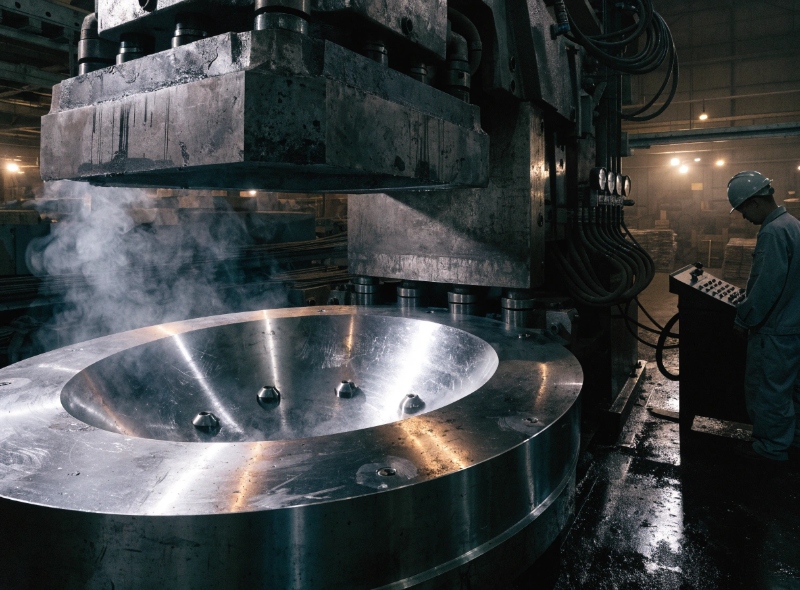
High pressure die casting fills a steel die in 30 to 60 milliseconds with metal moving at 30 to 60 m/s at the gate. Squeeze casting fills the same kind of die in 1 to 3 seconds with metal moving at 0.2 to 0.5 m/s, then holds 50 to 100 MPa of pressure on the solidifying part until it is rigid. One is a sprint that relies on speed to keep the metal liquid; the other is a controlled pour that relies on pressure to feed shrinkage.
Everything else follows from that. Fast fill means turbulence, gas entrapment, and oxide folded into the part — which is why HPDC parts have 1 to 3 % porosity and 1 to 3 % elongation. Slow fill means the metal is never turbulent, and the applied pressure feeds the shrinkage that gravity casting would leave as porosity — which is why squeeze cast parts reach 6 to 12 % elongation and can be T6 heat treated without blistering. The published ranges behind those numbers are not folklore: a review in China Foundry and an investigative review in Materials Today both tabulate how applied pressure, die temperature and pouring temperature move strength and elongation, and both land in the same place — pressure is the variable that buys ductility, and it has diminishing returns once the section is fed.
The comparison that matters on a drawing review
| Parameter | HPDC | Squeeze casting | What it means for design |
|---|---|---|---|
| Gate velocity | 30 to 60 m/s | 0.2 to 0.5 m/s | Squeeze does not entrain gas; no vacuum needed for most parts |
| Fill time | 30 to 60 ms | 1 to 3 s | Squeeze cannot fill thin sections before freezing |
| Minimum wall | 1.2 to 1.5 mm achievable | 3 to 4 mm practical, 2.5 mm with effort | Mass saving is HPDC’s home ground |
| Typical porosity | 1 to 3 % | 0.2 to 0.6 % | Sealing and fatigue both improve |
| Elongation (A380 / AlSi7Mg) | 1 to 3 % | 6 to 12 % | Squeeze parts absorb crash energy; HPDC parts do not |
| Heat treatment | T5 only; T6 blisters | T6 standard | Squeeze unlocks 250 to 320 MPa UTS with ductility |
| Cycle time | 60 to 90 s | 150 to 240 s | Two to three times the machine hour per part |
| Tool life | 100,000 to 150,000 shots | 30,000 to 60,000 shots | Thermal cycling at 100 MPa is hard on inserts |
| Tooling cost (medium part) | 60,000 to 120,000 € | 90,000 to 180,000 € | Higher pressure, thicker die base, more clamping |
| Economic volume | 20,000+ per year | 3,000 to 40,000 per year | Different sweet spots, some overlap |
Read the table as a set of constraints rather than a ranking. Squeeze casting is not “better HPDC”. It is a slower process with a thicker wall limit and a much better defect budget, and it costs what it costs.
What the fatigue test actually showed
The HPDC node failed at the boss-to-wall transition, which is where we expected it to fail and where the customer’s CAE said the stress was highest. The fracture surface had three distinct porosity clusters in the initiation zone, each 0.4 to 0.9 mm across. The part had passed 100 % X-ray at 200 µm. That is not a contradiction: X-ray at 200 µm resolution reliably finds voids above roughly 0.5 mm in a 6 mm section, and these were right at the edge of detection and partly masked by the section thickness.
The squeeze cast version had no voids above 0.3 mm in the same zone and passed at 3.1 × 10⁶ cycles. The material was AlSi7Mg0.3 in T6, 265 MPa UTS, 8.5 % elongation on the coupon.
The honest caveat: part of the improvement came from the heat treatment, not the casting process. A T6 treatment on the HPDC part was not possible — the entrapped gas expands at 500 °C solution treatment and blisters the surface — so the comparison is really “HPDC in T5” versus “squeeze in T6”, which is how the choice actually presents itself in practice. If someone tells you they can T6 an HPDC structural part without blistering, ask to see the section through the thickest wall.
Where semi-solid fits between them
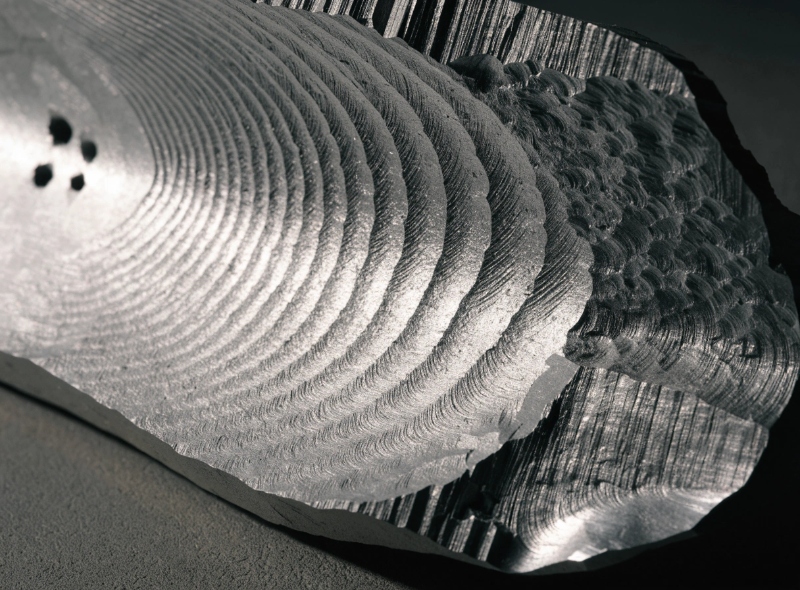
There is a third option and it is often the right one for a 2 to 4 kg structural part at 20,000 to 60,000 units a year: semi-solid casting, where the melt is held at 30 to 50 % solid fraction and behaves like a slurry rather than a liquid. Fill is laminar like squeeze, cycle time is 60 to 90 seconds like HPDC, and porosity lands in the 0.5 to 1.5 % band — better than HPDC, worse than squeeze. Ductility lands at 4 to 8 %.
The constraint is the slurry itself: you need a slurry-on-demand machine or a billet reheating line, and the process window for solid fraction is narrow enough that a two-degree error changes the fill. Our note on semi-solid casting covers the equipment side. For the node above, we quoted all three and the customer picked squeeze because the T6 property was in the specification and nobody wanted to re-run the fatigue qualification.
How to choose without a committee
| If the part is… | Choose | Because |
|---|---|---|
| 1.2 to 2.5 mm walls, 200,000+ per year, cosmetic or fluid-touching | HPDC, with vacuum if it must seal | Nothing else fills that section at that rate; porosity is managed with vacuum and gate design |
| Structural, must pass fatigue or crash, 3,000 to 40,000 per year | Squeeze casting | T6 and 6 to 12 % elongation; tooling amortises at these volumes |
| Structural, 20,000 to 60,000 per year, wall above 2.5 mm | Semi-solid | Half the cycle time of squeeze with most of the ductility |
| Under 3,000 per year, or a prototype | Gravity or sand casting, or billet machining | Tooling cost dominates everything else at low volume |
| Very high strength, simple geometry, thick sections | Forging | Better fatigue and no porosity at all; machining allowance costs more |
The last row deserves a mention because it is often the real competitor. Our die casting versus forging comparison goes through the cost model; the short version is that forging wins on fatigue at low volume and loses on near-net shape at high volume.
The cost model that decided the node
At 12,000 parts a year over four years:
HPDC: tooling 95,000 €, unit cost 8.90 €, scrap 4.8 %, plus the risk-adjusted cost of a fatigue failure in validation — one failed validation round cost 34,000 € in test and schedule.
Squeeze: tooling 148,000 €, unit cost 12.40 €, scrap 2.1 %, T6 included at 1.10 € per part.
Difference over the programme: 48,000 € of tooling plus 172,000 € of unit cost, against 46,000 € of expected re-validation and warranty exposure on the HPDC route. The squeeze route was 174,000 € more expensive in the clean case and roughly 128,000 € more expensive in the risk-adjusted case. The customer chose squeeze anyway, because the launch timing meant a second failed validation would have cost a quarter of production.
That is the decision, and it is not a casting decision. It is a schedule decision wearing a metallurgy costume.
Frequently Asked Questions
Can vacuum HPDC reach squeeze casting ductility?
No. Vacuum removes the gas that would otherwise be entrapped — it typically cuts porosity by 60 to 80 % and is the right answer for sealing — but it does not change the solidification shrinkage that leaves 1 to 2 % porosity in thick sections. Ductility stays in the 2 to 4 % range. If the specification needs 6 % elongation, the process has to change.
Why is squeeze tool life so much shorter?
Pressure. A squeeze die sees 50 to 100 MPa on the part surface every cycle, and the thermal cycle is longer and hotter because the die is closed on solidifying metal for 100 seconds or more. Inserts crack from thermal fatigue rather than from erosion. Nitriding and a proper stress-relief schedule every 20,000 shots are the usual countermeasures.
Can a squeeze cast part be machined like an HPDC part?
Yes, and usually more easily, because there is less porosity to interrupt a cut and the material is heat treated to a consistent hardness. Allowances are similar, 0.5 to 1.5 mm depending on feature, but near-net shape is slightly worse because the minimum wall is thicker. Our comparison with CNC machining has the allowance numbers.
What is the smallest part that makes sense in squeeze casting?
Around 0.8 kg. Below that, the cycle time and the tooling cost per part stop working, and a 600-ton HPDC cell with vacuum will usually beat it on total cost. The exception is a small part with a fatigue requirement that cannot be met any other way, and those exist.


