

When developing structural or thermal management components for modern automotive architectures, engineering teams eventually hit a critical crossroad: should we CNC machine this part from a solid billet, or invest in tooling for High-Pressure Die Casting (HPDC)?
For Tier 1 system integrators, making the wrong choice here doesn’t just inflate the piece price; it jeopardizes the scalability of the entire vehicle platform. If you machine a high-volume part from billet, you will bleed cash on machine time and material waste. If you die-cast a low-volume part too early, you will never amortize the massive H13 steel tooling costs.
Having managed both intensive CNC floors and large-tonnage HPDC cells for decades, we are bypassing the textbook definitions. Here is an objective, floor-level engineering analysis of die casting versus CNC machining, examining the exact cost thresholds and metallurgical performance realities.
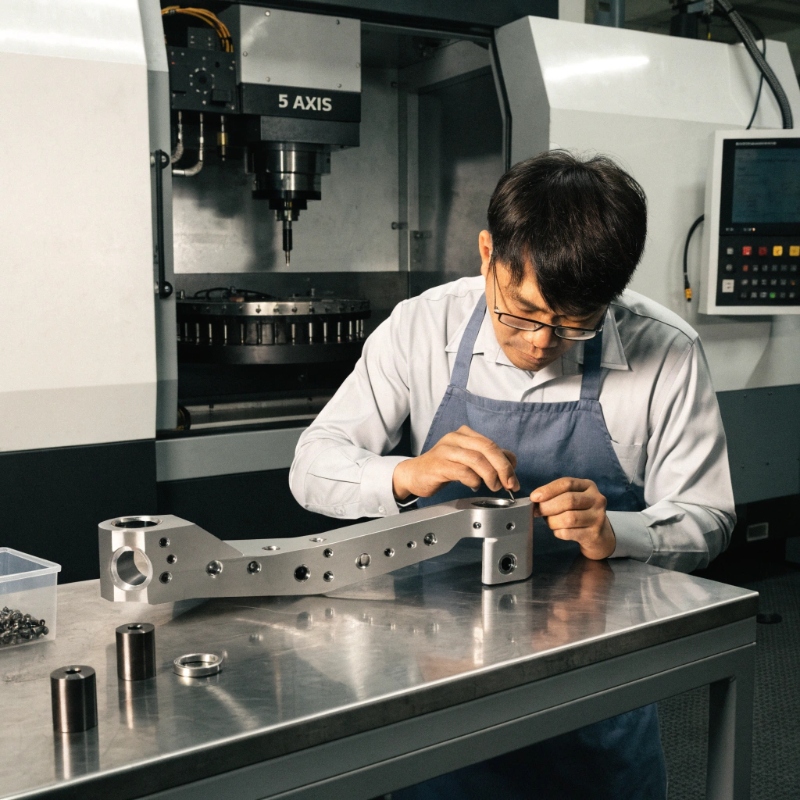
1. Billet CNC Machining: Precision at a Premium
CNC (Computer Numerical Control) machining is a subtractive process. You start with a solid block (billet) of extruded or forged aluminum, such as 6061-T6, and a robotic spindle mills away everything that isn’t the part.
The Engineering Reality:
Because the billet has a highly uniform, dense grain structure, a CNC-machined part will exhibit exceptional mechanical strength and absolutely zero internal porosity. You can hold tolerances down to the micron level right off the machine.
The Production Bottleneck:
If you are designing a liquid-cooled housing with deep water jackets and complex pin-fins, machining it from a solid block is an operational nightmare. The cycle time is measured in hours, and the "buy-to-fly" ratio (material waste) can exceed 70%. CNC machining from billet is strictly reserved for rapid prototyping, low-volume hyper-car production, or parts with extremely simple geometries.
2. High-Pressure Die Casting (HPDC): The High-Volume Heavyweight
Automotive aluminum die casting1 is a formative process. Molten aluminum (like ADC12 or AlSi10MnMg) is shot into a hardened steel mold cavity at speeds exceeding 5 meters per second.
The Engineering Reality:
HPDC produces complex, near-net-shape geometries—like thin-walled heat sinks and integrated mounting bosses—in a cycle time of 60 to 90 seconds. The piece price drops dramatically at scale. However, the physical reality of rapid solidification means that micro-porosity (trapped gas and shrinkage voids) is inevitable.
The Production Solution:
You cannot pretend porosity doesn’t exist; you must manage it. By strictly following NADCA engineering guidelines2, we utilize Vacuum HPDC and predictive Moldflow simulation to push unavoidable porosity into overflow wells, keeping the critical structural nodes dense and strong.
The Cost & Performance Matrix
When deciding between the two, Tier 1 sourcing managers should reference this baseline comparison:
| Metric | Billet CNC Machining | High-Pressure Die Casting (HPDC) |
|---|---|---|
| Initial CAPEX (Tooling) | Very Low (Fixtures and programming only) | Very High (Requires hardened H13 steel molds) |
| Piece Price at Volume | Extremely High | Very Low (Highly economical at scale) |
| Cycle Time | Hours per part | 60 – 120 seconds per part |
| Material Waste | 50% – 80% (Subtractive) | < 10% (Runners and overflows are remelted) |
| Internal Integrity | 100% Dense (No porosity) | Susceptible to micro-porosity (Requires Vacuum HPDC) |
| Geometric Complexity | Limited by tool access (Blind corners are difficult) | Exceptional (Deep coring and thin-wall integration) |
The Volume Tipping Point
The mathematical crossover point between CNC machining and die casting typically sits between 2,000 and 5,000 units.
If your lifetime production volume is 1,500 units, the cost of a $50,000 die casting mold will add $33 to the price of every single part, making CNC machining the financially viable choice. However, if your program demands 50,000 units annually, the tooling amortization drops to mere cents per part, while the rapid cycle time of HPDC saves millions in production costs.
The "Hybrid" Truth: Why You Actually Need Both
In the reality of the Tier 2 automotive supply chain, it is never strictly "Die Casting vs. CNC." It is almost always Die Casting then CNC Machining.
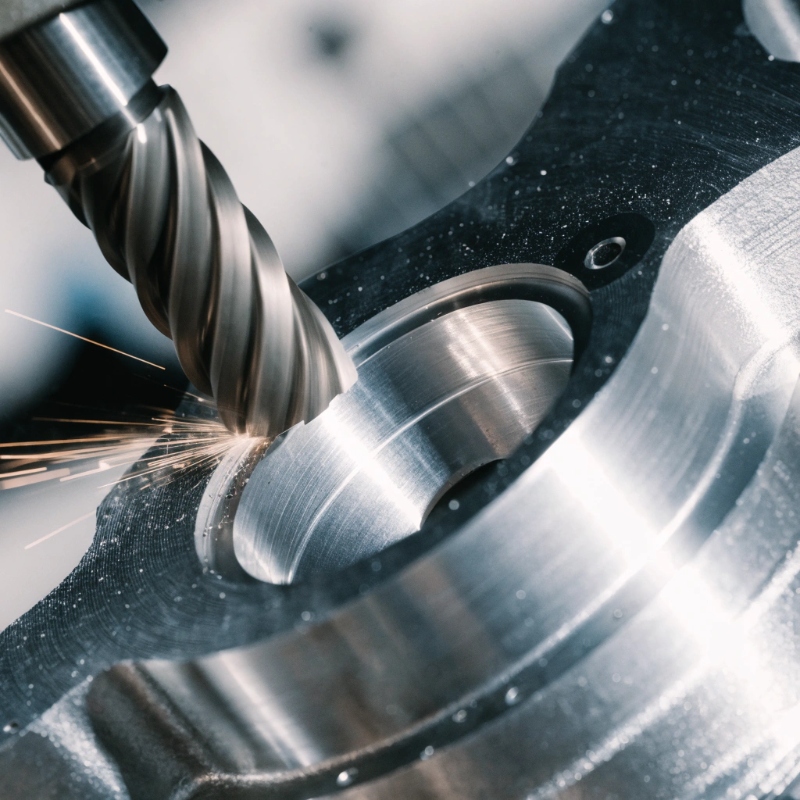
Take an EV motor controller housing3 as an example. We use high-tonnage HPDC to rapidly form the complex cooling channels and the main structural body. But HPDC cannot hold the ±0.01mm tolerances required for the O-ring sealing grooves or the bearing bores.
The Original Insight: The Machining Trap
This is where split supply chains fail. If you cast a part at Foundry A and ship it to Machine Shop B, disaster awaits. If Machine Shop B cuts the O-ring groove right through the thermal center of a thick casting flange, they will expose the internal micro-porosity, guaranteeing a coolant leak on your assembly line.
To mitigate this, the die casting design and the CNC machining strategy must be engineered together. At EMP Tech, we adjust the gating design in Moldflow to ensure the specific areas targeted for CNC machining are dense and void-free. Following the single-setup 5-axis CNC machining, we validate the final geometry using Zeiss CMM equipment4 and 100% inline air-decay leak testing.
Evaluate Your Project Before Cutting Steel
Selecting the right manufacturing process is about mitigating risk and managing capital expenditure. If you commit to a die casting tool before your design is fully stabilized, tooling modifications will cripple your launch schedule.
If you are transitioning a component from a machined prototype to high-volume die casting, do not guess on the manufacturability. Upload your 3D CAD (STEP/IGES) today5. Our engineering team will deliver a ruthless, objective DFM review, highlight potential shrinkage risks via thermal simulation, and provide a pragmatic manufacturing quote within 24 hours.
References & Footnotes
EMP Tech. Automotive Aluminum Die Casting Solutions & Capabilities. ↩
North American Die Casting Association (NADCA). Engineering & Design Standards. ↩
EMP Tech. EV Motor Controller Housing Engineering Specifications. ↩
EMP Tech. Automotive-Grade Quality Control & Inspection Laboratory. ↩
EMP Tech. Upload CAD for DFM Review and Pragmatic Quoting. ↩


