

Automotive Die Casting vs Forging: Which Is Better for OEMs?
When engineering automotive components for high-volume production, the choice of manufacturing process dictates not only the mechanical limits of the part but also the economic viability of the entire vehicle platform. For decades, the debate between automotive die casting1 and forging has been a strict trade-off: do you prioritize absolute mechanical strength, or do you need geometric complexity and lightweighting?
With the aggressive transition toward Electric Vehicle (EV) architectures, OEMs are rethinking this paradigm. The push for component consolidation and advanced thermal management has heavily tilted the scales.
Based on metallurgical realities and floor-level manufacturing data, here is an objective engineering breakdown of automotive die casting versus forging, and how OEMs should allocate these processes in 2026.2
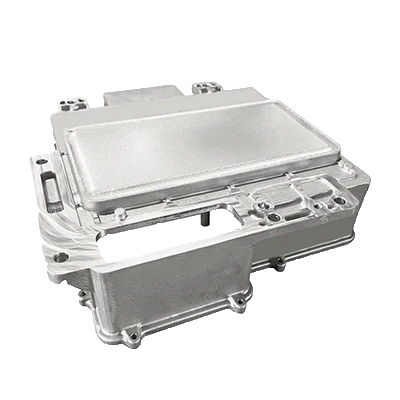
The Fundamental Metallurgical Difference
To understand where each process belongs, we must look at the grain structure.
Forging involves heating a solid billet of metal (usually steel or specific aluminum alloys) and hammering or pressing it into shape. This physical deformation aligns the internal grain structure of the metal to follow the contours of the part, resulting in exceptional tensile strength, impact resistance, and zero internal porosity.
High-Pressure Die Casting (HPDC) involves injecting molten metal (primarily aluminum or magnesium) into a hardened steel mold cavity at high speeds and pressures. Because the metal is liquid, it can fill incredibly intricate molds, resulting in near-net shapes. The metallurgical reality, however, is that as the liquid metal rapidly cools and shrinks, micro-porosity (internal voids) will occur.
Process Comparison Matrix
| Specification | Forging | High-Pressure Die Casting (HPDC) |
|---|---|---|
| Tensile Strength & Fatigue | Exceptional (Directional grain flow) | Moderate to High (Depends on alloy/porosity control) |
| Geometric Complexity | Very Low (Cannot forge internal cavities) | Exceptional (Thin walls, deep coring, water jackets) |
| As-Cast Dimensional Tolerance | ±0.5 mm to ±1.0 mm | Up to ±0.05 mm (ISO 2768-m) |
| Secondary Machining Required | Very High (Heavy material removal) | Low to Moderate (Near-net shape) |
| Production Speed / Cycle Time | Slower | Very Fast (Ideal for high-volume OEMs) |
| Typical Auto Applications | Crankshafts, connecting rods, gears | EV motor housings3, battery trays, transmission cases |
When Forging Remains the Undisputed Choice
Let’s be realistic: if a component is subjected to relentless, heavy-duty dynamic fatigue or extreme impact loads without the need for weight reduction, forging wins.
Internal combustion engine (ICE) components like connecting rods, camshafts, and transmission gears require the continuous, unbroken grain flow that only forging provides. Similarly, high-stress suspension components in heavy-duty trucks often rely on forged aluminum or steel. Die casting simply cannot match the absolute yield strength of a closed-die forged billet.
Why HPDC Dominates Modern Automotive and EV Design
If forging is stronger, why are OEMs pouring billions of dollars into die casting infrastructure? The answer lies in geometric capability and part consolidation.
1. The Impossible Geometry of Thermal Management
In the EV sector, thermal management is the bottleneck. A modern EV Battery Case4 or inverter housing requires complex, integrated conformal cooling channels, dense pin-fin heat sinks, and multiple mounting bosses.
Engineering Reality Check: You cannot forge a water jacket. Forging is strictly limited to solid, relatively simple shapes. If you attempted to machine an EV cooling housing out of a forged billet, the cycle time would be measured in hours per part, and material waste (chips) would exceed 60%. HPDC achieves these complex internal geometries in a 60-second cycle time.
2. Part Consolidation (The Giga-Casting Trend)
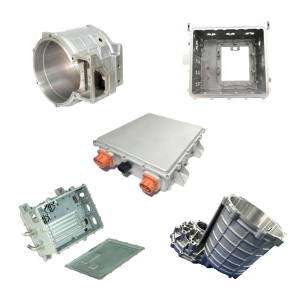
Automotive OEMs are actively moving toward structural die casting to replace assemblies that previously required stamping, welding, and riveting dozens of individual steel parts. A single large-format aluminum die casting can integrate mounting brackets, fluid routing, and structural webbing into one near-net shape part. This drastically reduces assembly line footprint, minimizes tolerance stack-up errors, and drops vehicle weight.
3. Bridging the Strength Gap: Structural Alloys and Vacuum HPDC
The traditional knock against die casting is internal porosity leading to lower fatigue resistance. However, modern foundries have evolved.
By utilizing Vacuum High-Pressure Die Casting (VHPDC), foundries extract air from the mold cavity milliseconds before the molten metal is injected. This process drastically reduces gas entrapment. When combined with specialized ductile alloys (like AlSi10MnMg) and subsequent T6 heat treatment (solution heat treating and artificial aging), structural die castings now achieve yield strengths and elongations that meet stringent crash-safety requirements for chassis nodes and shock towers.
Cost-Benefit Analysis for OEMs
For high-volume production (typically >30,000 units/year), HPDC offers a significantly lower piece price.
While the initial tooling costs for a hardened H13 steel die casting mold are high, the amortization of that tool over hundreds of thousands of parts makes it highly economical. More importantly, because HPDC produces a near-net shape, CNC machining is generally limited to critical sealing faces (O-ring grooves) and tapping blind holes for fasteners.
Forging tools are cheaper, but the per-part cost remains high due to slower production rates, intensive secondary CNC machining, and high material scrap rates.
The Verdict
There is no "better" process—only the correct process for the specific engineering intent.
- Specify Forging for solid, high-impact, dynamic-load components where geometric complexity is low and strength is the absolute priority.
- Specify Die Casting for enclosures, thermal management systems, and consolidated structural parts where lightweighting, complex internal coring, and high-volume cost efficiency are paramount.
If you are developing a highly complex aluminum component and are concerned about porosity, strict geometric tolerances (GD&T), or technical cleanliness, upload your CAD (STEP/IGES) to our engineering team. EMP Tech provides objective Design for Manufacturability (DFM) reviews and Moldflow simulations to ensure your automotive castings are engineered for reliable mass production.
References & Footnotes
EMP Tech. Automotive Die Casting Solutions & Capabilities. ↩
North American Die Casting Association (NADCA). Die Casting vs. Other Processes. ↩
EMP Tech. EV Motor Controller Housing Specifications. ↩
EMP Tech. EV Battery Case (Tray) Specifications. ↩


