

When looking at the architecture of an electric vehicle (EV), the battery and the electric motor usually get all the attention. However, sitting between them is the true "brain" of the powertrain: the motor controller (or inverter).
As high-performance EVs shift toward 800V architectures and Silicon Carbide (SiC) MOSFETs, these electronic modules generate immense amounts of heat and electromagnetic noise. Consequently, the EV motor controller housing has evolved from a simple protective metal box into a highly complex, multi-functional thermal management and structural component.
In this guide, we break down the true functions, critical design challenges, and manufacturing realities of modern motor controller housings.
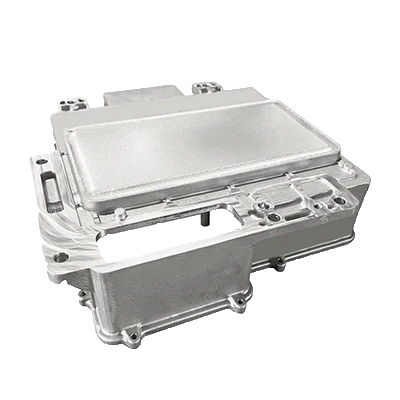
The 3 Core Functions of a Motor Controller Housing
To understand the design, you have to look at what the housing actually does. It is tasked with three non-negotiable functions:
1. Active Thermal Management (The Bottleneck)
The power modules (IGBTs or SiC) inside the controller switch high currents thousands of times per second. If this heat isn’t dissipated instantly, the electronics will throttle power or fail catastrophically. Modern housings integrate complex liquid cooling jackets directly into the casting. Coolant flows through these internal labyrinth channels, pulling heat directly away from the electronic pedestals.
2. EMI/RFI Shielding (The Faraday Cage)
High-voltage switching creates intense Electromagnetic Interference (EMI) and Radio Frequency Interference (RFI). If unshielded, this noise can disrupt the vehicle’s low-voltage sensors, ADAS systems, or infotainment. An aluminum die-cast housing acts as a natural, seamless Faraday cage, keeping the high-frequency noise safely contained.
3. Absolute IP67/IP68 Environmental Sealing
Mounted low in the vehicle chassis or directly onto the drive motor, the housing is constantly exposed to road spray, salt, dust, and vibration. The enclosure must maintain a strict hermetic seal to prevent moisture ingress, which would cause an instant short circuit in the high-voltage system.
Design Insights: The Manufacturing Reality Check
Many hardware engineers design beautiful cooling layouts in CAD, only to realize they are a nightmare to manufacture. Here are a few original insights from the foundry floor on what makes a controller housing successful.
Insight 1: The "Machining Trap" in Sealing
Designers often worry about the overall wall thickness for waterproofing. But in reality, 90% of leak failures happen at the O-ring groove.
If the aluminum casting has micro-porosity (tiny internal air bubbles) located right where the CNC tool cuts the sealing groove, the O-ring will not seat properly. Coolant or moisture will weep through these micro-voids. This is why elite foundries insist on Vacuum High-Pressure Die Casting (VHPDC) to eliminate porosity specifically around gasket interfaces.
Insight 2: Internal Coplanarity Matters More Than You Think
The internal electronics are usually bolted onto raised mounting bosses or pedestals inside the housing. If these mounting points are not perfectly coplanar (flat relative to each other), tightening the bolts will physically bend the PCB or the ceramic substrate of the power module.
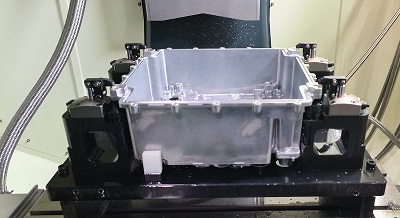
Achieving strict coplanarity requires single-setup 5-axis CNC machining, ensuring that all mounting surfaces are milled in one go without repositioning the part.
Material Selection: Why Aluminum Die Casting?
While plastics and composites are making their way into some auto parts, aluminum die casting remains the undisputed king for motor controller housings.
- Thermal Conductivity: Aluminum alloys naturally draw heat away from the electronics.
- Weight Reduction: Compared to cast iron or steel, aluminum significantly reduces the overall weight of the powertrain, extending the vehicle’s driving range.
- Scalability: High-Pressure Die Casting (HPDC) allows for the rapid, repeatable manufacturing of complex internal geometries (like cooling fins and fluid channels) in high volumes that CNC-machining from a solid billet simply cannot match economically.
Commonly used alloys include ADC12 and A380 for their excellent castability and dimensional stability. For housings requiring extreme heat dissipation, customized high-thermal-conductivity aluminum alloys are often specified.
Overcoming Production Challenges
Taking a motor controller housing from a CAD file to mass production requires overcoming specific manufacturing hurdles:
- Draft Angles and Deep Coring: Liquid cooling channels require intricate steel cores in the mold. Designing the correct draft angles (tapers) ensures the tool can extract without damaging the cooling fins.
- Thermal Warpage: Large, flat sealing covers are prone to warping as the molten aluminum cools. Managing mold temperature dynamics is critical to maintaining a flat mating surface.
- Cleanliness (VDA 19): After CNC machining, any remaining aluminum burrs or chips left inside the housing could cause a fatal electrical short. Intensive ultrasonic cleaning is required to meet strict automotive technical cleanliness standards.
Need a Reliable Manufacturing Partner?
If you are developing a high-voltage inverter or EV Motor Controller Housing, the line between success and failure often comes down to porosity control and machining precision.
At EMP Tech, we specialize in engineering-driven aluminum die casting for modern EV architectures. From predictive Moldflow analysis to 100% inline air-decay leak testing, we provide the objective data and precision required by global Tier 1 suppliers.
Upload your CAD files today to get a comprehensive Design for Manufacturability (DFM) review and pricing within 24 hours.


