

If you look under the hood of any modern vehicle—especially within the powertrain and structural chassis—you are looking at the results of High Pressure Die Casting (HPDC).
For automotive engineers and procurement teams, HPDC is the undisputed champion for producing complex, tight-tolerance aluminum components at high volumes. However, while the basic concept (injecting molten metal into a steel mold) sounds simple, the actual execution is a highly volatile thermodynamic event. Controlling this process is the difference between a leak-proof EV Motor Controller Housing and a scrapped part full of internal voids.
In this guide, we bypass the textbook definitions and break down the cold-chamber high pressure die casting process step-by-step, highlighting the engineering realities that dictate part quality.
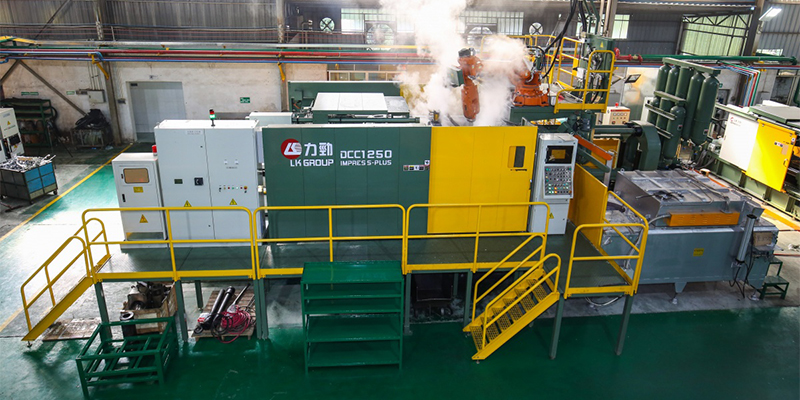
Cold Chamber vs. Hot Chamber HPDC
Before diving into the steps, it is important to clarify that aluminum automotive parts are exclusively cast using the Cold Chamber process.
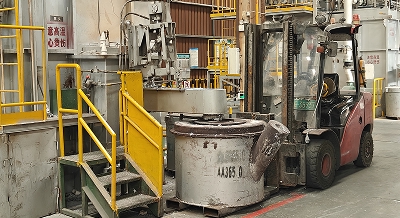
Because molten aluminum has a high melting point (around 660°C) and is highly corrosive to steel, it would rapidly destroy the pumping mechanisms used in hot chamber machines. Instead, in cold chamber HPDC, the molten aluminum is kept in a separate holding furnace and ladled into the machine’s shot sleeve for each individual cycle.
The 6 Steps of the HPDC Process
Step 1: Melting and Degassing
The process begins in the furnace. Aluminum ingots (such as ADC12 or AlSi10MnMg) are melted down.
Insight from the foundry floor: Melting the metal is easy; keeping it pure is hard. Molten aluminum absorbs hydrogen gas from the atmosphere. If this gas isn’t removed via rotary degassing before casting, it will form severe gas porosity in the final part.
Step 2: Die Preparation and Lubrication
The two halves of the steel mold (the fixed die and the moving die) are cleaned and sprayed with a release agent.
This step is not just about preventing the aluminum from sticking to the steel. The spray acts as critical thermal management, cooling specific areas of the die to ensure the molten metal solidifies evenly. Uneven cooling leads to thermal warpage, a major risk for large-format components likeEV Battery Trays.
Step 3: The Injection (The Shot)
Once the die is locked under immense pressure (clamping force), a robotic ladle pours the molten aluminum into the shot sleeve. A plunger then forces the metal into the die cavity. This happens in two distinct phases:
- The Slow Shot: The plunger moves slowly to push the metal past the pouring hole and allow air in the sleeve to escape, preventing air entrapment.
- The Fast Shot (Intensification): Once the metal reaches the gating system, the plunger accelerates violently—often exceeding 5 meters per second. The cavity is filled in milliseconds under thousands of PSI of pressure.
Note on Vacuum HPDC: For parts requiring absolute airtightness, elite foundries pull a vacuum on the mold cavity right before the fast shot. This extracts trapped air, drastically reducing micro-porosity.
Step 4: Cooling and Solidification
Once the cavity is full, the pressure is maintained (intensification) while the metal solidifies. This forces extra metal into the mold to compensate for volumetric shrinkage as the aluminum cools. Internal cooling lines (water jackets) designed into the tool extract heat rapidly, dictating the overall cycle time.
Step 5: Ejection
The die opens, and ejector pins uniformly push the solidified casting out of the mold. The design of these pins and the draft angles (tapers) on the part’s walls are critical. Insufficient draft angles will cause the part to drag against the steel, creating galling or bending the component during ejection.
Step 6: Trimming and Secondary Operations
The ejected part is not a finished component. It comes out attached to the "biscuit" (the excess metal in the shot sleeve), runners, and overflow wells.
This excess flash is sheared off using a mechanical trim press. Afterward, the part moves to secondary operations, such as shot blasting for a uniform surface finish, and precision 5-axis CNC machining to achieve tight positional tolerances for bearing bores and O-ring sealing grooves.
Why Machine Tonnage Isn’t Everything
When buyers audit a supplier, they often ask, "What is your maximum machine tonnage?" While having large machines (like 3050T or 4500T presses) is necessary for large parts, tonnage only refers to the clamping force keeping the mold shut.
The real differentiator in die casting quality is process control.
Maintaining the perfect PQ2 diagram (the relationship between pressure and flow rate), managing tool temperatures, and utilizing advanced metallurgical standards—often defined by organizations like the North American Die Casting Association (NADCA)—are what actually prevent cold shuts, blisters, and dimensional inconsistencies.
Ensure Your Design is Ready for Mass Production
High pressure die casting is an unforgiving process. A wall that is too thick will cause shrink porosity; a feature without enough draft will destroy the mold.
At EMP Tech, we believe quality is engineered before steel is ever cut. If you are developing a new powertrain or structural component, upload your CAD (STEP/IGES) to our engineering team. We provide predictive Moldflow analysis and a strict Design for Manufacturability (DFM) review to ensure your part can be cast reliably, efficiently, and to exact OEM specifications.


