

Choosing the best die cast aluminum housing starts with knowing what your project needs. People want strong, light, and cheap options. Aluminum is good because it does not break easily. It is also light and handles heat and electricity well. You should match these features to your project. This helps you avoid problems later. Take each step slowly. This will help you feel sure about your final choice.
Key Takeaways
Know what your project needs. Think about the size, weight, and how you will use it. This helps you pick the right die cast aluminum housing.
Pick the right aluminum alloy. Each alloy has its own strength and fights rust in different ways. This changes how long it lasts and how well it works.
Check the environment. Look at things like heat, wetness, and if there are chemicals. This helps make sure the housing will last a long time.
Look at the design features. Notice the shape, wall thickness, and draft angles. These things help make the part strong and easy to build.
Pick a supplier you can trust. Make sure they have good quality checks and certifications. This helps you get good die cast aluminum housings.
Project Requirements
Picking the right die cast aluminum housing means knowing your project needs. Each job needs something different. You must think about size and weight. You also need to know how it will be used. The place where it works matters too. Let’s look at each part.
Size and Weight
Size and weight are very important. The right size helps the part work well. It should not be too heavy. In cars and electronics, housings come in many sizes. They also have different weights. Here is a table that shows some common ranges:
Specification | Range |
|---|---|
Minimum part weight | 0.017 kg |
Maximum part weight | 12 kg |
Minimum part size | ∅ 17 mm × 4 mm |
Maximum part size | 400 mm × 300 mm |
Minimum wall thickness | 0.5 mm |
Maximum wall thickness | 12.7 mm |
Tolerance class for casting | ISO 8062 ST5 |
Tip: Always make sure the housing fits your space. Check if it meets the weight rules for your machine.
A lighter die cast aluminum housing helps a lot. These housings are much lighter than steel ones. This makes moving parts work better. It also saves energy. Air use can drop by 20%. Machines work faster. Factories can save energy every year. In packaging machines, alloys like ADC12 or A380 help the housing stay strong. They do not bend or break easily, even when used a lot.
Application Needs
Each project needs something special. Some need high strength. Others need tight fits or good heat control. Here are some things people look for in die cast aluminum housing:
Requirement Type | Description |
|---|---|
Mechanical properties | |
Dimensional tolerances | ISO 2768 makes sure parts fit together well. |
Testing methods | Ways to check the metal’s makeup and strength. |
Industry-specific standards | Extra rules for special jobs, like IATF 16949 for car parts. |
Different features help with these needs:
Feature | Description | Application Impact |
|---|---|---|
Lightweight | Easier to move and put in place. | |
High Precision | Tolerances as close as +/- 0.05 mm. | Needed for things like airplane parts. |
Thermal Conductivity | Alloys like A356 move heat well (150 W/m·K). | Helps motors and electronics stay cool. |
Electrical Conductivity | Good for electric car motors and other electric uses. | Makes sure electricity moves safely and well. |
Fatigue Strength | Alloys like A380 last longer under stress. | Good for machines that run a lot or carry heavy loads. |
Note: Always match the housing’s features to your project. A motor housing may need good heat control. A sensor case may need high precision.
Environmental Factors
The place where the housing works can change how long it lasts. Some places have more pollution, water, or heat. These things can cause rust or wear. Here are some things to think about:
Alloy composition: Some alloys fight rust better.
Surface finish: Smooth surfaces protect the metal.
Temperature: High heat can make metal weaker.
Humidity and moisture: Too much water can cause rust.
Surface treatment and coating: Special coatings help stop damage.
Chemicals: Some chemicals can eat away at the housing.
Mechanical stress: Scratches or dents can make it weaker.
Cleaning methods: Strong cleaners can remove protection.
Changes in temperature and humidity also matter. Cold can make the housing stronger but less bendy. Heat can make it weaker but easier to bend. The modulus of elasticity stays about the same. But strength and bendiness can change with the weather.
Tip: Always think about where the housing will be used. If it faces tough weather or chemicals, pick an alloy and finish that can handle it.
By thinking about size, weight, what you need, and the environment, you can pick the best die cast aluminum housing for your project.
Die Cast Aluminum Housing Design
Design is very important for how well a die cast aluminum housing works. The shape, thickness, and small details all make a difference. Let’s look at the main design features and see how they change the final product.
Part Geometry
The shape of a part affects how easy it is to make and how strong it is. Designers must think about how aluminum moves and cools in the mold. If the shape is too hard, the metal might not fill every space. It could also cool in a strange way. This can make weak spots or mistakes.
Aluminum alloys work best with shapes that help the metal cool evenly.
Designers often change the shape many times to match how aluminum cools.
Shapes that are good for casting help the housing stay strong and high quality.
The castability geometry, or the shape made for casting, helps the metal fill the mold and cool without trouble. It also changes how heat moves through the part and the mold. Good shapes mean fewer problems like shrinking or bending.
Hard shapes can cost more and slow down making the part. Fancy designs, thin walls, undercuts, and tight fits make the mold harder to build. This can mean longer wait times and more chances for mistakes.
Hard molds take more time to make.
More details mean higher costs.
Problems with quality can happen with tricky shapes.
Wall Thickness
Wall thickness is important for strength and weight. If the walls are too thin, the metal might not fill the mold. If they are too thick, the part can cool in a strange way and get problems. Designers must pick the right thickness for the job.
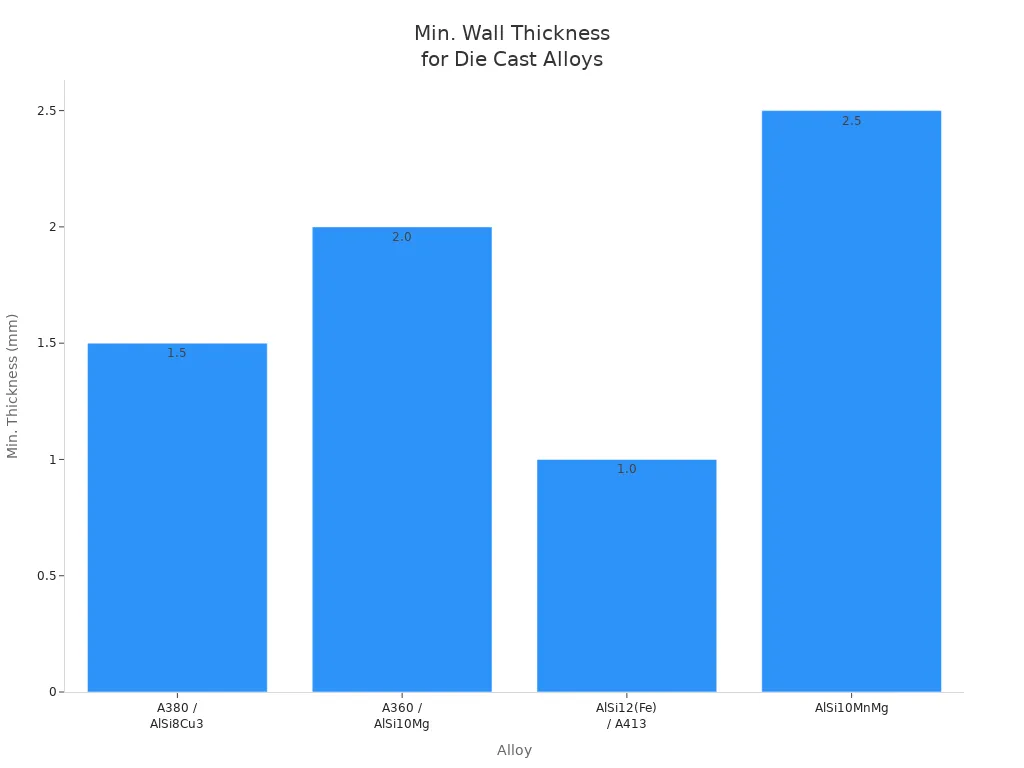
Here’s a table showing common wall thicknesses for different aluminum alloys:
Alloy | Common Application | Min. Rec. Thickness (mm) | Key Consideration |
|---|---|---|---|
A380 / AlSi8Cu3 | General Purpose, Housings | 1.5 – 2.0 | Good balance of castability and properties. |
A360 / AlSi10Mg | High Corrosion Resist. | 2.0 – 2.5 | Less fluid, requires careful design. |
AlSi12(Fe) / A413 | Very Thin Sections | 1.0 – 1.5 | Excellent fluidity, but lower strength. |
AlSi10MnMg | Structural Parts | 2.5 – 3.0 | Good strength and ductility, needs uniform walls. |
Wall thickness also changes the chance of problems. Uneven thickness can cause things like holes, bending, and cracks. Thin walls might cool too fast. Thick walls cool slowly and can trap gas. Here’s a quick look at common problems:
Defect Type | Cause of Defect | Impact on Product Quality |
|---|---|---|
Porosity | Thick sections cool slowly, leading to voids due to inadequate feeding. | Compromises mechanical properties and finish. |
Warping | Inconsistent cooling rates cause distortion in the final shape. | Affects fit and function of the part. |
Cracking | Internal stresses from uneven solidification lead to fractures. | Reduces structural integrity. |
Shrinkage Porosity | Thick areas contract more, leading to voids if not properly fed. | Weakens the overall structure. |
Hot Tears | Different cooling rates between thick and thin sections create internal stress. | Can lead to catastrophic failure. |
Tip: Designers should keep wall thickness the same everywhere. This helps the die cast aluminum housing stay strong and look nice.
Draft Angles
Draft angles help the part come out of the mold easily. If there is not enough draft, the part can stick to the mold and get damaged. Draft angles also help keep the surface looking good.
Here’s a table with standard draft angle recommendations:
Surface Type | Typical Draft Angle (°) | Notes |
|---|---|---|
Polished Surfaces | 0.5° – 1° | For visible or aesthetic surfaces requiring finish. |
Textured / Matte | 1° – 3° | Rougher textures need larger draft. |
Internal Cavities | 2° – 3° | Prevents vacuum lock during ejection. |
Deep/Complex Pockets | 3° – 5° | Compensates for shrinkage drag. |
External Walls | 1° – 2° | Standard for most housing components. |
If the draft angle is too small, the part may stick to the mold. This makes it hard to take out and can hurt both the part and the mold. Scratches and dents can show up on the surface. Sometimes, the pins push too hard and leave marks. More force means deeper marks and a rougher finish.
Note: Good draft angles make it easier to remove the part and keep the surface smooth. They also lower the chance of damage and save time.
Undercuts
Undercuts are tricky features that make the mold more complex. They can cost more and slow down making the part. Designers should think hard before adding undercuts to a die cast aluminum housing.
Challenge | Description |
|---|---|
Increased Complexity | Undercuts require more intricate mold designs, complicating the manufacturing process. |
Cost Implications | The complexity of undercuts raises production costs due to additional labor and tooling requirements. |
Design Constraints | Undercuts limit design freedom, forcing compromises in part features and geometry. |
Assembly Difficulties | The presence of undercuts complicates assembly, requiring special tools or methods to align parts. |
Potential for Part Distortion | Uneven cooling rates caused by undercuts can lead to distortion, affecting part integrity. |
Undercuts can make putting parts together harder. Workers may need special tools or extra steps to line up the parts. The force needed to put parts together can also cause damage.
Hard molds for undercuts mean higher costs and longer times to make parts. Good tools help reduce waiting, but the best way to save money is to keep the design simple.
Tip: Designers should not use undercuts unless they are really needed. Simple shapes make the die cast aluminum housing easier and cheaper to make.
Surface Finish and Die Design
Surface finish matters for both looks and how the part works. A smooth finish protects against rust and makes the part look better. Die design changes how the metal moves and cools. Good die design means fewer problems and a better final part.
Designers should work with manufacturers to make sure the die cast aluminum housing meets all needs. They should balance shape, wall thickness, draft angles, and undercuts for the best results.
Material and Performance
Aluminum Alloy Selection
Picking the right aluminum alloy is very important. Each alloy has special strengths. Some alloys are better for hard jobs. Others work well for lighter tasks. The table below lists common alloys and their main properties:
Alloy Grade | Tensile Strength (MPa) | Yield Strength (MPa) | Elongation (%) | Brinell Hardness (HB) |
|---|---|---|---|---|
A380 | 200-250 | 110-130 | 1.5-3.0 | 75-85 |
A360 | 210-260 | 120-140 | 2.0-4.0 | 70-80 |
A413 | 190-240 | 100-120 | 2.0-3.5 | 75-85 |
B390 | 240-290 | 200-230 | <0.5 | 110-120 |
518 | 150-190 | 90-110 | 5.0-10.0 | 55-65 |
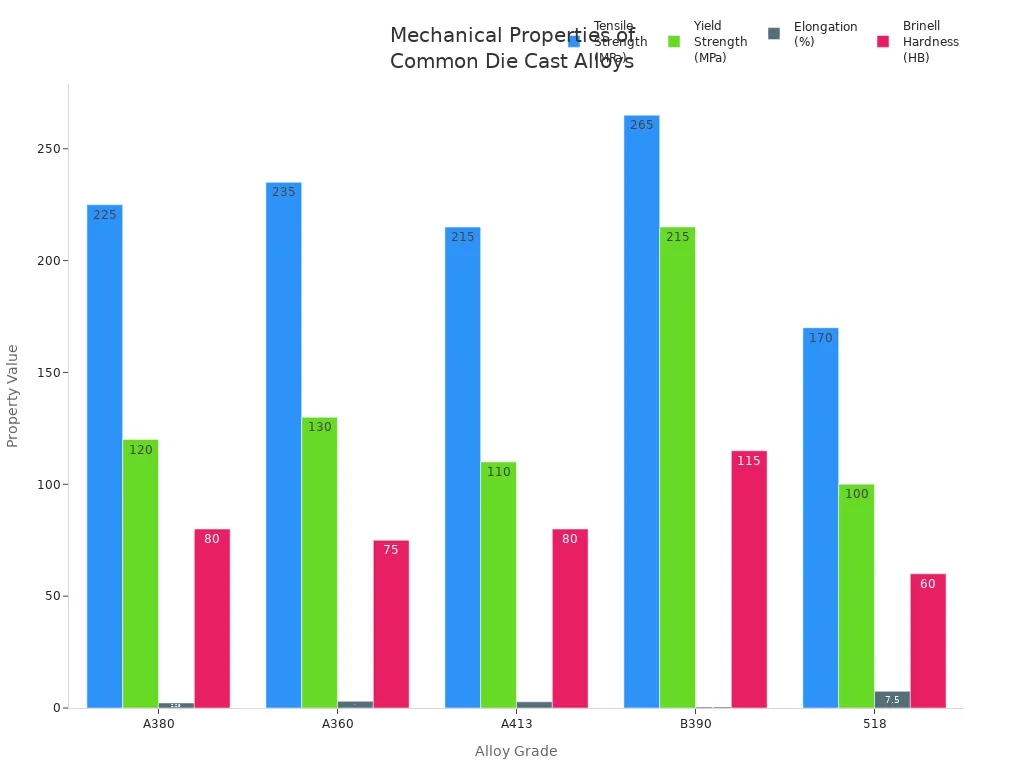
A360 and A356 are good at fighting rust. They are also strong. B390 is very hard and does not wear out fast. A380 is used for tough jobs because it is strong and not too expensive.
Corrosion Resistance
Rust can make a housing last less time. Some alloys do not rust as fast. A360 and A356 protect well in rough places. Passivation helps stop rust and keeps parts working longer. Car and electronics companies use this process to make parts last.
Here are some common treatments and what they do:
Treatment Type | Effectiveness | Additional Notes |
|---|---|---|
CastGuard™ Anodizing | Makes aluminum last longer in salty air | Helps aluminum die castings work for more years. |
Chromate Conversion | Good mix of price and protection | Works well for machines in factories. |
Powder Coating | Looks nice and protects well | Used for parts people see and touch. |
Passivation | Stops rust from starting | Needed for parts in busy industries. |
Tip: Always check if the housing will be near salty air or chemicals. These things make rust happen faster.
Heat Dissipation
Aluminum moves heat away quickly. This keeps motors and electronics cool. Aluminum die castings have thermal conductivity of about 205 W/m·K. Steel only has 45–60 W/m·K. Good heat movement means less chance of overheating.
High thermal conductivity keeps things safe.
Electronics last longer when heat leaves fast.
Power converters and inverters work better with good heat control.
Note: Good heat movement protects important parts and helps the housing last longer.
Supplier Assessment
Picking the right supplier is just as important as picking the right housing. A good supplier helps your project go well and gives you parts that last a long time. Here are some ways to see if a supplier is a good fit for you.
Quality Control
Good quality control makes sure die cast aluminum housings work well. The best suppliers use many ways to find problems early. They make sure every part is made right.
Description | |
|---|---|
Inspecting Raw Materials | Checks the purity of aluminum before casting. |
Maintaining Mold Integrity | Keeps molds in good shape for consistent results. |
Temperature Monitoring | Watches heat levels to prevent defects like warping or porosity. |
Dimensional Checks | Uses precise tools to measure each part. |
Advanced Technologies | Uses real-time monitoring and automated inspection systems. |
Continuous Improvement | Reviews data and feedback to improve processes over time. |
Some suppliers use special tests that do not hurt the part, like using light to find tiny problems on the surface. They also use computer programs to guess where problems might happen before making the parts. The best suppliers check every step and always try to get better.
Certifications
Certifications show a supplier follows strict rules and cares about doing a good job. Look for these important certifications:
ISO 9001: This is a main certification for die cast aluminum housing makers.
IATF 16949: This is needed for car parts.
International standards: These show a supplier meets world quality rules.
Suppliers with these certifications, like GC Precision Die Casting and Fort Recovery Industries, show they follow high industry rules. Certifications help buyers feel sure the parts will be safe and work well.
EMP Tech Support
EMP Tech is known for great support and custom help. They give many services, from design to finishing. Here is what they offer:
Description | |
|---|---|
Die-Casting Tooling | Designs and builds molds for each project. |
Post-Processing | Adds finishing touches after casting. |
CNC Machining | Shapes parts to exact sizes and needs. |
Welding | Joins parts for extra strength. |
Surface Treatment | Improves durability and appearance. |
EMP Tech makes custom parts for cars, like electric vehicle controller housings. Their team uses new technology and offers many services in one place. This makes them a great choice for projects that need special designs and high quality.
Picking the right die cast aluminum housing needs good planning. Here are the main steps you should follow: First, figure out the size, weight, and what your project needs. Next, look at how well it handles heat and the place it will be used. Then, pick the best alloy and finish so it stays strong and does not rust. Last, check if the supplier has good quality and the right certificates.
A good supplier makes everything simpler. EMP Tech is a great choice because they have lots of experience, many services, and the best tools:
What EMP Tech Offers | Why It Matters |
|---|---|
They know how to help with any project | |
One-stop service | You get help from the start to the end |
IATF16949 certification | They follow tough rules for quality |
Advanced equipment | They can make big or tricky parts |
You get the best results when you pick the right housing for your project and work with people who know what they are doing.


