

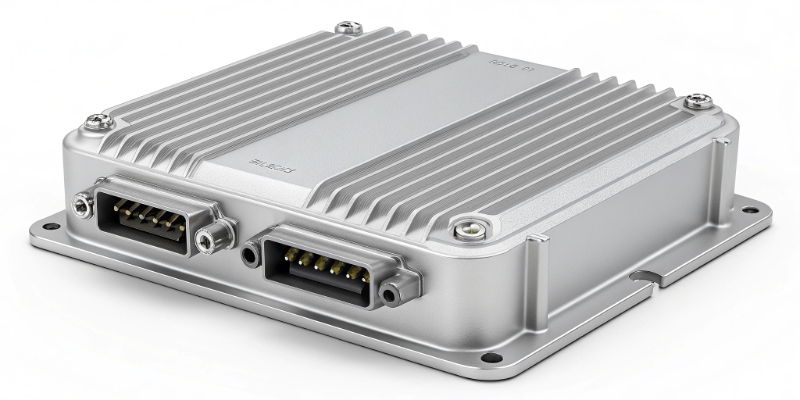
In the era of vehicle electrification and autonomous driving, the Electronic Control Unit (ECU) has evolved from a simple component to the "brain" of the vehicle. As these systems become more powerful, they generate more heat and require robust protection. This is where ECU housing aluminum casting becomes a critical manufacturing process.
For automotive OEMs and Tier 1 suppliers, choosing the right material and manufacturing partner for ECU enclosures is vital to ensure the longevity and reliability of sensitive electronics. At EMP Tech, we specialize in high-pressure die casting (HPDC) to produce lightweight, durable, and thermally efficient ECU housings that meet rigorous IATF 16949 standards.
Why Aluminum is the Standard for ECU Housings
While plastic and steel are used in automotive manufacturing, ECU housing aluminum casting remains the preferred choice for onboard computers, battery management systems (BMS), and ADAS controllers.
Here are the three engineering reasons why aluminum die casting is superior:
- Thermal Management (Heat Dissipation): Modern ECUs generate significant heat. Aluminum alloys (like ADC12 or AlSi10Mg) offer excellent thermal conductivity, acting as a natural heat sink to transfer heat away from the PCB and prevent overheating.
- EMI/RFI Shielding: Automotive environments are noisy with electromagnetic interference. Aluminum provides natural EMI shielding, protecting sensitive data signals without the need for expensive conductive coatings required by plastic housings.
- Durability & IP Rating: Die-cast aluminum provides a rigid, non-corrosive structure that maintains tight tolerances for sealing (IP67/IP68), protecting electronics from water, dust, and vibration.
Material Comparison: Aluminum vs. Plastic vs. Steel
To help procurement teams justify the choice of material, we have compared the key attributes relevant to ECU manufacturing:
| Feature | Aluminum Die Casting | Engineering Plastic | Stamped Steel |
|---|---|---|---|
| Thermal Conductivity | High (Excellent for cooling) | Low (Insulator) | Medium |
| EMI Shielding | High (Natural property) | None (Requires plating) | High |
| Weight | Lightweight | Very Lightweight | Heavy |
| Design Complexity | High (Complex fins/bosses) | High | Low (Simple shapes only) |
| Durability | High | Medium (Brittle over time) | High (Prone to rust) |
The Manufacturing Process: Ensuring Zero Defects
Producing a high-quality ECU housing aluminum casting requires more than just melting metal. It requires precise control over the entire die-casting process to prevent common issues like porosity, which can lead to leaks.
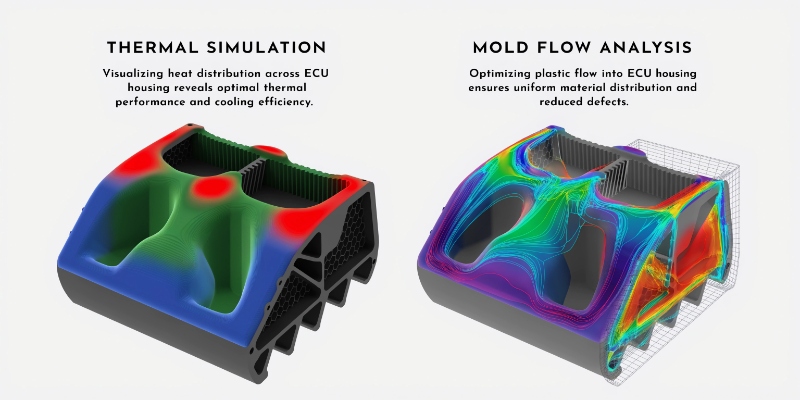
1. DFM and Flow Simulation
Before cutting the mold, we use mold flow simulation software to analyze filling patterns. This allows us to optimize gate locations and overflow wells to minimize air entrapment, ensuring a dense microstructure.
2. High-Pressure Die Casting (HPDC)
We utilize advanced cold chamber die casting machines ranging from 280T to 800T. By controlling the injection speed and pressure intensification, we produce housings with thin walls and complex cooling fin geometries without sacrificing strength.
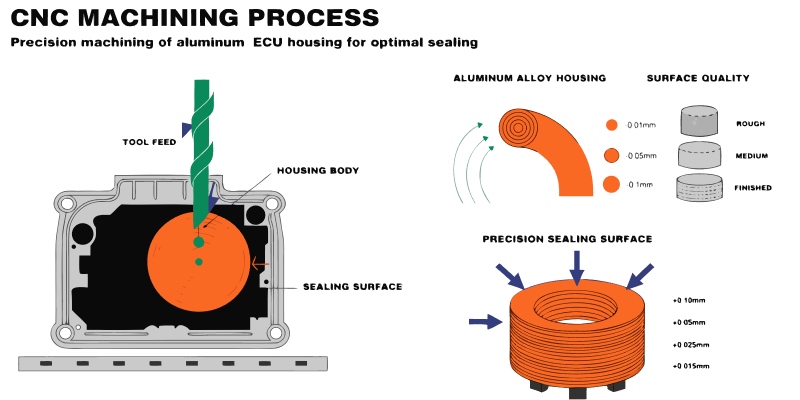
3. Precision CNC Machining
The sealing surface of an ECU housing must be perfectly flat to ensure the gasket works correctly. Our in-house CNC centers mill the mating surfaces to micron-level flatness tolerances, ensuring the final assembly is waterproof.
4. Leak Testing & Surface Treatment
Every ECU housing aluminum casting undergoes rigorous testing. We perform air decay leak testing on 100% of critical parts. Finally, parts undergo passivation or e-coating to withstand salt spray tests (up to 720+ hours) for under-hood corrosion resistance.
Applications in Modern Vehicles
Our die-cast solutions support a wide range of automotive electronic applications:
- Engine Control Modules (ECM/ECU): The core computer for internal combustion engines.
- New Energy Vehicle (NEV) Components: Inverter housings, DC-DC converter boxes, and Battery Management System (BMS) covers.
- ADAS Modules: Housings for radar, lidar, and camera processing units requiring high heat dissipation.
Partner with an IATF 16949 Certified Expert
When sourcing ECU housing aluminum casting, you need a partner who understands the difference between a "good part" and an "automotive-grade part."
At EMP Tech, we combine advanced manufacturing technology with strict quality control to protect your electronics in the harshest environments.
Ready to optimize your ECU design for mass production?
Contact our engineering team today for a free DFM (Design for Manufacturing) review and quote.
Email: [email protected]


