

From the smartphone in your pocket to the car you drive, countless everyday objects are made possible by advanced manufacturing processes. One of the most crucial of these is aluminum alloy die casting. An aluminum alloy die casting factory is a specialized facility dedicated to creating precise, complex, and durable metal parts by injecting molten aluminum into a reusable mold under high pressure. This guide explores the entire world of aluminum die casting, explaining the process, its benefits, and how to choose the right factory for your needs.
A robotic arm handling a freshly made aluminum part in a die casting factory.
Image alt text: A robotic arm moving a complex aluminum alloy die cast part within a factory setting, with die casting machinery in the background.
What is Aluminum Alloy Die Casting?
Aluminum die casting is a manufacturing process used to produce accurately defined metal parts with smooth or textured surfaces. The process begins by melting ingots of aluminum alloy at extremely high temperatures. This molten metal is then forced into a steel mold, also known as a die, under significant pressure. After the aluminum solidifies, the two halves of the die are separated to reveal the newly created part. Because the steel dies can be used over and over, this method is exceptionally efficient for mass production.
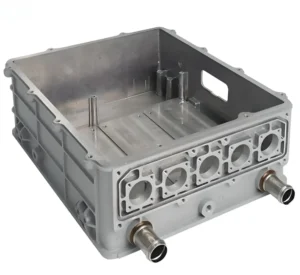
This process is renowned for its ability to create complex shapes with thin walls and tight tolerances that other manufacturing methods cannot easily achieve. The resulting products are lightweight yet strong, with a high-quality surface finish that often requires minimal secondary machining.
The Advantages of Using an Aluminum Alloy Die Casting Factory
Choosing aluminum for die casting offers a multitude of benefits that make it a preferred material across countless industries.
- Lightweight and Strong: Aluminum alloys boast an excellent strength-to-weight ratio, making parts durable without adding unnecessary bulk. This is critical in industries like automotive and aerospace for improving fuel efficiency.
- High Dimensional Accuracy: The process produces parts with exceptional precision and stability, which is vital for components that need to fit together perfectly.
- Corrosion Resistance: Aluminum is naturally resistant to corrosion, enhancing the longevity and reliability of the final products.
- Excellent Conductivity: With high thermal and electrical conductivity, aluminum is an ideal choice for electronic components and heat sinks.
- Complex Geometries: Die casting is perfect for producing intricate parts with thin walls, offering designers significant flexibility.
- Cost-Effective for High Volumes: The rapid production cycle and the reusability of the dies make aluminum die casting a highly economical solution for large-scale production.
- Superior Surface Finish: Parts come out of the mold with a very smooth surface, reducing the need for post-production finishing.
Molten aluminum being poured into a die casting machine.
The Step-by-Step Aluminum Die Casting Process in a Factory
While the concept is straightforward, the process within an aluminum alloy die casting factory is a precise sequence of events.
- Die Preparation: The steel die is cleaned and lubricated to ensure the final part can be removed easily and to help regulate the die’s temperature.
- Melting: High-quality aluminum alloy ingots are melted in a separate furnace to a precise temperature. Because aluminum has a high melting point, this is typically done in a "cold chamber" machine, where the melting pot is separate from the injection mechanism.
- Injection: A specific amount of molten aluminum is ladled into the machine’s shot chamber. A hydraulic piston then injects the metal into the die cavity at high speed and pressure.
- Cooling and Solidification: The molten aluminum cools and solidifies rapidly within the water-cooled die.
- Ejection: Once the part has hardened, the two halves of the die are opened, and an ejection mechanism, typically using pins, pushes the casting out.
- Trimming: The finished part, which may have some excess material called "flash," is trimmed. Any additional required finishing, such as deburring, sanding, or powder coating, is then performed.
Common Applications of Aluminum Die Cast Parts
Thanks to its versatility, aluminum die casting is indispensable to numerous industries.
- Automotive: This is one of the largest sectors, using die casting for engine blocks, transmission housings, pistons, and other structural parts to reduce vehicle weight and improve performance.
- Aerospace: Lightweight and high-strength components are crucial for aircraft performance and fuel efficiency.
- Electronics: Die casting is used to create durable and lightweight enclosures, connectors, and heat sinks for computers, smartphones, and telecommunications equipment.
- Consumer Goods: From kitchen appliances and power tools to outdoor furniture, die casting provides the strength and finish required for everyday products.
- Industrial Equipment: The process is used to manufacture components for machinery, lighting systems, and hydraulic equipment.
How to Choose the Right Aluminum Alloy Die Casting Factory
Selecting the right manufacturing partner is crucial for ensuring product quality, managing costs, and maintaining an efficient supply chain. Here are key factors to consider:
- Experience and Specialization: Look for a factory with a proven track record and experience in your specific industry, whether it’s automotive, medical, or electronics.
- Manufacturing Capabilities: Ensure the manufacturer has the right equipment, such as a range of die casting machine sizes (tonnage), and can handle your required production volume.
- Quality Control and Certifications: A reputable factory will have strict quality control processes, including X-ray inspections and CMM (Coordinate Measuring Machine) checks. Look for certifications like ISO 9001.
- Technical Expertise: The factory should be able to provide design and engineering support to help optimize your part for manufacturing, potentially saving you time and money.
- Communication and Transparency: Choose a partner that is responsive, communicates clearly, and is transparent about its processes. Don’t hesitate to ask for samples or a tour of their facility.


