

In the competitive world of automotive manufacturing, component integrity is non-negotiable. As vehicles move toward lightweight designs to improve fuel efficiency and EV range, the demand for automotive aluminum parts has surged. However, one persistent challenge remains in the manufacturing process: porosity.
For engineers and procurement managers, finding a way to reduce porosity is critical for ensuring part durability, safety, and performance. This is where Vacuum High-Pressure Die Casting (V-HPDC) changes the game.
What is Porosity in Die Casting?
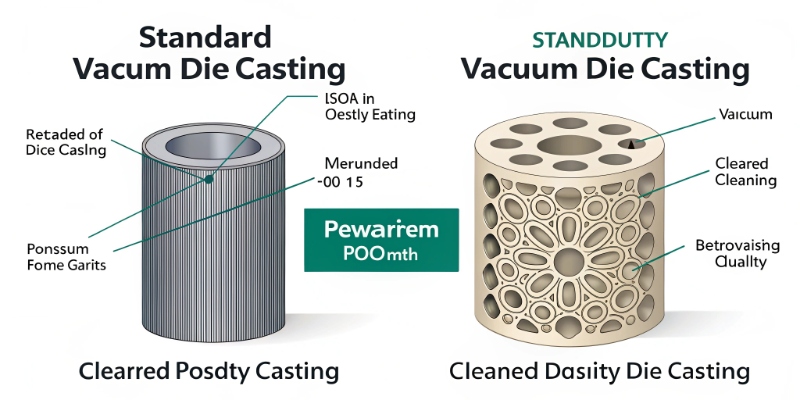
Before diving into the solution, it is essential to understand the problem. Porosity refers to the formation of voids or holes within a cast part. In standard High-Pressure Die Casting (HPDC), this typically occurs due to two main reasons:
- Gas Porosity: Air or lubricants get trapped inside the mold cavity during the high-speed injection of molten aluminum.
- Shrinkage Porosity: As the aluminum cools and solidifies, it shrinks; if the metal feed is insufficient, voids form.
While minor porosity is acceptable in cosmetic parts, it is a point of failure for structural automotive components like engine blocks, shock towers, and transmission cases.
How Vacuum High-Pressure Die Casting Works
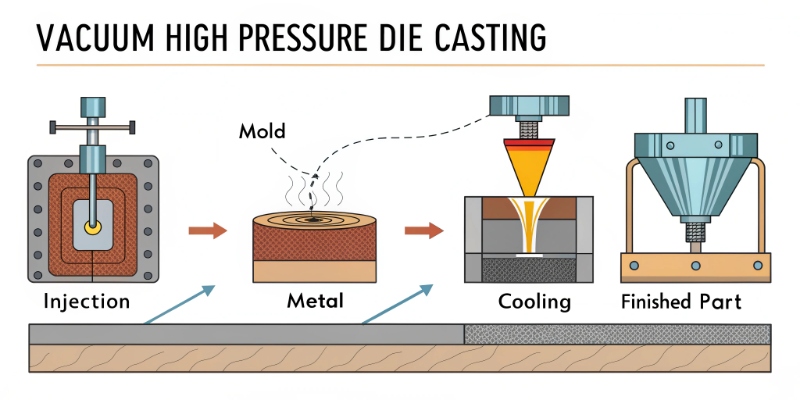
Vacuum High-Pressure Die Casting is an advanced variation of the standard HPDC process. The primary goal is to evacuate air and gases from the mold cavity before and during the injection of the molten metal.
The Process Steps:
- Sealing: The mold is tightly sealed to prevent air leakage.
- Evacuation: A vacuum system extracts air from the die cavity and the shot sleeve, creating a negative pressure environment.
- Injection: Molten aluminum is injected at high speed into the vacuumed cavity.
- Solidification: Because there is minimal air resistance, the metal fills the mold more densely.
By removing the air, we significantly reduce the back pressure, allowing the aluminum to flow more smoothly and solidifying with a much tighter microstructure.
Key Benefits of Vacuum HPDC for Automotive Parts
For an automotive aluminum parts manufacturer, adopting vacuum technology offers distinct advantages that translate directly to vehicle performance.
1. Superior Mechanical Properties
Vacuum die casting produces parts with higher density. This results in improved tensile strength and elongation. For structural parts (body-in-white components) that must absorb crash energy, this structural integrity is vital.
2. Enables Heat Treatment (T6)
This is the most significant differentiator. Standard die-cast parts generally cannot be heat-treated because the trapped gas bubbles will expand and blister the surface when heated.
Vacuum HPDC parts have minimal entrapped gas, allowing for solution heat treatment (T6) and welding. This opens the door for manufacturing complex structural components that require joining.
3. Enhanced Surface Finish
With reduced turbulence and gas entrapment, the surface finish1 of the casting is significantly smoother, reducing the need for extensive post-processing or machining.
Comparison: Standard HPDC vs. Vacuum HPDC
To help you understand the ROI of choosing vacuum die casting, here is a comparison of the technical capabilities:
| Feature | Standard HPDC | Vacuum HPDC |
|---|---|---|
| Porosity Level | Moderate to High | Extremely Low |
| Heat Treatability | Not Recommended (Blistering risks) | Suitable (T5, T6 possible) |
| Weldability | Poor | Excellent |
| Mechanical Strength | Standard | High Performance |
| Ideal Applications | Housing, Brackets, Cosmetic parts | Structural pillars, Engine blocks, Suspension parts |
Common Applications in the Automotive Industry
As a specialized manufacturer, we utilize vacuum high-pressure die casting for critical safety and performance components, including:
- Structural Body Parts: A-pillars, B-pillars, and longitudinal bearers.
- Chassis Components: Subframes, shock towers, and control arms.
- Powertrain: Transmission housings and complex engine blocks2 requiring high pressure tightness.
Conclusion: Partnering for Quality
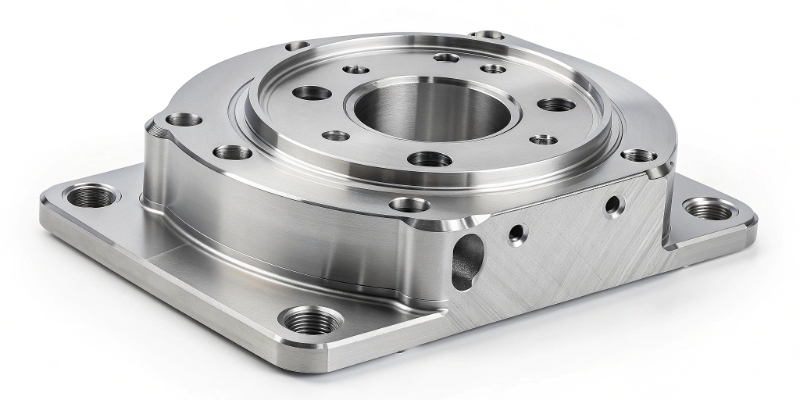
Reducing porosity is not just about aesthetics; it is about ensuring the safety and longevity of the vehicle. By leveraging Vacuum High-Pressure Die Casting, we deliver aluminum parts that meet the rigorous standards of modern automotive engineering—lightweight, strong, and defect-free.
If you are looking for a reliable manufacturing partner capable of producing weldable, heat-treatable, and low-porosity aluminum components, contact our engineering team today. Let’s drive innovation together.


