

Meta Description: essential guide to part design for die casting. Learn expert guidelines on draft angles, fillets, and uniform wall thickness for high-quality automotive aluminum parts.
In the competitive world of automotive aluminum die casting, the difference between a high-performance component and a failed production run often lies in the design phase. Design for Manufacturing (DFM) is crucial. By optimizing your 3D models specifically for the high-pressure die casting (HPDC) process, you can reduce cycle times, minimize defects like porosity, and extend die life.
This guide covers the three pillars of successful die casting part design: Uniform Wall Thickness, Draft Angles, and Fillets.
1. Uniform Wall Thickness: The Foundation of Quality
Achieving a uniform wall thickness is arguably the most critical rule in die casting design. The molten aluminum needs to flow smoothly into the mold and cool at a consistent rate.
Why Uniformity Matters
- Consistent Cooling: If walls are uneven, thin sections cool faster than thick ones. This uneven cooling creates internal stresses, leading to warping or cracking.
- Porosity Reduction: Thick sections (thermal mass) are prone to shrinkage porosity because they solidify last, leaving pockets of air or vacuum inside the part.
- Flow Optimization: Sudden changes in thickness can cause turbulence in the metal flow, resulting in cold shuts or incomplete fills.
Design Guidelines for Aluminum
For automotive aluminum parts, maintaining a consistent wall thickness ensures structural integrity and weight reduction.
| Feature | Guideline |
|---|---|
| Ideal Thickness | 2.5 mm to 4.0 mm (standard range) |
| Minimum Thickness | ~1.5 mm (depending on part size) |
| Gradual Transitions | If thickness must change, use a transition length at least 3x the difference in wall thickness. |
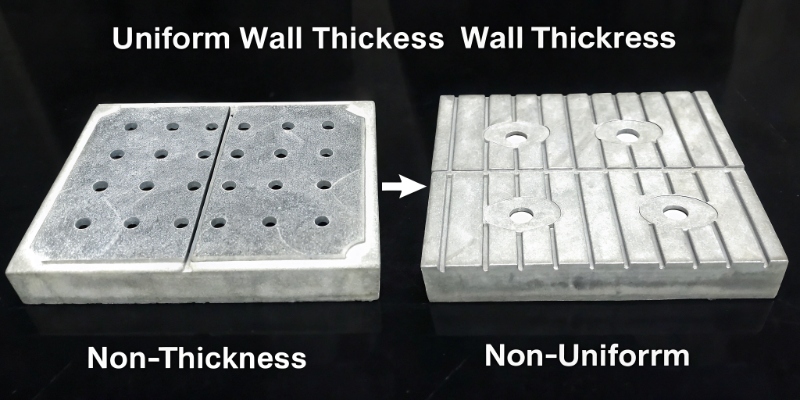
Pro Tip: If a specific area requires more strength, use ribs (reinforcement structures) rather than increasing the entire wall thickness. Ribs add stiffness without adding excessive mass or creating hot spots.
2. Draft Angles: Ensuring Smooth Ejection
Draft is the slight taper added to the vertical walls of the casting. Without sufficient draft, the part will bind to the die due to the shrinkage of the metal as it cools, causing drag marks or damaging the ejection system.
Understanding Internal vs. External Draft
- Internal Walls: As aluminum cools, it shrinks onto inner mold cores. Therefore, internal features require more draft to release easily.
- External Walls: The metal shrinks away from the outer cavity walls, so they typically require less draft than internal features.
Recommended Draft Angles for Aluminum Die Casting
| Feature Type | Standard Draft Angle | Note |
|---|---|---|
| Outer Walls | 1° to 2° | Shrinks away from the mold |
| Inner Walls / Cores | 2° to 3° | Shrinks onto the mold |
| Cored Holes | 2° per side | Critical to prevent core pin breakage |
Ignoring proper draft angles often leads to:
- Stuck castings.
- Bent ejector pins.
- Scuffed surface finishes (drag marks).
3. Fillets and Radii: Strengthening the Geometry
Sharp corners are the enemy of die casting. They create stress concentrations in the part and hinder the smooth flow of molten metal. Introducing fillets (rounded internal corners) and radii (rounded external corners) is essential.
Benefits of Generous Radii
- Stress Distribution: Fillets distribute mechanical stress over a larger area, preventing cracks under load—critical for automotive safety parts.
- Improved Metal Flow: Molten aluminum flows more easily around curved corners than sharp 90-degree turns, reducing turbulence and air entrapment.
- Extended Die Life: Sharp corners in the steel tool (mold) are prone to heat checking (thermal fatigue). Rounding these corners reduces thermal shock on the die steel.
4. Optimization for Automotive Aluminum Parts
In the automotive industry, the push for lightweighting (replacing steel with aluminum) makes these design rules even more pertinent.
- Weight Reduction: By adhering to uniform wall thickness and using ribs effectively, you reduce part weight, contributing to better fuel economy or EV range.
- Surface Finish: Proper drafts and fillets ensure a surface finish suitable for subsequent plating or painting without extensive machining.
Quick Checklist for Automotive Designers
- [ ] Is the wall thickness consistent (approx. 3mm)?
- [ ] Do all vertical walls have at least 1-2° of draft?
- [ ] Are all sharp corners replaced with fillets (min R1.0mm)?
- [ ] Are heavy masses cored out or supported by ribs?
Frequently Asked Questions (FAQ)
Q: What is the minimum wall thickness for aluminum die casting?
A: generally, the minimum wall thickness for aluminum die casting is around 1.5 mm to 2.0 mm for small to medium parts. However, for larger automotive components, 2.5 mm to 3.0 mm is recommended to ensure proper fill.
Q: Can I have zero draft on a die cast part?
A: No. Zero draft will cause the part to seize in the mold during ejection. If a vertical face is required for assembly, it must be achieved through secondary machining operations.
Q: How do fillets affect the cost of the die casting mold?
A: Including fillets actually reduces long-term costs. While the initial CNC machining of the mold might take slightly longer, fillets prevent premature die failure (heat checking) and reduce scrap rates from casting defects, saving money over the life of the project.
Need expert advice on your next automotive project?
As a specialized die-casting manufacturer for automotive aluminum parts, we can help review your designs for manufacturability. Contact our engineering team today to optimize your part design for quality and cost-efficiency.


