

A coolant pump housing comes back for one of three reasons: the bearing bore is out of round, the seal face is not square to that bore, or the gasket land leaks. In water pump housing die casting the question is not whether the part can be cast, because a 1.2 kg ADC12 housing is routine. It is which surfaces are machined, in how many setups, and what the leak test proves. Automotive die casting sets the process window; the drawing sets the cost.
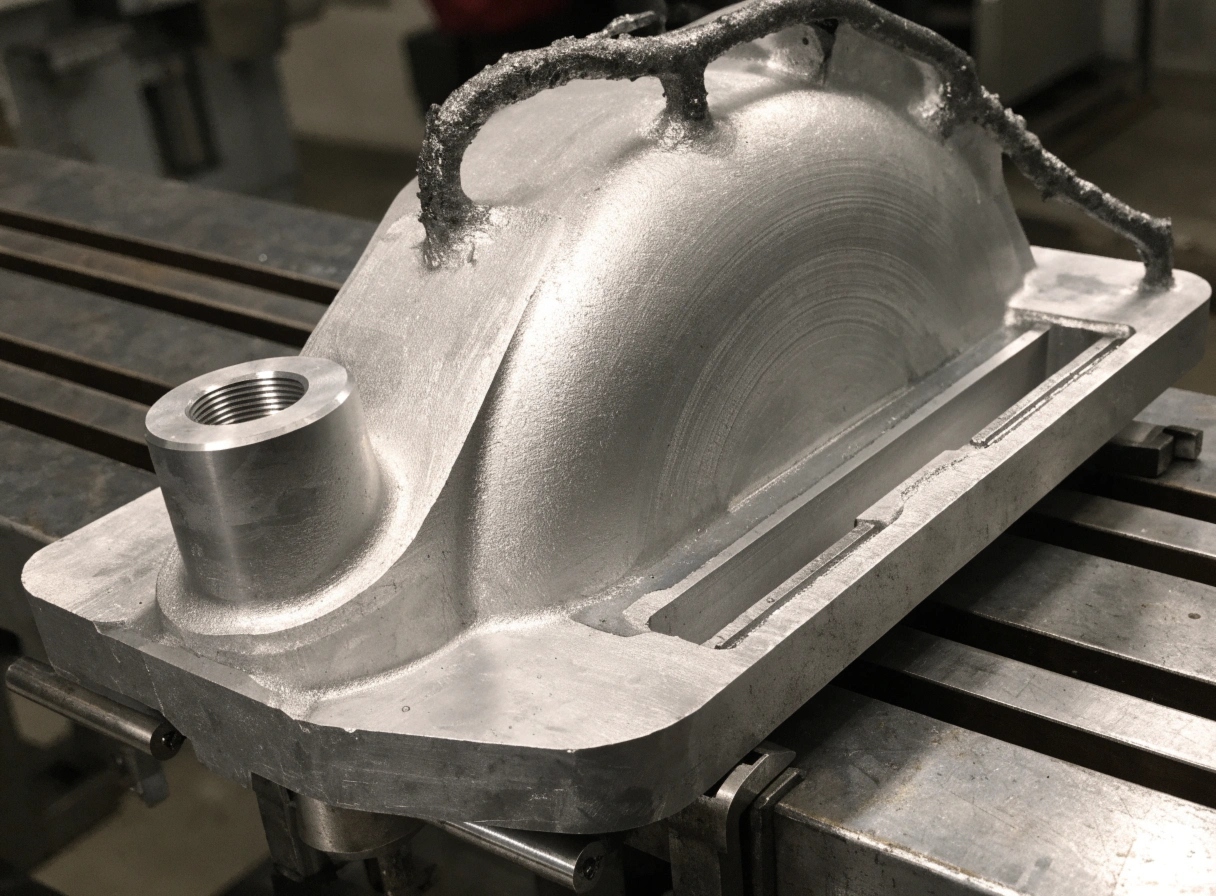
What a water pump housing has to hold
A pump housing has to locate a bearing, square a seal to that bearing, clamp a gasket and contain pressure at the same time, and the casting process controls only part of each. The table separates what the die decides from what the machining decides.
| Feature | Typical requirement | Set by | Process control | Evidence |
|---|---|---|---|---|
| Bearing bore | Roundness 0.01–0.02 mm, Ra 0.8–1.6 µm, Cpk ≥ 1.33 | Machining | Bore and seal seat in one setup; clamp on the mounting pads | CMM roundness and cylindricity |
| Seal counterface | Flatness 0.02–0.05 mm, square to the bore within 0.03–0.05 mm, Ra 0.4–0.8 µm | Machining | Same setup as the bore; finish pass after roughing | CMM plus runout on a mandrel |
| Gasket land | Flatness about 0.05 mm across the land, Ra 1.6–3.2 µm, no surface porosity | Machining and casting | Machined land; thermal balance at the bolt bosses | Pressure decay and dye penetrant |
| Volute passage | As-cast Ra 2–6 µm, no cold shut or lap | Casting | Fill pattern, die temperature, vacuum | Visual and flow bench |
| Pressure boundary | Leak-tight at 0.2–0.3 MPa for the specified dwell | Casting and machining | Vacuum-assisted fill, gate placement, wall section | 100% pressure decay; helium where tighter |
The numbers are typical for a passenger-car coolant pump, not a specification. The drawing and the customer’s test standard win every argument.
Bore roundness and the bearing seat
A bearing bore is machined, never cast, and its roundness is decided by clamping and the finish pass rather than by the die. Die casting leaves 1–2 mm of stock, and boring the bore in the same setup as the seal seat keeps the two coaxial.
Roundness matters more than diameter when the bearing is a press fit. A bore that measures 30.00 mm across two axes but is oval by 0.02 mm prints that oval into the outer race, and the shaft runs with a load it was not designed for. The failure shows up later as bearing noise, seal runout or a drain-hole weep.
Clamping is the hidden variable: a fixture that squeezes a thin wall closes the bore while the tool cuts it, then releases it out of round. We clamp on the mounting pads, rough and finish in one setup, and measure with the part free: ±0.05 mm and Cpk ≥ 1.33 on a functional bore, 1.67 on a safety-critical shaft seat.
Seal faces, gasket lands and the volute surface
A seal face leaks along the shortest path between two surfaces, so flatness, roughness and squareness describe one path. A 0.05 mm flatness number means little if the face is tilted to the bore: the mechanical seal counterface has to be square to the shaft within 0.03–0.05 mm, or the lips run eccentric and pump air.
Two flatness numbers on the same drawing cause most arguments. An as-cast sealing face on a large housing is quoted at 0.3–0.5 mm depending on face size, because a die will not hold better over 300 mm. A machined gasket land is a different promise, typically 0.05 mm across the land. If the drawing gives one number for both, ask which surface it applies to.
Porosity under the gasket land is the leak path a flatness check misses: a land can be flat and still weep through a pore that connects the coolant passage to the outside. That is why the pressure test comes after machining, and why die castings fail leak tests for reasons unrelated to the seal.
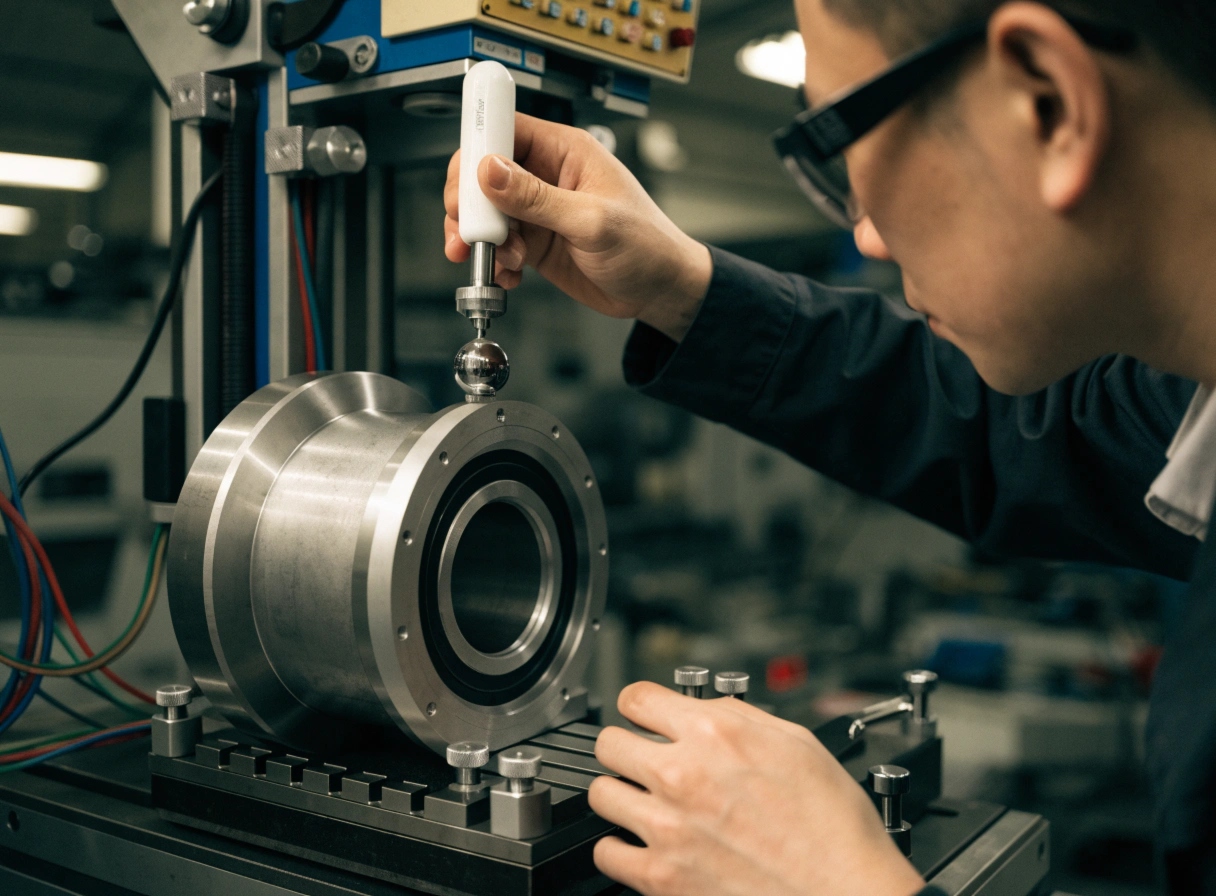
An as-cast Ra of 2–6 µm is adequate for a coolant pump volute; the losses that matter sit at the impeller clearance, the inlet and the cutwater, not in the middle of the passage. Machining the volute is expensive, interrupts the as-cast skin and often opens porosity below the surface.
That does not make the cast surface irrelevant. A cold shut or a lap across the flow path can trip separation and seed cavitation, and those are fill problems. Fix the fill and the die temperature rather than buying a polishing cell to compensate for a gate that was too small. Polish only when a flow bench shows a gain; on a 1.2 kg housing the same money buys a better inlet radius.
Cavitation, coolant chemistry and the alloy choice
Cavitation starts where local pressure falls below the coolant’s vapour pressure: at the impeller inlet, the suction side of the volute and the cutwater. It removes metal by surface fatigue, as vapour bubbles collapse against the wall and microjets pit the oxide and the metal beneath.
Erosion rate rises steeply with velocity, commonly modelled between the fifth and seventh power, which is why a pump marginal at 3,000 rpm can destroy a housing at 5,000. Hot coolant makes it worse: at 90–100 °C the margin between system pressure and vapour pressure at the inlet is thin, and a restricted radiator or low coolant level removes the rest.
Alloy selection helps less than geometry. In an open-access study of as-cast aluminium alloys exposed to acoustic cavitation in water at 10–50 °C, A380 lost less mass than the other alloy tested. That is useful for alloy choice, not a licence to ignore NPSH: an acoustic test does not reproduce a pump’s inlet velocity field.
The fixes are hydraulic: raise system pressure, open the inlet, enlarge the cutwater radius, remove suction-passage flash. A coating buys time; it does not change the pressure that caused the bubble.
Glycol does not attack aluminium by itself; the inhibitor package, its depletion and the water chemistry decide whether the surface stays passive. A 50/50 ethylene glycol mix with a healthy inhibitor package protects a housing, while the same mix after two years of hard-water top-ups can pit it.
Two mechanisms matter: depletion, where silicates, phosphates and organic acids are consumed protecting the metal; and galvanic coupling, where copper-bearing phases in ADC12 and A380 act as cathodes and chloride-rich coolant pits the aluminium around them. A360 gives up some fluidity for lower copper and better corrosion behaviour.
A 2026 study of glycol coolant pH and galvanic corrosion shows how far pH and chloride move the corrosion rate of aluminium coupled to stainless steel – the same mechanism that pits a housing around its copper-bearing phases. Corrosion and deposition are functions of the formulation and its service life rather than of glycol alone. So the alloy is chosen against the coolant specification, not against a claim that aluminium resists corrosion. We supply the alloy certificate and surface condition; the coolant chemistry belongs to the OEM.
Pressure testing: what 0.2–0.3 MPa proves
A pressure-decay test at 0.2–0.3 MPa proves the part holds that pressure for the dwell time; it does not prove the seal will survive 2,000 thermal cycles. Engine cooling systems typically run at 0.1–0.2 MPa, so a 0.2–0.3 MPa proof test gives margin, but the number, medium, dwell and acceptance limit are customer properties.
Air and water find different leaks. Air decay is fast, clean and sensitive to small paths, which is why it suits a 100% end-of-line test; water finds a weep that air passes when the pore is filled with machining coolant. Helium is for limits air decay cannot resolve. Our housing lines default to 100% pressure decay, with helium where the drawing asks.
Test after machining. Boring opens pores that the as-cast skin had closed, and a part that passed as a blank can weep at the seal land. Quality control is therefore a sequence: CMM on the bore and seal face, pressure decay after wash, a visual on the gasket land.
Machining strategy: one setup, two datums
Bore, seal seat and gasket land should come off the same fixture in one setup; every additional clamping adds a datum stack, and the stack shows up as seal runout. On a 4- or 5-axis cell the part is clamped once on the mounting pads, rough and finish follow in the same programme, and the probe checks the bore before the seal face is cut.
Three operations on three machines are not automatically cheaper. They add two fixtures, two queues and two chances to load the part on a chip. At 500,000 pieces a year the fixture cost is noise; the positional tolerance is not. This is the same argument behind machining issues in die-cast housings, where most defects trace back to a datum rather than a tool.
Deburr the weep hole, because a burr across a 1 mm drain passage hides a failing seal, and wash before test, because trapped chips can hold a leak open.
Impregnation and the defects that survive machining
Vacuum impregnation seals interconnected porosity that reaches the surface after machining; it does not seal a cold shut, a crack or a cavitation pit. That distinction matters because impregnation is often proposed as a cure for a leak that is really a filling defect.
Pull a vacuum, admit a methacrylate or sodium silicate impregnant, cure, re-test. Methacrylate tolerates glycol and engine-bay thermal cycling better than a basic silicate, which can be leached in hot coolant. Impregnation belongs after machining and before painting, and every batch needs a re-test because a sealed pore is not a repaired wall.
If the drawing forbids impregnation, the process has to carry it: vacuum-assisted fill, a gate that feeds the thick section, thermal balance at the bearing boss. Impregnation of aluminium die castings is a controlled patch, not a process window.
A defect that survives machining becomes a service failure with a delay. The table maps the common ones to what the customer sees and where the fix belongs.
| Defect | Effect in service | Fix at the source |
|---|---|---|
| Cold shut in the volute | Flow separation, cavitation nuclei, lost head | Raise die temperature and gate speed; move the gate |
| Gas porosity under the gasket land | Weep at the sealing path, failed decay test | Vacuum-assisted fill, venting, lower gas content |
| Bore ovality from clamping | Bearing noise, seal runout, early seal wear | Clamp on pads; finish in one setup; measure free |
| Flash in a coolant passage | Restricted flow, loose flash into the impeller | Trim tool maintenance; deburr and flow check |
| Hot tear at the bearing boss | Crack after thermal cycling, coolant loss | Thermal balance, fillet radius, ejection timing |
Where the cost goes
The piece price of a pump housing is dominated by metal, machining time and test time, in that order; the press rate is a small lever. A 1.2 kg housing at 500,000 pieces a year buys about 600 t of metal, so 100 g of extra wall is 50 t.
Machining is second because the drawing decides it. One extra setup adds a fixture and a datum stack; a tolerance tightened from ±0.1 to ±0.05 mm adds a finish pass and a CMM record. Neither is visible in a piece-price comparison until you ask for the operation list.
Test time is third and the most underestimated. An extra 20 seconds per part on 500,000 parts is about 2,800 hours a year of test capacity, before helium. A 0.2 MPa air decay test and a helium test can both be described as 100% leak tested on a quote; only one fits the cycle. Impregnation and leak rejects sit on top: a housing that needs impregnation on 10% of parts carries the cost on 100% of the quote.
Frequently asked questions
What pressure is a water pump housing leak tested at?
Engine cooling housings are commonly proof-tested at 0.2–0.3 MPa for 10–60 seconds. The customer’s specification sets the pressure, medium and acceptance limit; a 0.1 MPa system is not automatically qualified at 0.3 MPa.
Can the bearing bore be left as cast?
No. As-cast tolerances under ISO 8062-3 DCTG leave too much variation for a bearing seat, so the bore is machined with 1–2 mm of stock removed. Roundness comes from the boring pass and the clamping, not the die.
Does polishing the volute improve coolant flow?
Rarely enough to pay for it. As-cast Ra 2–6 µm is normal for a coolant volute, and head loss is dominated by impeller clearance, inlet geometry and the cutwater. Polish only when a flow bench shows a gain at the duty point.
Will impregnation stop a pump housing leak for good?
It seals interconnected porosity that reaches the surface, and it is durable when the impregnant suits the coolant and thermal load. It will not hold a crack, cold shut or cavitation pit, so a returning leak calls for casting inspection, not another cycle.
The judgement
A pump housing is sold as a sealing part, not a casting. The bearing bore, seal face and gasket land decide warranty, and all three are machining features; the die’s job is to deliver sound metal for them to be cut once. Price the drawing by setups and test specification.


