

The transition to electric vehicles isn’t just changing what powers our cars; it’s fundamentally reshaping their architecture. For Supplier Quality Engineers and Purchasing Directors, this rapid evolution presents a new set of challenges. You are no longer sourcing simple brackets and covers. You are responsible for procuring highly engineered components that are central to the vehicle’s performance, safety, and efficiency.
The stakes are incredibly high. A microscopic porosity in a controller housing can lead to a catastrophic electronics failure. A dimensional inconsistency in a motor housing can reduce drivetrain efficiency and lifespan. Any compromise in the battery enclosure threatens the vehicle’s structural integrity and passenger safety. Sourcing these complex parts requires a deep understanding of their function and the manufacturing processes that create them.
As an engineer who has been at the forefront of developing die-cast components for new energy vehicle projects, I’ve seen firsthand how aluminum die casting has become the backbone of modern EV design. It offers a unique combination of lightweighting, structural strength, thermal conductivity, and design complexity that is essential for these advanced systems. This guide breaks down the five most critical die-casting parts in an EV, explaining their function and why the right manufacturing partner is key to success.
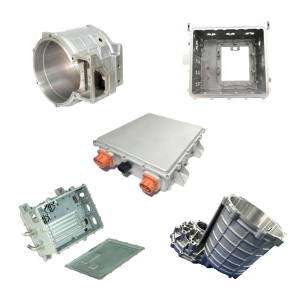
1. Motor Controller Housing
The motor controller is the electronic brain of the EV’s powertrain, managing the flow of energy from the battery to the motor. Its housing is far more than just a box; it’s a high-performance protective shell.
- Function: This housing protects the sensitive power electronics (like the IGBTs) from moisture, dust, vibration, and electromagnetic interference (EMI). It also plays a critical role in dissipating the immense heat generated by the electronics.
- Key Requirements:
- High Airtightness: Must meet stringent standards like IP67 or IP6K9K to prevent ingress of water and contaminants.
- Thermal Management: Often designed with complex, thin-walled cooling fins or integrated cooling channels to act as a heat sink.
- EMI Shielding: The aluminum material itself provides excellent shielding to prevent interference with other vehicle electronics.
- Dimensional Accuracy: Precise mounting points and sealing grooves are non-negotiable for reliable assembly and performance.
- Why Die Casting is Ideal: Aluminum die casting allows for the creation of intricate, thin-walled fins and complex internal features in a single piece, delivering superior thermal performance and lightweighting. The process ensures the part-to-part consistency required for automated assembly.
My Expert Insight: We recently developed a motor controller housing for a German Tier 1 supplier where the density and height of the cooling fins pushed the limits of the die-casting process. Using mold flow simulation, we were able to optimize the gate design and injection parameters to ensure complete filling without cold shuts, delivering a 15% improvement in thermal dissipation over the previous design.
2. Drive Motor Housing
The drive motor housing encases the stator and rotor, the core components of the electric motor. This part must be both structurally robust and dimensionally precise.
- Function: It provides the primary structural support for the motor assembly, aligning the bearings and rotor with extreme precision. It also protects the motor’s internals and helps manage heat generated by the motor’s operation.
- Key Requirements:
- Structural Integrity: Must withstand torque forces and vibrations from the drivetrain.
- High Dimensional Stability: Tight tolerances on the inner diameters are critical for maintaining the air gap between the stator and rotor, which directly impacts motor efficiency.
- Heat Dissipation: Like the controller, it must effectively transfer heat away from the motor windings. Some designs incorporate liquid cooling channels cast directly into the housing.
- Why Die Casting is Ideal: Die casting produces a near-net-shape part with excellent strength-to-weight ratio and exceptional dimensional repeatability, minimizing the need for costly secondary machining operations.
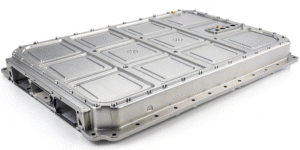
3. Battery Enclosure and Structural Frame
Perhaps the most significant evolution in automotive manufacturing, the battery enclosure is a massive, multi-functional component. It’s not just a box; it’s a core part of the vehicle’s chassis, often referred to as a "skateboard."
- Function: This structure protects the hundreds or thousands of individual battery cells from physical impact, seals them from the environment, manages thermal runaway events, and contributes directly to the vehicle’s overall torsional rigidity and crashworthiness.
- Key Requirements:
- Maximum Structural Strength and Crash Performance: Must protect the battery pack in the event of a collision.
- Lightweighting: Crucial for maximizing vehicle range.
- Thermal Management: Often includes intricate, leak-proof cooling channels cast into the floor of the tray to maintain optimal battery temperature.
- Part Consolidation: Large-scale die castings ("gigacastings") can replace dozens of individual stamped and welded steel parts.
- Why Die Casting is Ideal: Large tonnage die casting machines (4000T and above) can produce these massive single-piece structures, dramatically simplifying the supply chain and assembly process, reducing weight, and improving vehicle performance and safety.
4. Inverter and Converter Casings
Inverters (DC to AC) and converters (DC to DC) are essential power electronic modules that manage electricity for the main drivetrain and auxiliary systems (like the 12V battery and infotainment).
- Function: Similar to the motor controller housing, these casings provide physical protection, EMI shielding, and critical thermal management for the power conversion electronics inside.
- Key Requirements:
- Complex Geometries: Must accommodate multiple connectors, circuit boards, and mounting points in a compact space.
- Leak-Proof Sealing: Essential for protecting the electronics from the elements.
- Effective Heat Dissipation: Integrated heat sinks are standard.
- Why Die Casting is Ideal: The ability to cast complex, net-shape parts with high precision makes die casting the perfect method for producing these compact, multi-functional housings cost-effectively and at high volume.
5. Charger Housing and Connection Interfaces
This category includes the On-Board Charger (OBC) housing and the structures surrounding the vehicle’s charging port.
- Function: The OBC housing protects the internal electronics that convert AC power from the grid into DC power to charge the battery. The connection interfaces provide a robust and weatherproof mounting point for the vehicle’s charging inlet.
- Key Requirements:
- Durability and Weather Resistance: These parts are frequently exposed to the elements and user interaction.
- Thermal Performance: The OBC generates significant heat during charging and requires an effective heat sink housing.
- Aesthetic Finish: For user-facing parts like the charge port bezel, a high-quality surface finish is often required.
- Why Die Casting is Ideal: Die casting provides the durability, thermal properties, and potential for high-quality surface finishes needed for these applications, all while enabling complex designs in a single, reliable component.
Summary: The Backbone of E-Mobility
These five components demonstrate that die-cast aluminum is not just an option, but a foundational technology for electric vehicles. Choosing a supplier is about more than just cost per piece; it’s about partnering with an expert who understands the critical functions these parts perform.
| Die-Cast Part | Primary Function | Key Engineering Challenge |
|---|---|---|
| Motor Controller Housing | Protect and cool powertrain electronics | High airtightness (IP67) & complex thermal design |
| Drive Motor Housing | Structurally support and cool the electric motor | Extreme dimensional precision & structural rigidity |
| Battery Enclosure/Frame | Protect battery & provide chassis structure | Crash safety, part consolidation, & leak-proof cooling |
| Inverter/Converter Casing | House and cool power conversion modules | Compact, complex geometry & EMI shielding |
| Charger Housing/Interface | Protect on-board charger & provide connection port | Durability, weather resistance, & thermal management |
A qualified supplier can collaborate on DFM, simulate mold flow to prevent defects, and implement rigorous process controls to ensure every part meets the demanding standards of the automotive industry.
Are you looking for a reliable partner to develop and manufacture critical die-cast components for your e-mobility projects?
At EMP Tech, my team and I offer a one-stop solution, from early-stage DFM analysis and mold flow simulation to mass production and factory inspection. We specialize in solving the lightweighting, airtightness, and tight-deadline challenges faced by our Tier 2 automotive clients.
Contact me at [email protected] to discuss how we can help make your next EV project a success.


