

As a Purchasing Director, you’re constantly balancing cost, quality, and lead times. When you specify a material for a critical automotive component, you’re placing a bet that it will perform. For a Supplier Quality Engineer, that material choice directly impacts whether a part will pass rigorous IATF 16949 audits and function reliably in the field. Choosing the wrong aluminum alloy isn’t just a minor mistake; it’s a decision that can lead to misruns on the production line, failed leak tests, premature field failures, and ultimately, costly project delays.
The problem is that a material datasheet only tells part of the story. An alloy with great strength might have poor fluidity, making it impossible to cast the thin cooling fins on an EV controller housing. An alloy that flows perfectly might lack the ductility to withstand vibration, leading to stress cracks. The challenge lies not in finding an alloy with one great property, but in selecting one that offers the optimal balance of all the properties your component demands.
With over two decades spent developing die-cast solutions for leading Tier 1 and Tier 2 automotive suppliers, my team and I have made material selection a cornerstone of our process. It’s a strategic decision made during the DFM phase, not an afterthought. Understanding these seven key requirements will empower you to have more effective technical discussions with your partners and ensure you procure parts made from an alloy that is truly fit for purpose.
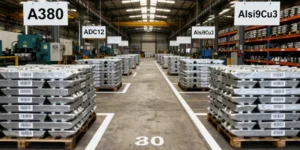
1. High Fluidity for Thin-Wall and Complex Structures
Fluidity refers to the ability of molten metal to flow and fill intricate sections of a mold cavity before it solidifies.
- Why it matters: Modern automotive components, especially for EVs, are defined by their complexity and lightweight design. Motor controller housings require tall, thin cooling fins; inverter casings have complex internal walls; structural parts integrate numerous features into one piece. An alloy with poor fluidity will result in "misruns" or "cold shuts"—incomplete filling of the mold—leading to scrapped parts and production inefficiencies. High fluidity is essential to achieve these complex, near-net-shape designs successfully.
- Common Alloys: Alloys with higher silicon content, such as A383 or AlSi12 (EN AC-44300), are known for their excellent fluidity.
2. Excellent Mechanical Strength and Ductility
Mechanical properties define how a part behaves under load. Strength (tensile and yield) dictates its ability to resist deformation, while ductility allows it to bend or deform without fracturing—a key trait for absorbing impact and vibration.
- Why it matters: A drive motor housing must withstand significant torque and vibration without failing. A structural battery frame must meet stringent crash safety requirements, which demand a combination of high strength and ductility. Specifying an alloy without the right mechanical properties for the application can lead to catastrophic failure.
- Common Alloys: Alloys like AlSi10Mg (EN AC-43500) are favored for structural parts because they offer a great balance of strength and ductility, which can be further enhanced through heat treatment. A380 is a strong, general-purpose alloy suitable for many applications.
3. Good Thermal and Electrical Conductivity
Thermal conductivity is the material’s ability to transfer heat, while electrical conductivity measures its ability to conduct electrical current. For many automotive applications, these properties are just as important as mechanical strength.
- Why it matters: For any housing protecting power electronics—be it a motor controller, OBC, or inverter—the primary function is to act as a heat sink. The aluminum alloy must efficiently draw heat away from critical components like IGBTs to prevent overheating and failure. Good electrical conductivity is also vital for grounding and EMI/RFI shielding. An alloy with poor thermal performance will lead to an oversized, inefficient, and unreliable electronic system.
- Common Alloys: While adding silicon for fluidity can slightly reduce thermal conductivity, alloys are carefully balanced to provide the best of both worlds. Specialized alloys with lower silicon and higher copper can be used where thermal performance is the absolute priority.
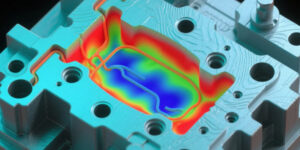
4. Stable Dimensional Accuracy and Low Shrinkage
As molten aluminum cools and solidifies, it shrinks. An ideal die-casting alloy has a low and predictable shrinkage rate, ensuring that the final part conforms tightly to the intended design dimensions.
- Why it matters: Tight tolerances are non-negotiable for parts that require precise assembly, such as motor housings with bearing seats or enclosures with critical sealing grooves. An alloy with high or inconsistent shrinkage will lead to dimensional instability, causing assembly problems, failed leak tests, and an increase in costly post-machining operations.
- Common Alloys: Alloys in the Al-Si family (like A380 and AlSi10Mg) are popular because the silicon content helps reduce solidification shrinkage and improves casting stability.
5. Superior Corrosion and Oxidation Resistance
Aluminum naturally forms a protective oxide layer, but its resistance to corrosion can be significantly influenced by its alloying elements, especially in the harsh automotive environment.
- Why it matters: Components like battery enclosures, motor housings, and chassis parts are exposed to road salt, moisture, and temperature fluctuations. Corrosion can degrade a part’s structural integrity and aesthetic appearance. While coatings are often applied, starting with an alloy that has inherently good corrosion resistance provides a more robust, long-term solution.
- Common Alloys: Alloys with lower copper content, such as A360 (AlSi10Mg), offer superior corrosion resistance compared to the more common A380, making them a preferred choice for parts in highly corrosive environments.
6. Compatibility with Surface Treatments and Coatings
Most die-cast parts undergo some form of surface treatment, whether it’s for cosmetic appearance, enhanced corrosion protection, or improved wear resistance.
- Why it matters: The chosen alloy must be compatible with required secondary processes like powder coating, e-coating, anodizing, or chromate conversion. Certain alloying elements can affect the quality and adhesion of these finishes. For example, high silicon content can make decorative anodizing more difficult, resulting in a gray, less appealing finish. This must be considered during the initial material selection phase.
- My Expert Insight: When a customer specifies a Chromate (Cr-free) conversion coating for corrosion resistance and electrical conductivity, we often recommend an alloy with managed copper levels. This ensures the coating adheres properly and provides a consistent, low-resistance surface, which is critical for grounding points on EV housings.
7. Recyclability and Environmental Compliance
Sustainability is no longer a footnote; it’s a core requirement for modern manufacturing. Aluminum is highly recyclable, which is a major environmental and economic advantage.
- Why it matters: Using recycled aluminum content reduces energy consumption by up to 95% compared to primary production. Automotive OEMs and Tier 1s are increasingly setting targets for recycled content and demanding compliance with environmental regulations like RoHS and REACH. Selecting a common, easily recyclable alloy supports a circular economy and helps meet corporate sustainability goals.
- Common Alloys: Standard alloys like A380 are widely used and recycled, ensuring a stable supply of secondary (recycled) material that meets stringent quality standards.
Summary: Balancing the Properties for Optimal Performance
Choosing the right aluminum alloy is a balancing act. You cannot maximize one property without impacting another. The key is to work with an engineering partner who understands these trade-offs and can guide you to the material that provides the best overall fit for your specific application.
| Requirement | Why It’s Critical | Best-in-Class Alloy Characteristics |
|---|---|---|
| High Fluidity | For casting complex, thin-walled parts | High Silicon (e.g., AlSi12) |
| Mechanical Strength | For structural integrity and durability | Balanced Silicon & Magnesium (e.g., AlSi10Mg) |
| Conductivity | For thermal management and EMI shielding | Low impurities, balanced alloy elements |
| Dimensional Stability | For tight tolerances and precise assembly | Low shrinkage rates (e.g., Al-Si family) |
| Corrosion Resistance | For longevity in harsh environments | Low Copper content (e.g., A360) |
| Surface Treatment | For finishing and functional coatings | Managed alloying elements for compatibility |
| Recyclability | For sustainability and cost-effectiveness | Common, widely available alloys (e.g., A380) |
The next time you review a technical drawing or a supplier quote, don’t just look at the alloy number. Ask why that alloy was chosen and how it satisfies these seven critical requirements.
Is your supplier treating material selection as a strategic engineering decision or just another line on the bill of materials?
At EMP Tech, we begin with the end in mind. My team and I analyze your component’s functional requirements to select an alloy that guarantees performance, manufacturability, and cost-effectiveness. It’s a key part of our one-stop solution.
Contact me at [email protected] to ensure your next project is built on the right foundation.


