

High-pressure die casting (HPDC) has become the dominant manufacturing process for automotive structural and powertrain components, driven by the industry’s relentless push for lightweighting, integration, and cost efficiency. For Tier 1 and 2 suppliers, knowing which parts are feasible—and which process variants each demands—is the difference between a smooth PPAP Level 3 submission1 and a field failure.
Below is a breakdown of the 10 most common automotive applications for die casting, with material choices, functional requirements, and the engineering reality of each part. This is not a marketing brochure. It is a shop-floor perspective on what works and what doesn’t.
1. EV Motor Housing (Drive Motor Casing)
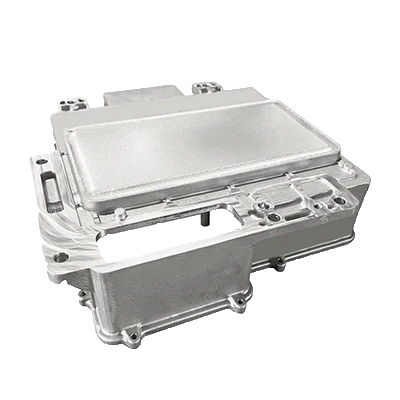
The motor housing is the structural backbone of an electric drive unit. It must locate the stator and rotor with minimal runout, manage thermal loads (from -40°C to over 150°C at the winding), and withstand torsional reaction forces. Leak-tightness is non-negotiable for oil-cooled or water-jacket designs.
- Typical Alloy: A380, AlSi9Cu3, or A356 (T6 heat-treated for high-ductility requirements).
- Critical Features: O-ring sealing grooves, bearing pockets with tight concentricity, and integrated cooling channels.
- Process Consideration: Vacuum-assisted HPDC is standard to minimize gas porosity in the water jacket area. Post-casting, 5-axis CNC single-setup machining2 is required for the bearing journals and mounting faces. Expect a typical 100% air-decay leak test at 3-5 bar.
- Real-World Example: A typical EV motor housing weighs 10–30 kg and integrates the front cover and stator support into a single casting, eliminating multiple fasteners.
2. Inverter / Controller Housing (Inverter/PDU Case)
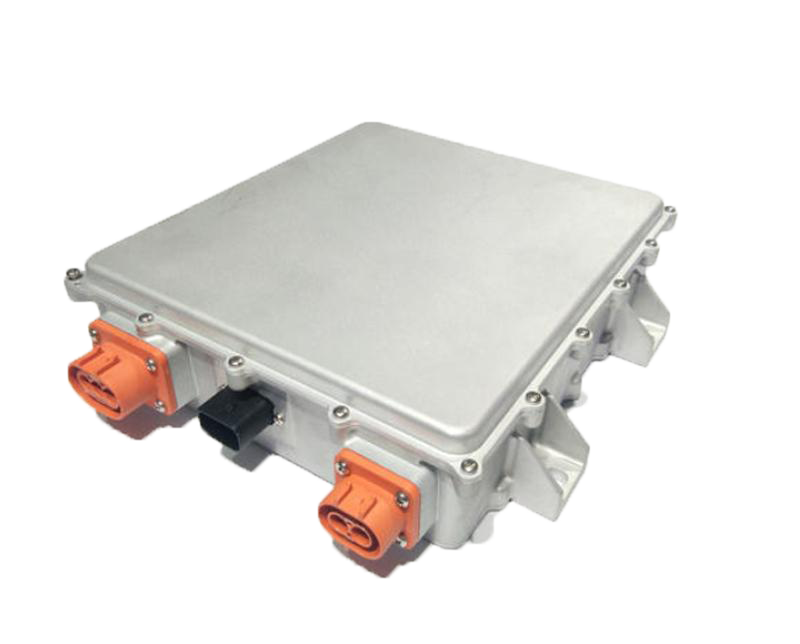
Thermal management is the primary driver here. Power electronics (IGBTs or SiC modules) generate significant heat. The housing serves as a heat sink and an EMI/RFI shield, often requiring a flatness of < 0.1 mm on the lid mounting surface to ensure IP6K9K sealing.
- Typical Alloy: A380 or ADC12 (good thermal conductivity and castability) or magnesium alloys (AM60B) for mass reduction and vibration damping.
- Critical Features: Threaded inserts, high-voltage connector mounting bosses, and cooling fins with high aspect ratios.
- Process Consideration: Wall thicknesses can be as low as 2 mm to save weight. High injection speeds are required to fill thin fins, but this increases the risk of cold shuts.
- Real-World Insight: Magnesium inverter housings are gaining traction in hybrid vehicles due to their excellent heat dissipation behavior, though corrosion protection (PEO coatings) is critical.
3. Battery Tray / Housing (Integrated Battery Tray)
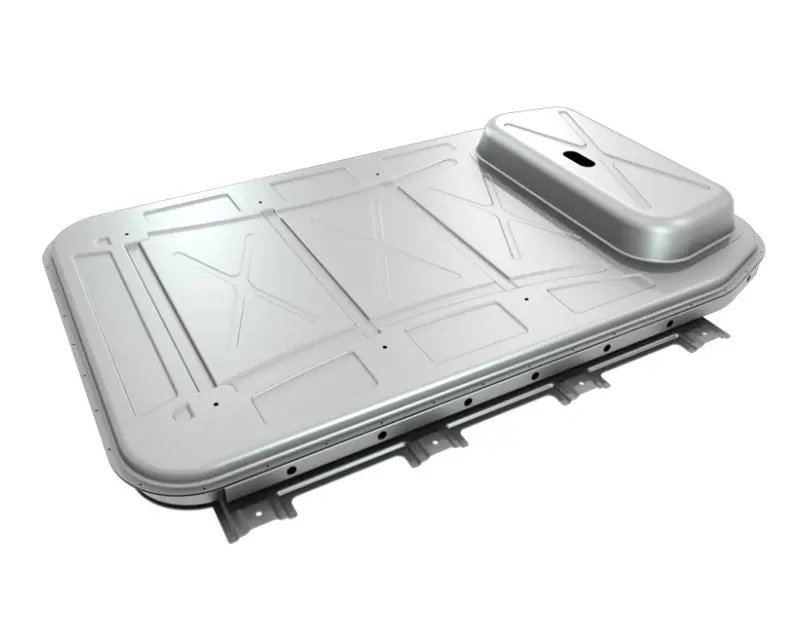
One of the most demanding applications. Large-format battery trays (up to 2,000 mm x 1,600 mm) are replacing welded steel or extruded aluminum assemblies with a single high-pressure die casting. The structural requirements are extreme: front and rear crash loads, side pole impacts, and vibration endurance for the lifetime of the vehicle.
- Typical Alloy: High-ductility alloys like Silafont-36 or Aural-5 (for crash energy absorption).
- Critical Features: Threaded bushings for vehicle attachment, cooling channel integration, and electromagnetic compatibility (EMC) shielding.
- Process Consideration: Requires massive die casting machines (4,500 – 12,000 tons). The challenge is controlling thermal gradients during cooling to prevent distortion. Shot blasting and grinding are often necessary for runner removal.
- Component Count Reduction: A single integrated tray can replace up to 22 separate stamped and welded components, saving 30-40% in mass and cost according to NADCA design guidelines3.
4. Transmission & Gearbox Housing (Transmission Case)

A classic application that remains critical. It must support the differential, bearings, and shafts while managing oil pressure and return. The housing is a structural node, often connecting the engine and subframe.
- Typical Alloy: A380 or AlSi8Cu3Fe.
- Critical Features: Bearing bores, oil return passages, and breather vents.
- Process Consideration: Porosity control is essential. Vents must be placed correctly to avoid oil leaks. High-pressure water-cooling channels can be cast in if the process is carefully controlled.
- Cost Efficiency: Die casting eliminates the need for multiple bolted or welded sub-assemblies, reducing assembly complexity.
5. Steering Knuckle (Front & Rear Steering Knuckles)
Safety-critical chassis components requiring high strength and fatigue resistance. They connect the wheel hub to the suspension. Traditionally forged steel, aluminum die casting is now standard.
- Typical Alloy: A356.2 (T6 heat-treated) or similar.
- Critical Features: Bearing hub bore, tie-rod attachment, and brake caliper mounting points.
- Process Consideration: Squeeze casting or semi-solid casting are sometimes preferred over standard HPDC to achieve the required ductility (elongation > 7%). However, high-vacuum HPDC is increasingly competitive.
- Weight Reduction: Weight reduction is 30-50% compared to iron or steel forgings, directly improving vehicle dynamics and efficiency per SAE Aluminum Casting Standards4.
6. Engine Cradle / Sub-frame
A large structural frame that supports the powertrain and suspension. It is a core element of a vehicle’s front-end structure.
- Typical Alloy: Silafont-36 or SF36 (high strength).
- Critical Features: High dynamic stiffness, mount bosses, and crash management structures.
- Process Consideration: High-vacuum HPDC is mandatory to eliminate gas inclusions that would cause failure under weld or high stress. Robot handling is standard due to the weight and size.
- Real-World Example: The Z06 Corvette engine cradle utilizes a magnesium casting, saving significant weight over aluminum while maintaining NVH performance.
7. Bracket & Structural Nodes (A/B/C Pillar Nodes, Shock Towers)
These are small but highly stressed connection points in unibody construction. They are usually attached via MIG welding or self-piercing rivets.
- Typical Alloy: A380 or high-ductility alloys.
- Critical Features: Flange geometry for welding, precise stud locations.
- Process Consideration: The die must be designed to optimize fill at thin wall sections (1.5-2.5 mm).
- Integration: Replaces multi-piece stamping assemblies with a single rigid node.
8. Connectors & Electrical Sensor Housings
Small zinc or aluminum die castings with tight dimensional tolerances and EMI shielding requirements.
- Typical Alloy: Zamak #3, #5 (zinc) or A380 (aluminum).
- Critical Features: Ultra-thin walls (0.5 mm min), flatness, and corrosion resistance.
- Process Consideration: Zinc offers excellent thin-wall fill and superior surface finish, often eliminating secondary machining.
- Real-World Example: Fiber optic transceiver housings and camera brackets are frequently converted from plastic to zinc die casting to improve heat dissipation and durability.
9. Cam Cover & Cylinder Head Covers
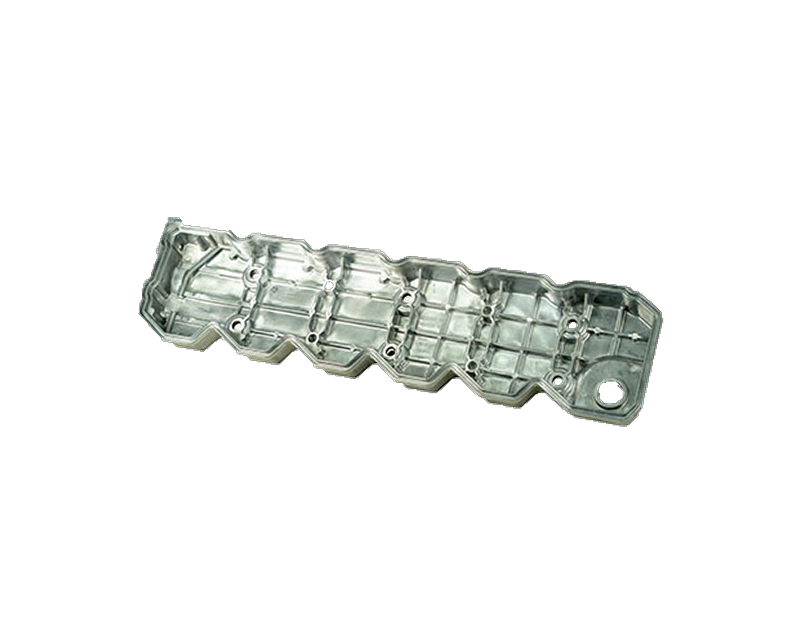
These are large, thin-walled enclosures that replace plastic or steel stampings. They provide sealing, oil mist separation, and ventilation.
- Typical Alloy: A380.
- Critical Features: Oil separators (baffles), spark plug tube seals, and PCV ports.
- Process Consideration: Structural stability at high temperatures is a key advantage over plastic. Distortion must be controlled via die thermal design.
- Cost Factor: Aluminum allows stake pins for baffle plates to be cast-in, reducing assembly steps.
10. E-Drive Mounting Brackets & Motor Mounts
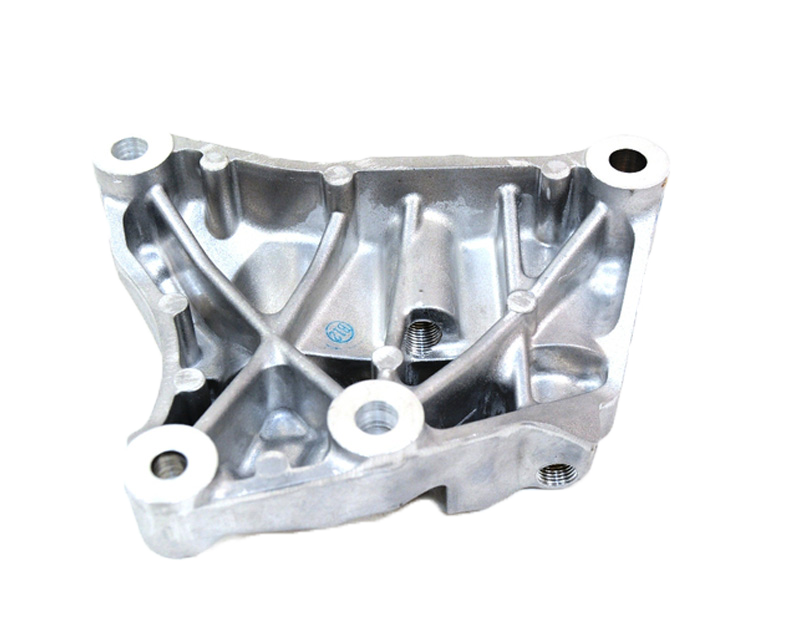
These parts support the motor or transmission unit relative to the subframe.
- Typical Alloy: A380 or AM60 (for magnesium variants).
- Critical Features: High load absorption, rubber bushing housings.
- Process Consideration: Requires high elongation to absorb shock loads without cracking. Often requires CNC drilling for the bushings.
- Functional Insight: Single die castings can replace four-piece welded assemblies, reducing cost by an estimated 50%.
Summary Table: Comparative Requirements
| Part Category | Primary Material | Typical Alloy | Key Function | Critical Tolerance | Common Failure Mode |
|---|---|---|---|---|---|
| EV Motor Housing | Al | A380, A356 | Structural support/Heat dissipation | Bearing bore roundness | Porosity leaking oil |
| Battery Tray | Al | Silafont-36 | Crash protection | Flatness, Wall thickness | Distortion/Stress cracks |
| Inverter Housing | Al/Mg | A380, AM60 | EMI shielding/Cooling | Surface flatness | Cold shuts on fins |
| Transmission Case | Al | A380 | Bearing alignment | Bearing bore concentricity | Pinhole leaks |
| Steering Knuckle | Al | A356 T6 | Safety/Durability | Hub bore runout | Fatigue cracks |
| Engine Cradle | Al/Mg | SF36, AM60 | Structural stiffness | Mounting hole positions | Porosity under weld |
| Structural Nodes | Al | A380 | Joint integrity | Flange thickness | Lack of fusion |
| Connectors | Zn | Zamak #3 | Conductivity | Pin spacing | Warpage |
| Cam Cover | Al | A380 | Sealing | Gasket surface finish | Distortion |
| Motor Mounts | Al/Mg | A380, AM60 | Vibration damping | Bushing fit | Elongation failure |
References & Footnotes
EMP Tech. Automotive-Grade Quality Control & Inspection — PPAP, CMM, Leak Testing ↩
EMP Tech. Electric Vehicle Parts — EV Motor Housings, Inverters, Battery Trays ↩
NADCA. Die Casting Design Standards & Application Guidelines ↩
SAE International. Aluminum Casting Standards for Automotive Chassis Applications ↩


