

When engineering the lower architecture of an electric vehicle (EV), the battery pack enclosure—or battery tray—is arguably the most critical structural component. It must support hundreds of kilograms of lithium-ion cells, protect them from catastrophic side-pole impacts, manage intense thermal loads, and maintain an absolute IP67/IP68 hermetic seal.
For years, OEMs and Tier 1 system integrators debated the primary material for this application: Advanced High-Strength Steel (AHSS) versus Aluminum.
While steel offers raw tensile strength and a lower upfront raw material cost, the physical realities of modern EV engineering have aggressively shifted the industry standard. Based on data from the foundry floor and metallurgical realities, here is a pragmatic, engineer-to-engineer breakdown of why automotive die casting1 using aluminum is dominating the EV battery housing sector.
The Core Engineering Matrix: Aluminum vs. Steel
Before looking at the manufacturing process, we must look at the base thermodynamics and physical properties of the materials.
| Engineering Metric | Advanced High-Strength Steel (AHSS) | Aluminum Die Casting (e.g., AlSi10MnMg) |
|---|---|---|
| Density (Weight) | ~7.8 g/cm³ (Heavy) | ~2.7 g/cm³ (Lightweight, extends EV range) |
| Thermal Conductivity | ~50 W/m·K (Traps heat) | ~130 – 170 W/m·K (Excellent heat dissipation) |
| Part Consolidation | Very Low (Requires stamping and welding 50+ parts) | Very High (One-piece near-net-shape casting) |
| Crash Energy Absorption | High stiffness, transfers impact energy | High ductility (bends and absorbs energy before fracture) |
| Corrosion Resistance | Poor (Requires heavy e-coating/galvanizing) | Excellent (Natural oxide layer) |
1. The Assembly Nightmare: Tolerance Stack-Up vs. Part Consolidation
If you choose steel for an EV battery tray, you are choosing stamping and welding. A typical steel battery enclosure consists of dozens of individually stamped brackets, rails, and cross-members welded together.
The Manufacturing Reality: Welding 50 pieces of steel together is a Geometric Dimensioning and Tolerancing (GD&T) nightmare. The intense localized heat from the welding process causes severe thermal distortion. By the time the steel tray is fully assembled, the sealing flange is often warped out of specification.
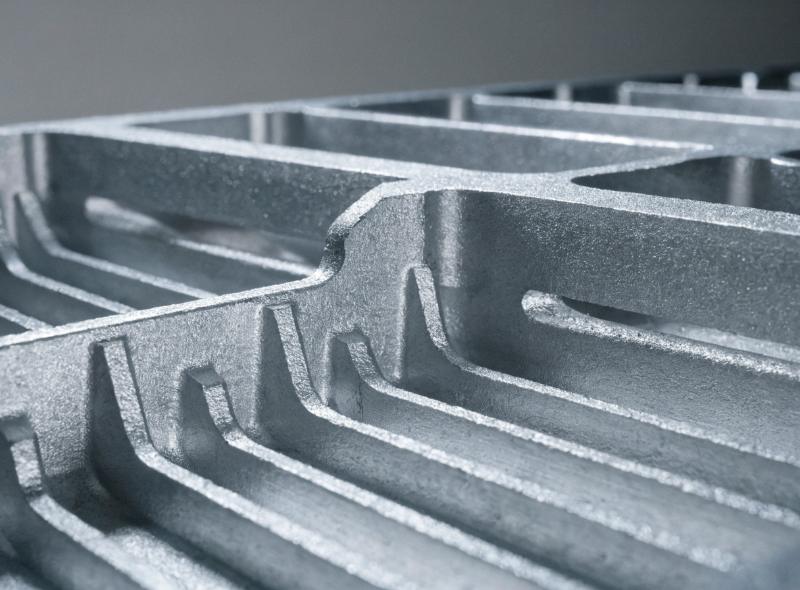
The Aluminum HPDC Solution: Utilizing large-tonnage Vacuum High-Pressure Die Casting (HPDC), elite foundries can consolidate those 50 steel parts into a single, large-format aluminum EV battery case2. This eliminates welding distortion and assembly line bottlenecks. Once the raw casting is cooled, the sealing flange and internal mounting bosses are machined on a 5-axis CNC center in a single setup, guaranteeing the strict coplanarity required for a leak-proof gasket seal.
2. Active Thermal Management & Runaway Mitigation
Lithium-ion cells degrade rapidly if they get too hot, and thermal runaway is the ultimate safety failure.
The Manufacturing Reality: Steel is an insulator compared to aluminum. If a cell catches fire, a steel housing will trap the heat inside the pack, accelerating the chain reaction. Furthermore, integrating liquid cooling channels into a steel assembly requires brazing or welding separate cooling plates to the bottom of the tray—introducing multiple potential failure points for coolant leaks.
The Aluminum HPDC Solution: Aluminum naturally draws heat away from the cells. More importantly, using complex slider mechanisms in the die casting tool, we can cast the cooling channels directly into the structure of the aluminum tray. This eliminates the need for a secondary cooling plate, saving vertical packaging space and drastically reducing the risk of coolant leaking into the high-voltage cavity.
3. Crash Performance: Shattering the "Fragile Aluminum" Myth
A common misconception is that die-cast aluminum is too brittle to survive severe crash testing (such as a side-pole impact). If you are using standard commercial alloys, that is true.
The Manufacturing Reality: To pass strict OEM safety standards, Tier 2 suppliers do not use standard ADC12 for load-bearing battery trays. Instead, we use highly ductile structural alloys, such as AlSi10MnMg, formulated to meet rigorous SAE structural standards3.
To prevent internal voids (which act as stress concentrators where cracks originate), we utilize Vacuum HPDC and strictly adhere to NADCA guidelines4 for gating design. Following the casting process, the trays undergo a T6 heat treatment (solution heat treating and artificial aging). This transforms the aluminum—allowing it to absorb massive amounts of kinetic energy by bending and deforming, rather than shattering, during a crash.
4. EMI Shielding and FSW Compatibility
Modern battery packs contain highly sensitive Battery Management Systems (BMS). High-voltage cabling generates severe Electromagnetic Interference (EMI). While steel provides decent magnetic shielding, thick-walled aluminum provides superior inherent EMI shielding across a broader frequency spectrum.
Additionally, many Tier 1 integrators are moving away from bolted covers and elastomeric gaskets, opting instead to seal the battery pack using Friction Stir Welding (FSW). FSW is a solid-state joining process that creates a flawless, waterproof seal. Aluminum die castings, provided they are dense and free of micro-porosity along the sealing edge, are perfectly compatible with FSW, whereas steel cannot be friction-stir welded practically in a high-volume automotive environment.
The Verdict for Tier 1 & Tier 2 Sourcing
Steel will always have its place in commercial trucking and budget-tier vehicle frames where weight is not penalized. However, for modern, range-optimized passenger EVs, aluminum die casting is the undisputed standard. It is the only process that simultaneously solves the challenges of lightweighting, active thermal management, and part consolidation.
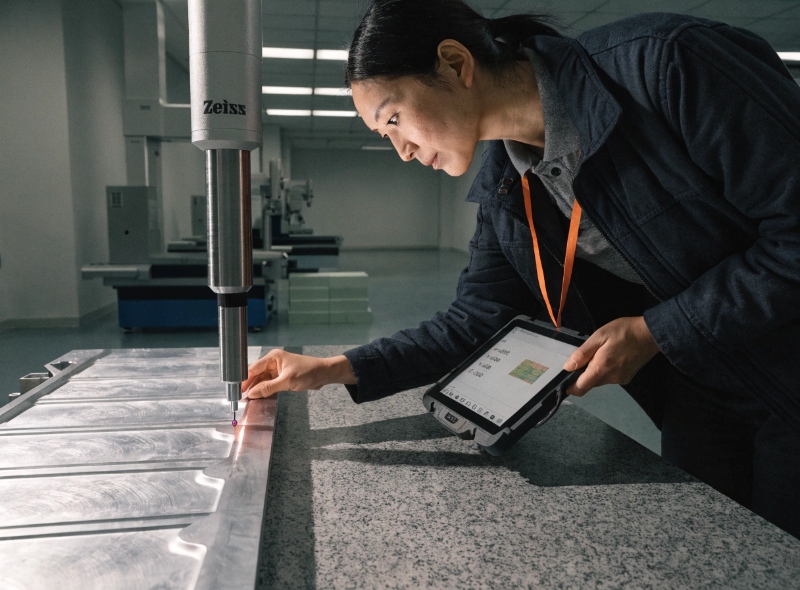
At EMP Tech, we understand that casting a 1.5-meter-long battery tray without thermal warpage requires ruthless process control. Equipped with large-tonnage HPDC cells (up to 3050T) and backed by our automotive-grade quality control lab5 performing 100% X-Ray flaw detection and CMM verification, we help global Tier 1 suppliers mitigate supply chain risks.
Are you evaluating manufacturing partners for a new EV battery architecture?
Upload your 3D CAD (STEP/IGES) via our contact form today. Our engineering team will deliver an objective Design for Manufacturability (DFM) review and a pragmatic production quote within 24 hours, long before you invest in expensive H13 tooling.
References & Footnotes
EMP Tech. Automotive Aluminum Die Casting Solutions. ↩
EMP Tech. EV Battery Case (Tray) Manufacturing Specifications. ↩
SAE International. Automotive Material Standards. ↩
North American Die Casting Association (NADCA). Engineering & Design Standards. ↩
EMP Tech. Automotive-Grade Quality Control & Inspection Laboratory. ↩


