

As the automotive industry accelerates towards an all-electric future, the spotlight shines brightly on the core technology of New Energy Vehicles (NEVs): the three-electric system. Comprising the battery, motor, and electronic control unit, this trinity dictates a vehicle’s range, performance, and safety. However, these sophisticated components cannot function in a vacuum. They require a robust, intelligent, and highly engineered enclosure—the three-electric system housing.
As a leading manufacturer of automotive aluminum parts, we are at the forefront of providing these critical structures. This article will explore the pivotal role of these housings and explain why aluminum die casting has become the definitive manufacturing process for building the backbone of the EV revolution.

What is the Three-Electric System?
The "three-electric system" is the collective term for the three fundamental powertrain components of an EV:
- Power Battery (The Heart): The battery pack stores the electrical energy that powers the vehicle. Its housing is critical for safety, thermal management, and structural integrity.
- Drive Motor (The Muscle): This unit converts electrical energy from the battery into mechanical energy to turn the wheels. Its housing must be precise, strong, and excellent at dissipating heat.
- Electronic Control System (The Brain): This includes the Vehicle Control Unit (VCU), Motor Control Unit (MCU), and Battery Management System (BMS). These controllers manage everything from power delivery to battery health, and their housings must protect sensitive electronics from heat, vibration, and electromagnetic interference.
These three systems work in concert, and their housings are far more than simple protective shells; they are multi-functional, integrated engineering solutions.
The Critical Functions of a Three-Electric System Housing
Each part of the three-electric system has unique demands, and its housing must be designed to meet them flawlessly. The challenges of thermal management, lightweighting, sealing, and structural safety are paramount.
| System Component | Housing’s Primary Functions | Key Engineering Requirements |
|---|---|---|
| Battery Pack Housing | Protect and carry cells, structural support, thermal management, IP67/IP68 sealing, crash protection | High strength-to-weight ratio, corrosion resistance, high thermal conductivity, precision sealing surfaces. |
| Drive Motor Housing | Align and support stator/rotor, heat dissipation, noise and vibration damping (NVH) | High dimensional accuracy, structural rigidity, superior thermal conductivity, pressure tightness. |
| Electronic Controller Housing | Shield sensitive electronics, heat dissipation, EMI/RFI shielding, dust and water protection | Excellent electromagnetic shielding, lightweight, complex heat sink geometry, robust sealing. |
Why Aluminum Die Casting is the Ideal Solution
To meet these demanding and often conflicting requirements, aluminum die casting has emerged as the premier manufacturing technology for three-electric system housings. Here’s why:
1. Superior Thermal Management
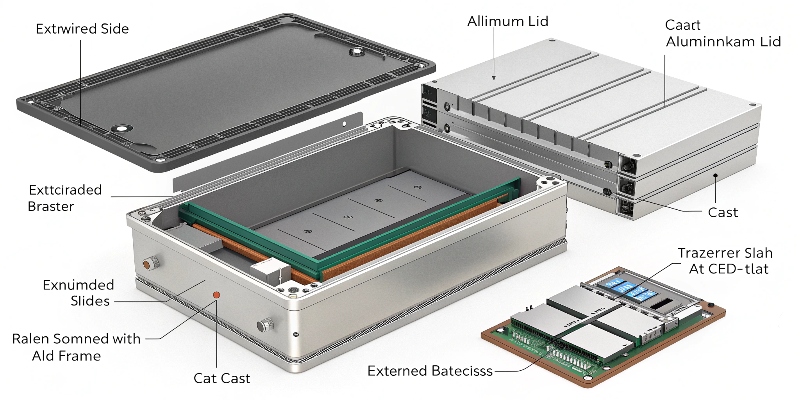
EV components generate immense heat. Aluminum’s excellent thermal conductivity, combined with the die casting process, allows for the creation of housings with intricate, built-in cooling features. We can seamlessly integrate liquid cooling channels, complex cooling fins, and micro-channel structures directly into the part, creating a highly efficient, single-piece thermal management system.
2. Ultimate Lightweighting for Maximum Range
Range anxiety is a major concern for EV consumers. Lighter vehicles are more efficient and have a longer range. Aluminum is about one-third the density of steel. By using aluminum die casting, we produce housings that offer exceptional strength and protection at a fraction of the weight of traditional steel fabrications, directly contributing to extended vehicle range and better performance.
3. High Integration and Design Freedom
Die casting allows us to combine multiple parts into a single, complex component. A battery tray, for example, can be cast as one piece with a built-in cooling system, mounting points, sealing grooves, and reinforcing ribs. This monolithic design:
- Reduces part count, assembly time, and cost.
- Eliminates welds and joints, which are potential points of failure and leakage.
- Improves structural integrity and sealing reliability.
- Enables more compact and optimized packaging.
4. Unmatched Safety, Strength, and Shielding
Safety is non-negotiable. Die-cast aluminum housings provide a rigid, protective cage for battery cells and electronics, withstanding significant vibration and impact forces. Furthermore, the metallic nature of the aluminum housing creates a natural Faraday cage, providing excellent Electromagnetic Interference (EMI) shielding. This is crucial for protecting the vehicle’s sensitive "brain" from interference and ensuring all systems operate flawlessly.
Choosing Your Partner for the Electric Future
The quality of your three-electric system housing directly impacts your vehicle’s performance, safety, and market competitiveness. Selecting the right manufacturing partner is therefore critical. A world-class die casting supplier should offer:
- Deep Automotive Expertise: A proven track record in manufacturing complex automotive components and a thorough understanding of IATF 16949 standards.
- Collaborative Engineering (DFM): The ability to work with your design team from day one to provide Design for Manufacturability (DFM) feedback, optimizing for cost, quality, and performance.
- Advanced Simulation & Tooling: Use of mold flow, thermal, and stress analysis software to perfect the design before a single tool is cut.
- State-of-the-Art Production: Large-tonnage die casting machines (e.g., 4000T+) for large, one-piece battery trays, coupled with high-precision CNC machining and CMM inspection.
- Rigorous Testing: In-house capabilities for pressure leak testing, cleanliness testing, and other validation methods to guarantee IP67/IP68 sealing and performance.
Conclusion
The three-electric system housing is no longer just an afterthought; it is a core enabling technology for the next generation of electric vehicles. Through the unparalleled advantages of aluminum die casting—superior thermal management, lightweighting, high integration, and robust safety—we can build the strong, reliable backbone that these advanced systems require.
As a dedicated partner in automotive innovation, we specialize in delivering high-performance aluminum die-cast solutions for battery, motor, and controller housings. Contact us today to discuss how our expertise can drive your next EV project to success.


