

The lightweight of EV Battery Housing
In addition to the lightweight of the body structure, the battery pack itself also needs to be lightweight. The lightweight of the battery housing is one of the directions of efforts.
Especially for battery packs of pure electric vehicles, the pursuit of high mileage on the premise of the current lithium-ion battery level of development will inevitably require that the weight of the battery case be reduced as much as possible while ensuring high structural strength, the weight of the battery pack can be reduced about 10-30% by using light aluminum alloy than by using steel, which can reduce the overall weight of the battery pack to some extent.
Die-casting and extrusion are commonly used in the production of aluminum alloy housing. The housing can be molded in one piece (flatness and accuracy are affected to a certain extent, especially if the installation interface has sealing requirements, it may require post-processing to modify), do not need welding, need large tonnage die-casting machine to achieve, generally subject to size restrictions, housing size will not be too large, usually used for battery tray, you can increase the tailor-welded process to compensate if the size of housing is too large.
Examples of battery housing made of Die-cast Aluminum Alloy
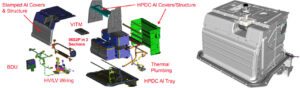
1) GM Cadillacs battery housing using stamping and high-pressure casting process (below) , the tray using aluminum high-pressure casting (HPDC).
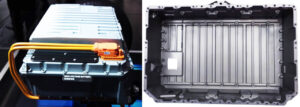
2) This battery housing is made of aluminum high pressure die casting aluminum Alloy AlSi10MnMg with a weight of 6.4 kg.
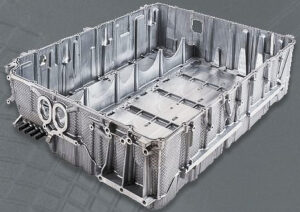
3) The parts as below show low pressure die casting of Aluminum Alloy AlSi7Mg with integrated cooling function.
Which aluminium alloy a battery housing actually uses
Two families dominate. AlSi10MnMg is the one specified when the housing is part of the crash load path, because its as-cast elongation stays in the 8–12 % range while yield strength sits around 120–150 MPa. ADC12 and A380 are cheaper and cast more easily, but their elongation is 1–3 %; they belong on covers, brackets and internal frames where the load path does not run through the casting.
The trade-off is not only mechanical. AlSi10MnMg is a hypoeutectic alloy with a narrow freezing range, which means it is more sensitive to die temperature and to the vacuum level in the cavity. On a thin 2.5 mm tray wall, a drop in vacuum below roughly 200 mbar shows up as scattered porosity long before it shows up in X-ray of the thick sections — the vacuum level is the process variable to log, not the alloy certificate.
| Alloy | As-cast elongation | Typical yield | Where it belongs |
|---|---|---|---|
| AlSi10MnMg | 8–12 % | 120–150 MPa | Crash-relevant trays, thick-to-thin structural sections |
| ADC12 / A380 | 1–3 % | 150–170 MPa | Covers, brackets, internal frames |
| AlSi7Mg (low pressure) | 5–9 % | 90–120 MPa | Large thin-wall housings with integrated cooling |
Wall thickness, flatness and the sealing face
A die-cast tray typically runs 2.5–3.5 mm on the floor and 3–4 mm on the perimeter flange. Going thinner is possible but buys little: the floor is not usually stiffness-critical, and the sealing face is. That face is where most of the cost hides, because it has to be flat enough for a compression seal and, in most programmes, it is machined after casting.
As a working rule, a machined sealing face is specified flat to 0.3–0.5 mm across the full length, with 1.0–1.5 mm of machining allowance on the cast surface. If the die is thermally unbalanced, that allowance disappears on one side and the machinist chases the face — which is the same mechanism that produces distortion in long structural parts, described in where HPDC stops on structural components. Dimensional tolerances for cast features follow ISO 8062-3 unless the drawing says otherwise.
Leak testing: the test that decides acceptance
Most battery housings are accepted on an air-decay test at 0.3–1.0 bar, with a pressure drop limit agreed per volume; IP67 parts that must survive immersion are usually checked again with helium after machining. Two details decide whether the test means anything: the fixture has to seal on the machined face rather than on as-cast metal, and the part has to be at a stable temperature, because a housing that is still warm from machining expands and masks a small leak.
Porosity that is interconnected but does not reach the surface will pass a pressure test today and leak after thermal cycling in service. That is why the drawing should state whether the acceptance criterion is a leak rate, a porosity class, or both — and why a casting that passes X-ray can still fail the bench.
What drives the price of a cast housing
Machine size is set by the projected area and the injection pressure, not by part weight: a 6 kg tray usually needs a 1,600–2,500 tonne cell, while a 2 kg cover runs on 800–1,200 tonnes. Tooling for a single-cavity tray with two slides typically sits in the EUR 80,000–150,000 band, and that number moves with slide count far more than with part size.
At the part level, the cost is dominated by cycle time and by the machining and leak-test operations, not by the metal. The cycle-time levers are the same ones that apply to any thick-to-thin casting, and they are worth reading before quoting a tray: where the seconds in a cycle actually go. For the part family itself, see the battery case page.
| Item | Working value | What it decides |
|---|---|---|
| Floor / flange wall | 2.5–3.5 mm / 3–4 mm | Fill pattern and solidification order |
| Machined face flatness | 0.3–0.5 mm over length | Whether the seal compresses evenly |
| Machining allowance | 1.0–1.5 mm | How much distortion the machinist can absorb |
| Air-decay test | 0.3–1.0 bar | Surface-connected leaks |
| Helium test (IP67) | After machining | Leaks that open after thermal cycling |
None of those numbers is a standard; they are the band in which most automotive programmes end up. What matters is that the drawing fixes one value per line, because the same casting can be quoted two ways depending on whether the supplier is allowed to machine the sealing face, and the difference shows up only at the leak-test bench.
Frequently Asked Questions
Can an HPDC battery housing be welded?
Yes, but not reliably without a process change. Standard HPDC castings contain gas, so fusion welding produces porosity in the weld and heat affects the surrounding material. Friction stir welding or a vacuum-assisted casting is normally specified when the housing needs a welded joint.
Is low-pressure casting better for battery housings?
It is better where wall thickness must be uniform and porosity must be minimal, and it tolerates larger parts. It is slower and usually dearer per part. HPDC wins when the geometry suits a die and the volume justifies the tool.
What porosity level is acceptable?
There is no single number. A structural tray is often held to a leak-rate criterion plus a local porosity limit in the load path; a cover may accept more. What matters is that the drawing states both the test method and the zone, otherwise two suppliers will quote different parts at the same price.
Conclusion
In general, the application of die-casting aluminum alloy in battery housing can be low-pressure casting or high pressure die casting. According to different requirements, it can also integrate the cooling function in it, omitting the individual cooling plate, which may be one of the trends in the future.


