

In September 2026 a report went around that Tesla’s humanoid team had landed in Ningbo and started auditing suppliers across the Yangtze River Delta. Put that beside the numbers Musk has repeated since his March all-staff meeting — 50,000 to 150,000 Optimus units targeted for 2026, a fifty-million figure for 2030 — and the story stops being about robotics research. It becomes a sourcing story. And a large share of that sourcing story is the robot’s skeleton.
China’s humanoid output passed 15,000 units in 2025, roughly thirty times the year before, according to Roland Berger. The parts behind those machines are not exotic. Frames, joint housings, actuator cases, brackets — mostly aluminium, much of it shaped by casting. Reporting on the Optimus bill of materials puts around 70% of its hardware content with Chinese suppliers, with names like Lizhong Sitong on the high-pressure die casting side and Xusheng Group shipping lightweight aluminium housings from plants that now reach into North America.
So the real question is not whether die casting belongs in a humanoid robot. Much of a humanoid robot already is a die casting problem. The question worth arguing about is which parts, and where casting still loses to a machined billet.
Agility Is a Mass-Distribution Problem Before It Is a Strength Problem
Robot teams love to talk about strength-to-weight. In a walking machine, distribution matters just as much. A hip or knee joint has to hold the torso’s static load and then absorb foot-strike impact and the torsion of a fast direction change. The inertia of the leg is a primary energy consumer in the gait cycle, so trimming mass down at the extremity does more for balance recovery than trimming it at the hip. Reduce the limb’s moment of inertia and the swing leg can move to a recovery position faster — which is often the difference between staying upright and falling.
That is the argument for casting the housings rather than machining them from solid stock. It is not the only argument, though. Match each assembly to the process that suits it:
| Robot assembly | What it has to survive | Usual route |
|---|---|---|
| Torso frame | stiffness, static load | extrusion + machining, 6xxx |
| Arm / leg links | fatigue, stiffness | CNC 6061/7075, some casting |
| Joint housings, actuator cases | heat, torque, shaft alignment | die cast + CNC |
| Covers and fairings | dent resistance, finish | sheet metal, some casting |
| Mounts and brackets | repeatable threads, cost | die casting or CNC |
The Alloy Argument Nobody Fully Agrees On
Ask five robot teams what aluminium they use and you will get five answers, because the right answer depends on the failure mode. A part that cracks from a fall is a different problem from a part that creeps at a bearing seat or corrodes in a coastal warehouse. Some notes from the field:
| Material | Where it wins | Where it bites |
|---|---|---|
| 6061-T6 | machined brackets, plates, prototype structure — easy to machine, weldable | genuinely strength-limited when mass is very tight |
| 7075-T6 / T651 | compact, highly loaded links | stress-corrosion cracking risk; overaged T73/T7351 tempers trade strength for SCC resistance |
| 5083 (5xxx) | welded frames, humid or marine-like environments | poor fit for ultra-precise machined bearing seats |
| A380 | general cast housings and covers — castability and cost | lower elongation; thin walls get difficult |
| A383 / A384 | intricate housings where fill and hot-cracking are the pain | — |
| A360 / 360 | moisture, thermal cycling, pressure tightness | — |
| Al-Si-Mg-Mn systems | thin-wall structural housings; strength without a full T6 that would distort complex castings | needs tighter process control |
One trap catches people again and again. If an arm link deflects too much, swapping 6061 for 7075 usually will not fix it, because stiffness is governed by geometry and modulus, and modulus barely moves across aluminium alloys. You fix deflection with section, ribbing, a shorter load path, a different topology. Save the 7075 for the compact part where you are truly at a yield or fatigue limit, and then treat its SCC behaviour as a real design input rather than a datasheet footnote.
Where Casting Actually Wins: Joint Housings and Actuator Cases
This is the category that decides whether your robot is buildable at volume. A humanoid converges on the same hybrid trick that worked in EV drive housings: cast the housing for packaging and ribs, then machine the critical features — bearing bores, sealing lands, datum pads — after the metal has stabilised.
Two things make it pay. The first is ribbing. A 1.5 to 2.0 mm skin reinforced by a network of internal ribs, aligned to the load paths your FEA already found, can cut the aluminium volume substantially against a solid wall while keeping the stiffness — order-of-magnitude figures in the literature run as high as 40% less material in torsion-critical ankle-like joints. A cross-hatched rib pattern is the usual answer when standing loads are axial but turning loads are torsional.
The second is integration. Functional features — cooling fins for the actuator controller, sensor mounts, cable-routing channels — can be cast into the housing essentially for free. Every feature you cast in is a bracket and a screw the robot does not need to carry. On a forearm housing, fins cast onto the exterior turn the part itself into the actuator’s heat sink, which lets the motor hold current longer without adding a fan or a liquid loop.
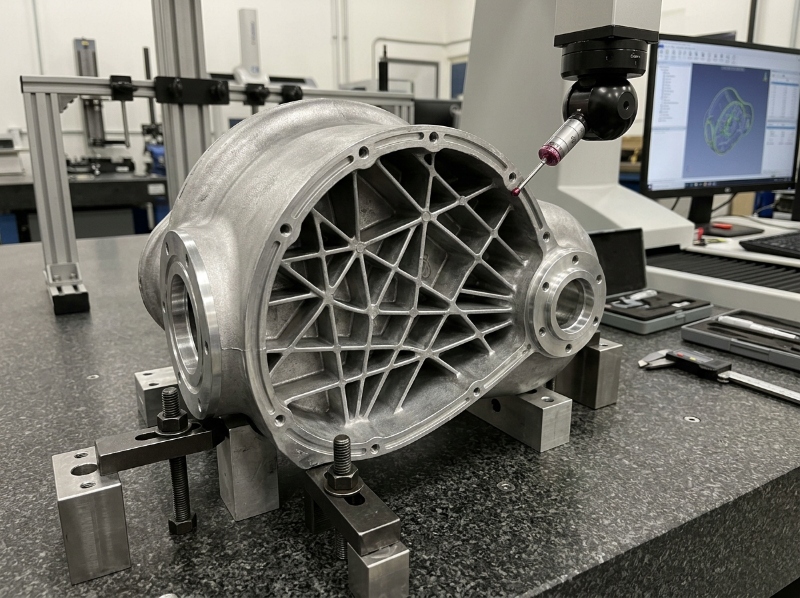
The caveat: none of this survives a sloppy design handover. The robotics CAD that looks clean on screen is often uncastable — undercut ribs, wall-thickness jumps, a parting line that traps air. The casting engineer needs to be in the room while the load cases are still fluid, not after the tool is cut.
Thin Walls, Cold Shuts, and the 1.5 mm Line
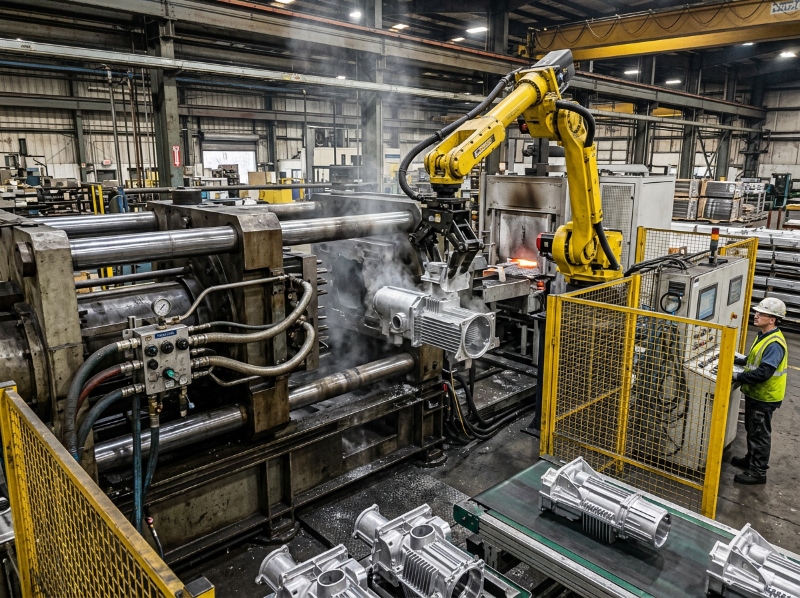
High-pressure die casting is a violent event. Metal enters the cavity at speeds above 50 metres per second under pressures that can approach 1,000 bar, and it is solidifying while it fills. Thin walls expose every weakness in the plan. As the wall shrinks, the metal freezes faster, and two metal fronts can meet without fusing — a cold shut, and a fatigue crack waiting to happen at exactly the section you were proudest of.
The countermeasures are not optional at this wall thickness:
Vacuum-assisted casting. Pulling vacuum on the cavity before injection removes much of the entrapped air and produces a denser part. For a joint expected to run thousands of hours, lower gas porosity converts directly into a more predictable fatigue life. It is the same reasoning we use on EV housings — see thin wall die casting in practice.
Fill and solidification simulation. CFD on the millisecond-long shot lets you move gates and overflows until the thin sections fill before they freeze. Guessing gate placement on a 1.5 mm rib network is a very expensive way to learn.
Non-negotiable process control. Si content in the 10–12% range buys fluidity; manganese additions suppress die soldering so the surface keeps its tolerance and the tool keeps its life.
The Real Reason to Switch: the Billet-to-Casting Case
Here is the pattern that repeats across projects. A humanoid programme prototypes its joint housings in CNC-machined 7075 — strong, quick to iterate, and expensive per unit. Machining also limits the geometry to what a cutter can reach, so the designer settles for simple shapes. When the programme moves to pre-production, the team redesigns for die-cast Al-Si-Mg.
The reported outcome of one such switch: about 25% less mass in the hip assembly, about 15% in the knee. The control team used the weight reduction to lift walking speed from 0.5 to 0.8 m/s at the same battery draw. Unit cost fell by more than 80%.
I would not wave that 80% around without the fine print, because it is the fine print that decides your project. Machined-from-billet and die-cast economics cross over only above a volume that justifies the tool. Below that crossover, billet still wins. The number varies with part size and complexity, but the logic does not: casting is a volume decision, and a humanoid programme that expects to build 5,000 units a year is past the line while a lab building twenty is not. That is also why a fair comparison belongs in any die casting vs CNC machining evaluation — including the amortised tool cost, not just the piece price.
Post-casting, two operations decide whether the part is actually good. Bearing seats and motor mounts come back onto a CNC for the micron-level fits that keep backlash and gear alignment in check — functionally, a bearing seat needs a controlled fit such as H7. And because a housing with thick bearing bosses and thin cover walls cools unevenly, a stress-relief step between casting and machining keeps the part from moving after you have cut it. Skip that and the bearing seizes three months into field use, which is a very public way to discover a residual-stress problem.
What to Put in Your RFQ
The good news is that a robot part is a normal casting part once you write the requirements down. The RFQ that goes out to your casting supplier should carry, at minimum:
- Alloy and temper, written explicitly — "6061-T6" or "AlSi10MnMg, as-cast" or "A380, no T6".
- Process route — CNC from billet, or die cast then post-machine.
- Critical interfaces, called out individually: bearing seats, gear mounting faces, sealing lands, datum pads.
- Finish — anodize type and colour, conversion coat, paint.
- Environment — indoor lab, humid home, coastal, sweat exposure. This alone changes the alloy conversation.
- Assembly details — steel inserts or helicoils needed, torque specs, expected service cycle count.
Most of the avoidable failures we see start with an RFQ that omits item 3. The supplier then guesses at which features are functional, and the guess shows up as a seized bearing.
The 2026 Supply Chain Reality
It is worth being clear-eyed about where these parts are made right now. The Optimus supply chain is heavily Chinese, and Tesla’s reported supplier audits in the delta region in September 2026 are a sign that the OEMs are locking capacity now rather than later. For a Western robot builder that brings a genuine tension: the same delta supply base that gives you cost and casting capacity also sits behind tariffs, export-control risk and, for anything crossing into the EU, the carbon accounting that now attaches to aluminium imports.
Three practical consequences. First, a supplier’s die casting capability matters less than its process documentation, because structural castings for a robot are only as good as their porosity and dimensional records. Second, dual-sourcing is not a slogan for a part with a 12-week tool — it is a decision to fund two tools or none. Third, for European assembly, ask early whether your supplier can produce the material and carbon data your importer now needs, not after the first shipment lands.
Where We Sit
We build structural aluminium castings for automotive and industrial customers, and the robotics and automation side of our industrial parts line is where these housings land. Our 13 cell high-pressure die casting line runs 350T to 3050T with VHPDC standard, backed by 150-plus 4- and 5-axis CNC stations for the post-cast machining a joint housing needs. IATF 16949 and VDA 6.3 "A" systems already carry the porosity, dimensional and leak-test records a robot programme audits against, and our Zeiss CMM and X-ray NDT close the loop on the critical features.
What we cannot do is make a humanoid programme cheap at prototype volumes — the tool economics above are real, and a twenty-unit lab build belongs on a billet, not a die. What we can do is take a part from the DFM table through tool, T1, and volume production once the design has settled. If you have a joint or actuator housing that needs to get off the mill, send us the drawings, the load cases and the annual volume.
Frequently Asked Questions
Q: Can humanoid robot parts really be die cast, or do they have to be machined?
A: Joint housings, actuator cases, covers and brackets are commonly die cast then machined on critical features like bearing seats and sealing lands. Load-bearing links are often machined from billet or extrusion because they are fatigue-critical and low volume. The choice usually tracks production volume.
Q: Which aluminium alloy is best for a robot joint housing?
A: There is no single answer. A380 suits general cast housings on cost and castability; A383/A384 help when fill and hot-cracking are problems; A360/360 helps where moisture or pressure tightness matters; Al-Si-Mg-Mn systems give thin-wall strength without a distorting T6. For machined links, 6061-T6 is the default and 7075 is for compact high-load parts.
Q: Why is die casting cheaper than CNC machining for robot housings?
A: Casting forms the near-net shape, including ribs and internal features a cutter cannot reach, so less metal is removed and less material is wasted. The saving is large at volume — reported cases exceed 80% per unit — but a die-cast route only crosses over above the volume that amortises the tool.
Q: What causes defects in thin-wall robot castings?
A: Cold shuts and gas porosity are the main risks. At 1.5 mm walls the metal freezes while filling, so two fronts can meet without fusing. Vacuum-assisted casting, gate and overflow tuning through CFD simulation, and tight process control on silicon and manganese content are the standard countermeasures.
Q: Do humanoid robot suppliers need IATF 16949?
A: Not by regulation, but the automotive-grade quality system is a useful proxy. A supplier that already holds IATF 16949 and runs documented porosity, dimensional and leak testing gives a robot programme the traceability it needs without building a new quality stack from scratch.


