

A finished car is not a CBAM good. The aluminium inside it is.
Since 1 January 2026 the EU’s Carbon Border Adjustment Mechanism has been running in its definitive regime. Importers of aluminium goods no longer only report embedded emissions — they buy and surrender CBAM certificates against them. Aluminium die castings sit inside that scope, typically under CN heading 7616, "other articles of aluminium". So do the EV motor housings, inverter casings, battery trays and structural brackets that our Tier 1 customers feed into European assembly lines.
What decides the certificate bill is one number: the specific embedded emissions of the imported part. Here is the trap. If nobody documents that number, the EU applies a default value — and for unwrought aluminium from China the 2026 default is 3.000 tCO₂e per tonne. A die casting poured from secondary ADC12, which is what most automotive die castings are actually made of, carries direct emissions nearer 0.1 tCO₂e per tonne. That is a gap of roughly thirty times, and your European buyer will price it into the next negotiation whether or not you have an opinion about it.
We have watched this play out in quote rounds through 2026: two Chinese suppliers, the same part, the same alloy, and one of them quietly loses on price because it cannot produce a scrap-content declaration. The difference is not the casting. It is the paperwork attached to the metal. quality control and material documentation is the same discipline — traceability, evidence, signed records — applied to carbon instead of dimensional tolerance.
What CBAM Actually Prices in a Die Casting
CBAM is a border carbon levy that mirrors the EU Emissions Trading System. It covers six sectors — steel, aluminium, cement, fertilisers, hydrogen and electricity. For every imported tonne of covered goods, the importer surrenders CBAM certificates equal to the embedded emissions, minus a free-allocation adjustment, minus any carbon price already paid in the country of origin.
For aluminium there is one structural quirk worth knowing before you open any spreadsheet. CBAM prices direct process emissions and perfluorocarbons (PFCs) only — not the electricity consumed in smelting. That restriction sits in Annex II of Regulation (EU) 2023/956. The EU’s reasoning is that European smelters already receive state compensation for indirect electricity costs, so charging imports for the same thing would be asymmetric. The consequence is blunt: for a primary smelter on a coal-heavy grid, the electricity that can represent 80% or more of its true carbon footprint simply is not charged.
For a die caster this quirk matters less than you would think, because your emissions were never electricity-dominated. What does matter is how a part’s embedded emissions are assembled:
Embedded emissions of a casting = emissions in the alloy you melted + direct emissions of your own melting, casting, trimming and machining.
And the first term is not the small one.
Where the Carbon Actually Sits: the Ingot, Not the Casting
This is the most useful thing to understand about CBAM and castings, and it is counter-intuitive if you picture the foundry as the dirty step.
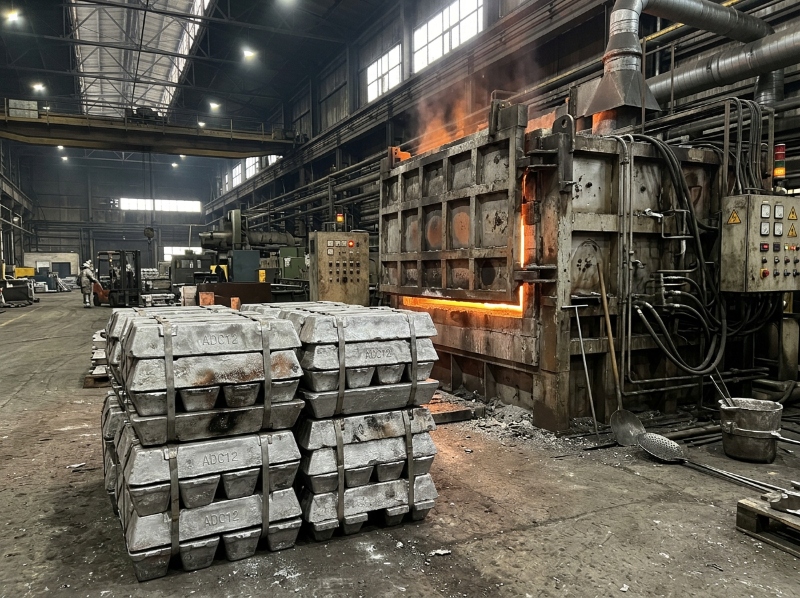
A die casting is, by mass, almost entirely its own alloy input. The furnace and the machine add energy; they do not add metal. So when you split specific embedded emissions per tonne of finished casting, the precursor alloy dominates. An independent component-level study of aluminium automotive parts under CBAM attributed 80.9% of total embedded emissions to the alloy precursor — the casting process itself was the remainder.
| Stage of production | Share of a casting’s embedded (direct) emissions |
|---|---|
| Aluminium alloy precursor (the ingot) | \~80% |
| Melting, holding, die casting | the bulk of the remainder |
| Trimming, machining, finishing | small, but not zero |
That split is good news for a die caster. The emissions you cannot control — your customer’s geometry, the machine you run — are minor. The emissions you can influence are large: which alloy you buy, and whether its recycled content is documented well enough for a verifier to accept.
Why the Chinese Default Value Is Roughly Thirty Times Reality
Default values exist for one reason: to make importers pay something when nobody puts a real number on the table. They are not averages of good practice. They are deliberately conservative, built from the full range of operating installations — including the least efficient — and they carry a penalty mark-up that grows every year.
For unwrought aluminium (CN 7601) the 2026 defaults are set per country and per production route:
| Origin (CN 7601, primary route) | Base default (tCO₂e/t) | With 2026 +10% mark-up | Mark-up from 2028 |
|---|---|---|---|
| China | 3.000 | 3.300 | +30% |
| UAE / Bahrain | 1.870 | 2.057 | +30% |
| Türkiye | 1.700 | 1.870 | +30% |
| No country-specific row (fallback) | 2.203 | 2.423 | +30% |
Mark-up schedule: +10% in 2026, +20% in 2027, +30% from 2028 onward, per Implementing Regulation (EU) 2025/2621 as corrected by IR (EU) 2026/1740.
Read the China row once more. Three tonnes of CO₂e per tonne of aluminium, on a route that assumes primary smelting. If your part is made from secondary alloy and you can prove it, the real number is not three. It is a fraction of one. The default is not measuring your casting. It is measuring the worst-case assumptions the EU is willing to accept in the absence of evidence — and the mark-up exists precisely to push you into supplying evidence.
Primary vs Secondary Alloy — the Lever You Actually Control
Secondary aluminium — alloy re-melted from scrap — carries direct embedded emissions of roughly 0.05 to 0.1 tCO₂e per tonne. Set that against coal-powered primary aluminium at 14 to 18 tCO₂e per tonne on a direct basis, and the difference is not incremental. It is fifteen to thirty times, and it survives any reasonable accounting.
The reason is worth stating plainly. Under current CBAM rules, post-consumer scrap is treated as a zero-emissions input: its carbon was already counted when the metal was first made, so it is not counted a second time. Re-melting also needs a fraction of the energy that electrolysis does, so even the furnace emissions stay low.
Now put that next to the alloys you already run. ADC12 and A380 — the two most common automotive die casting alloys — are secondary alloys. They are made from recycled stock, not smelted from alumina. The exact carbon advantage depends on how much of that stock is genuinely post-consumer and how well it is traced, but the direction is never in doubt. If you are still comparing these two grades on mechanical properties alone, ADC12 vs A380 now has a third column.
How the Certificate Bill Is Actually Calculated
The formula is worth putting in front of your buyer:
Certificates per tonne = specific embedded emissions − (CBAM factor × benchmark) − carbon price paid in the country of origin
The benchmark for primary unwrought aluminium in 2026 is 1.423 tCO₂e per tonne. The CBAM factor — the share of EU free allocation still retained — starts at 97.5% in 2026 and falls to zero by 2034. So the free-allocation adjustment this year is 0.975 × 1.423 = 1.387 tCO₂e per tonne.
Work that through at the Q1 2026 certificate price of €75.36 per tonne CO₂e:
| Route (CN 7601, 2026) | Embedded emissions (tCO₂e/t) | Minus free allocation (1.387) | Certificates due | Cost @ €75.36/t |
|---|---|---|---|---|
| China, default +10% | 3.300 | 1.913 | 1.913 | ≈€144 |
| UAE, default +10% | 2.057 | 0.670 | 0.670 | ≈€50 |
| Modern secondary ingot, verified actual | 0.10 | floored at 0 | 0.000 | €0.00 |
Notice the bottom row. In 2026 the free-allocation deduction is so large that a clean, well-documented secondary route pays effectively nothing — the deduction swallows the whole embedded footprint. That will not last. The factor collapses on a fixed schedule:
| Year | CBAM factor (free allocation retained) |
|---|---|
| 2026 | 97.5% |
| 2027 | 95% |
| 2028 | 90% |
| 2029 | 77.5% |
| 2030 | 51.5% |
| 2034 | 0% |
By 2030 the shield is half gone, and by 2034 the importer pays for every tonne of embedded carbon in full. A supplier that is competitive on the default route in 2026 may be uncompetitive on the same route in 2030. Anyone buying castings for an eight-to-ten-year vehicle programme is making that decision right now.
What Your Die Caster Has to Hand You
Non-EU producers carry no direct legal obligation under CBAM. The declarant is the EU importer. But the importer cannot report a low number without the producer’s data, so the commercial pressure lands on the supplier. A usable data package for a casting installation covers:
- Installation identification: legal name, site address, UN/LOCODE and coordinates.
- Production route and system boundaries, fixed in a monitoring plan.
- Specific direct embedded emissions per tonne of product, calculated under the methodology in IR (EU) 2025/2547.
- Documented scrap content, split into post-consumer (zero-rated) and pre-consumer input.
- Any carbon price already paid in the country of origin, where a recognised scheme applies.
Then comes the step no supplier can skip: the numbers must be verified by a verifier accredited under EN ISO/IEC 14065, and the first verification period requires a physical site visit. Verifier fees run from roughly €5,000 to €50,000 per site. That is a real cost, and for a long tail of small suppliers it is enough of a barrier that they simply stay on default values — which is exactly why a verified supplier gains price room.
Scrap Traceability Is the 2027 Problem
The clean story above — post-consumer scrap is free — has a soft spot, and the EU has already started to poke at it. In June 2026 the Council moved to bring pre-consumer scrap into CBAM scope, on the argument that scrap content was too easy to use as an accounting loophole. Post-consumer versus pre-consumer now matters, and it matters for die casters specifically, because a foundry generates its own process scrap: runners, overflows, rejected shots, all remelted in-house every day.
Ask a simple question of your own plant before an auditor does: can you show, per heat, how much of the charge was post-consumer scrap and how much was internal return? If the answer is a shrug, that is the gap to close in 2026, while verification is still voluntary and comparatively cheap.
What Changes in 2027 and 2028
Two dates are worth diarising.
From February 2027 the certificate platform opens and prices move from quarterly to weekly. Declarants must also hold certificates covering at least 50% of cumulative emissions at the end of each quarter. For 2026 imports, the first annual declaration is due by 30 September 2027 — which means the emissions data for parts you ship this year has to be assembled now, not next year.
And the scope is widening. The Commission proposal COM(2025)989 extends CBAM to roughly 180 downstream products, including automotive items that are not raw aluminium at all — chassis, gearboxes, wheels, radiators. The Council adopted the proposal in mid-2026, a final deal is expected by end-2026 or early 2027, and it takes effect on 1 January 2028. The old trick of dodging CBAM by importing a finished part instead of raw metal stops working at that point. If your castings already feed those assemblies, the clock is running — and it is worth weighing against the wider China vs Europe supplier trade-offs you already track on price and lead time.
What We Can Give You at EMP Tech
We are a die caster, not a smelter, so we will not pretend to solve the upstream half of this. But the half we control, we can document. Our 13 die casting cells from 350T to 3050T run secondary ADC12 and A380 sourced as recycled ingot, and we can trace and declare scrap content per heat rather than per year. Our IATF 16949 and VDA 6.3 "A" systems already generate the material traceability a verifier asks for; adding carbon to that paperwork is an extension, not a rebuild.
What we cannot do is sign your CBAM declaration, or stand in for the accredited verifier. Those are the importer’s obligations, and honestly they should stay with the importer. What we can do is hand your buyer a defensible, verifiable data package for the castings we make, so the reported number reflects the alloy rather than the default. If you want to see what that looks like against a specific part, send us the drawings and the annual volume.
Frequently Asked Questions
Q: Does CBAM apply to aluminium die castings, or only to raw aluminium?
A: It applies to castings. Most machined and cast aluminium automotive articles enter under CN heading 7616 ("other articles of aluminium"), which is CBAM-covered. The obligation falls on the EU importer, who surrenders certificates for the embedded emissions of the imported part.
Q: Why is the CBAM default value for China so much higher than my casting’s real emissions?
A: Default values are deliberately conservative — built from the full range of operating installations including the least efficient, and weighted toward primary smelting. For unwrought aluminium from China the 2026 default is 3.000 tCO₂e/t. A secondary-alloy casting is far lower, but you only get that lower figure by supplying verified actual data.
Q: Do recycled aluminium castings avoid CBAM cost?
A: Largely, in 2026. Post-consumer scrap is treated as a zero-emissions input and secondary re-melting adds very little direct CO₂, so a verified secondary-route casting pays close to zero once the free-allocation deduction is applied. That advantage shrinks as the deduction phases out to zero by 2034.
Q: What emissions data must my die casting supplier give me?
A: The installation’s identity and location, a monitoring plan defining system boundaries, specific direct embedded emissions per tonne of product under IR (EU) 2025/2547, documented post-consumer versus pre-consumer scrap content, and any recognised carbon price already paid. The data must then be verified by an EU-accredited verifier.
Q: When is the first CBAM declaration due for 2026 imports?
A: By 30 September 2027. Certificate prices were published quarterly through 2026 (Q1 was €75.36 per tonne CO₂e), the buying platform opens in February 2027, and from 2027 the price is published weekly. Data for 2026 shipments therefore has to be collected during 2026.


