

Every piece-price comparison spreadsheet a Tier 1 buyer builds looks clean — three suppliers, one column each, lowest number wins. What that spreadsheet almost never captures is where the real cost delta shows up over a program’s life: tooling amortization assumptions, secondary operation scope creep, engineering change cycles, and logistics structure. We’ve watched programs where the "cheaper" quote ended up 8–15% more expensive by SOP because none of that was priced in upfront.
This article walks through the cost categories that don’t appear on a standard RFQ line item but consistently determine total program cost.

1. Tooling Amortization Assumptions
The tooling quote itself is rarely the hidden cost — the amortization volume baked into the piece price is. If a supplier amortizes tooling over 500,000 units and your actual program runs 300,000 over its life, you’re paying a piece price that never fully recovers tooling cost, and the gap either surfaces as a renegotiation mid-program or gets absorbed silently by the supplier cutting corners elsewhere (skipped PM cycles, deferred cavity repair).
| Amortization Volume Assumption | Piece Price Impact if Actual Volume Is 30% Lower |
|---|---|
| Matches actual program volume | No hidden cost |
| Overstated by 20% | Piece price effectively 15–20% underpriced vs. true cost |
| Overstated by 40%+ | Tooling cost recovery gap typically resolved via mid-program price increase |
We ask for the customer’s realistic P50/P90 volume forecast before quoting amortization, not just the program’s nameplate capacity number, because that’s the number that actually determines whether the piece price is sustainable for both sides.
2. Secondary Operation Scope That Isn’t in the Casting Quote
A casting RFQ frequently specifies the net shape and tolerance callouts but leaves ambiguous exactly which operations are "in scope" for the piece price versus billed separately.
- Deburring and flash removal — often assumed included, sometimes quoted as a separate line depending on flash severity at the parting line
- Leak testing — 100% in-line testing vs. sample-based testing is a real cost delta (roughly 2-4% of piece price), and a quote that doesn’t specify testing coverage percentage is a quote you should send back for clarification
- Impregnation (for porosity-sensitive sealing applications) — this can add 5-8% to piece cost and is frequently omitted from an initial quote, then discovered as a "surprise" after first-article leak failures
- Post-machining tolerance work — as covered in tolerance-focused RFQs, any feature tighter than as-cast CT4-6 capability needs machining time costed separately, and vague scope here is one of the most common line items we see added after SOP
3. Engineering Change Cost Structure
Design changes after tool-cut are treated very differently supplier to supplier, and this is where total program cost diverges most sharply from the initial quote.
| Change Type | Typical Cost Driver | What Gets Missed in Early Quotes |
|---|---|---|
| Minor dimensional adjustment (no cavity insert change) | CNC program re-work, CMM re-qualification | Re-qualification lead time, not just machining hours |
| Cavity insert modification | New insert machining + die trial time | Trial shots consumed (material + press time), not just insert cost |
| Gate/runner redesign | Full Moldflow re-simulation + trial | Simulation engineering hours often billed separately, frequently absent from initial ECN quote |
| Added feature (boss, rib) | Cavity welding/insert + full re-validation | PPAP re-submission cost — this is the one buyers most consistently underestimate |
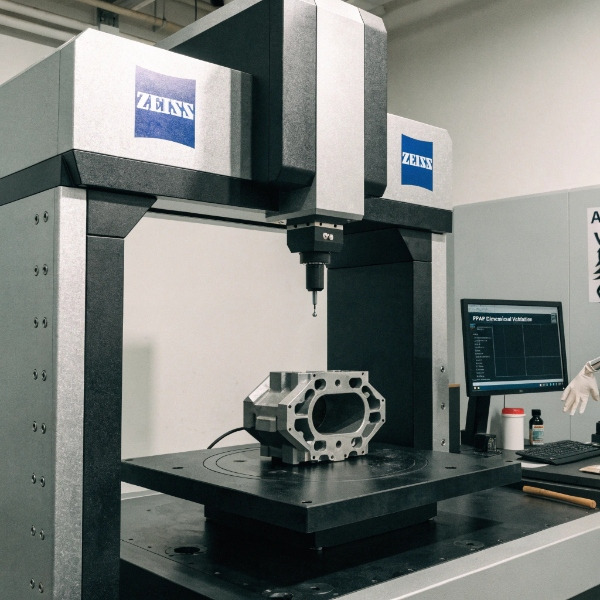
A PPAP re-submission triggered by any dimensional-affecting change isn’t a formality — it’s CMM time, updated FAI documentation, and typically a 2-4 week schedule impact that rarely appears as a line item in an ECN quote, even though it’s unavoidable under IATF 16949 change-control requirements.
4. Logistics and Incoterm Structure
FOB vs. DDP quotes from two suppliers aren’t comparable on piece price alone, and this is one of the most common apples-to-oranges mistakes we see in RFQ comparisons.
| Cost Element | Often Buried Under | Reality |
|---|---|---|
| Ocean freight volatility | "FOB" quotes that push freight risk to buyer | Container rates have shown 3-5x swings in recent years; a fixed piece price on FOB terms doesn’t protect against this |
| Customs duty classification | Assumed straightforward | Misclassified HS codes on machined vs. raw castings can shift duty rate materially |
| Packaging engineering | Assumed included | Custom dunnage for thin-wall housings (preventing transit damage on non-machined datum faces) is frequently a separate line, and skipping it shows up later as transit-damage scrap |
| Buffer/safety stock carrying cost | Not on the supplier quote at all | Sits on the buyer’s balance sheet, but a supplier with unreliable OTD forces higher buffer stock — a real cost driven by supplier reliability, not listed anywhere |
5. Quality Escape Cost — The One That Doesn’t Show Up Until It’s Expensive
This is the category buyers most underweight during sourcing because it’s probabilistic, not a line item. A supplier with a VDA 6.3 "B" rating and a supplier with an "A" rating can quote the same piece price, but the downstream cost profile is not the same.
- Field failure containment cost — if a leak-path defect escapes 100% in-line testing (because the supplier only does sample testing) and reaches a Tier 1 assembly line or worse, the field, containment and sorting costs dwarf any piece-price saving that justified the sourcing decision
- 8D/corrective action cycle time — a supplier without a mature root-cause process burns weeks on containment before the actual fix, during which the buyer’s line is either running suspect stock or expediting alternate supply at a premium
- Audit and re-qualification cost — a quality escape often triggers a for-cause audit, which has direct cost (buyer engineering travel/time) independent of the part cost itself
What This Means for RFQ Evaluation
We tell customers directly: a piece-price-only comparison across suppliers is comparing incomplete numbers. A defensible total cost of ownership comparison needs, at minimum, amortization volume assumptions stated explicitly, secondary operation scope itemized rather than bundled into "miscellaneous," an ECN cost structure agreed before tool-cut (not negotiated per-change), and Incoterm-normalized landed cost rather than raw FOB piece price. None of this shows up as a lower number on the first page of a quote comparison — which is exactly why it’s the part of the sourcing decision that determines whether a program is actually profitable by its second year.


