

For decades, the automotive die casting supply chain was highly predictable. A foundry’s primary job was to pour ADC12 aluminum into hardened H13 steel molds to produce transmission cases, oil pans, and engine brackets. If a part had minor internal porosity, it was generally acceptable as long as it didn’t leak oil or fail a basic tensile test.
The transition to Electric Vehicles (EVs) has violently shattered that baseline.
Today, if a foundry attempts to cast an 800V EV motor controller housing1 using the exact same thermodynamic parameters they used for a legacy oil pan, they will face catastrophic scrap rates. EV components are no longer simple protective covers; they are highly integrated convergence points for high-voltage power distribution, active liquid cooling, and extreme dynamic loads.
As a Tier 2 manufacturing partner navigating these physical limits daily on our CNC floors and high-pressure die casting (HPDC) cells, here is an objective look at how EV architecture has fundamentally rewritten the rules for automotive die casting solutions2.
1. From "Fluid Containment" to "Active Thermal Management"
In an internal combustion engine (ICE), an oil pan simply holds fluid. In an EV, thermal management dictates the continuous power output and safety of the entire vehicle.
To cool stators and silicon carbide (SiC) power modules, engineers must design housings with complex internal water jackets and dense pin-fin structures.
The Manufacturing Reality: Casting deep, intricate water jackets requires massive steel core pulls. If the draft angles are not perfectly calculated, the shrinking aluminum will grip the steel cores, causing galling or cold shuts during ejection.
Furthermore, thick sealing flanges next to 1.5mm thin walls create severe thermal gradients. The thin wall freezes instantly, cutting off the feeding path to the thick flange, resulting in severe shrinkage porosity. If a CNC tool cuts an O-ring groove right through that porous center, coolant will inevitably leak into the high-voltage cavity.
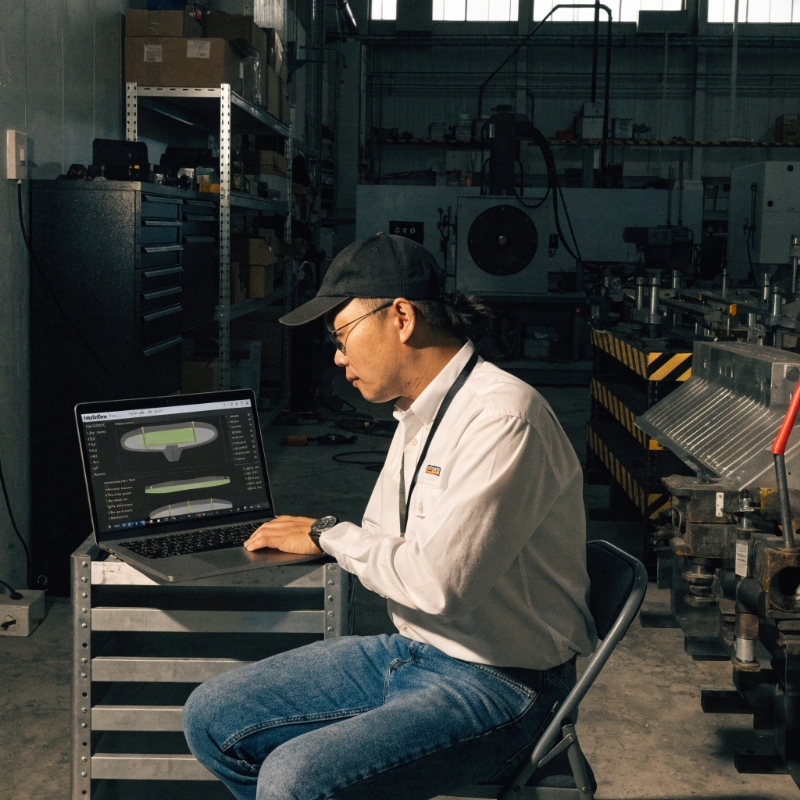
To mitigate this, foundries can no longer rely on operator guesswork. We must enforce strict NADCA design guidelines3 through predictive Moldflow simulations, pushing unavoidable porosity into overflow wells and away from critical CNC-machined sealing faces.
2. The Shift in Alloy Chemistry and Structural Demands
Historically, a die casting just needed to be rigid. In the EV era, structural components like battery trays and chassis nodes must absorb massive amounts of kinetic energy during a crash without shattering.
The Manufacturing Reality: Standard commercial alloys like ADC12 are too brittle for EV structural components. The industry has shifted toward highly ductile alloys, such as AlSi10MnMg.
However, you cannot heat-treat a standard die casting to increase its yield strength. The trapped air inside the casting will expand in the T6 heat treatment oven, causing the part’s surface to blister. To cast these structural alloys successfully, foundries must utilize Vacuum HPDC—evacuating air from the mold cavity milliseconds before the fast shot is triggered.
Paradigm Shift: Legacy ICE vs. Modern EV Castings
| Engineering Metric | Legacy ICE Component (e.g., Oil Pan) | Modern EV Component (e.g., Inverter Housing) |
|---|---|---|
| Primary Function | Debris protection, fluid containment | Heat dissipation, EMI shielding, structural load |
| Typical Alloys | ADC12, A380 | AlSi10MnMg, A356, Custom high-thermal alloys |
| Machining Tolerance | Loose (±0.1 mm to ±0.5 mm) | Micron-level (±0.01 mm for stator bearing bores) |
| Defect Tolerance | Minor porosity acceptable | Micro-porosity in sealing grooves causes fatal leaks |
| Cleanliness Standard | Basic compressed air blow-off | Strict gravimetric extraction (VDA 19 / ISO 16232) |
3. CNC Machining as the Ultimate Bottleneck
A common misconception is that die casting is a standalone process. In the EV supply chain, the casting is only a near-net-shape blank; the final Geometric Dimensioning and Tolerancing (GD&T) depends entirely on the CNC machining phase.
EV drive motors spin at upward of 20,000 RPM. At these speeds, if the front and rear bearing bores are misaligned by a fraction of a millimeter, the motor will suffer from severe gear whine and catastrophic NVH (Noise, Vibration, and Harshness) failures.
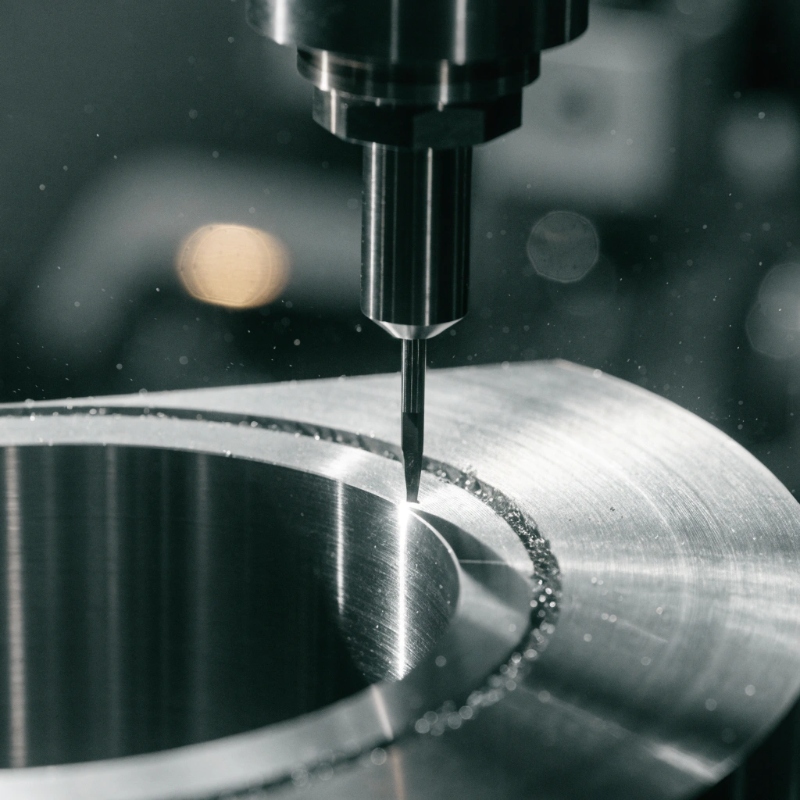
The Manufacturing Reality: You cannot achieve micron-level concentricity if the housing is moved between multiple 3-axis CNC machines. Every time a part is unclamped and re-clamped, tolerance stack-up errors multiply. Foundries must now operate single-setup 4-axis or 5-axis CNC machining centers, utilizing custom low-distortion fixturing to mill opposing bearing bores and stator press-fit diameters in one continuous operation.
4. Technical Cleanliness (The Invisible Threat)
Perhaps the most overlooked change in the EV era is the requirement for absolute technical cleanliness.
EV housings are riddled with blind tapped holes designed for mounting internal busbars and power electronics. During CNC tapping, these holes trap cutting fluids and microscopic aluminum chips. If those conductive burrs shake loose during vehicle operation, they will fall directly onto a high-voltage PCB, causing a fatal short circuit.
Foundries can no longer rely on an operator with an air hose. To pass Tier 1 OEM audits, suppliers must operate dedicated ultrasonic washing and vacuum drying lines, supported by a quality control standards4 lab that validates particle extraction weights against rigorous VDA 19 technical cleanliness standards5.
Securing Your EV Supply Chain
The transition to EVs has brutally exposed foundries that lack thermodynamic control and precision metrology. As a dedicated Tier 2 manufacturing partner, EMP Tech understands that you cannot inspect quality into a part that was cast with a flawed thermal design.
By keeping mold design, Vacuum HPDC, 5-axis CNC machining, and Zeiss CMM validation under one roof, we help global Tier 1 integrators mitigate supply chain risks and ensure their assembly lines run without friction.
Are you developing a new thermal management housing or structural EV component? Upload your 3D CAD (STEP/IGES) via our contact form today. Our engineering team will run a ruthless DFM analysis, identify potential shrink porosity traps, and deliver a pragmatic manufacturing quote within 24 hours.
References & Footnotes
EMP Tech. EV Motor Controller Housing Engineering Specifications. ↩
EMP Tech. Automotive Aluminum Die Casting Solutions & Capabilities. ↩
North American Die Casting Association (NADCA). Engineering & Design Standards. ↩
EMP Tech. Automotive-Grade Quality Control & Inspection Laboratory. ↩
Verband der Automobilindustrie (VDA). VDA 19.1: Inspection of Technical Cleanliness. ↩


