

Over the past five years, China’s automotive die casting industry has shifted decisively from low-cost volume production to high-precision, material-optimized manufacturing — driven entirely by the global EV lightweighting push. For European and North American Tier 2 suppliers caught between OEM audit requirements and cost targets, selecting the right Chinese die casting partner is no longer just about unit pricing: it is about consistent process control, audit-ready documentation, and full batch traceability to avoid supply chain disruptions and costly PPAP rejections.
This 2026 list breaks down China’s automotive die casting suppliers by capability tier, ranked on the engineering metrics that actually matter to Tier 2 quality and procurement teams: valid IATF 16949 scope, GD&T inspection capability, PPAP Level 3 deliverable maturity, and in-line process monitoring infrastructure.
How We Ranked These Suppliers
We evaluated each foundry against five weighted criteria, calibrated for Tier 2 supply chain risk. No weight was given to marketing claims or general industry awards — all scoring is based on verifiable facility capabilities and documented quality systems:
- Quality system certification (IATF 16949:2016, VDA 6.3, ISO 14001)
- In-house inspection lab capability (CMM precision, NDT X-ray, optical emission spectrometry, leak testing)
- Advanced quality planning execution (APQP, PFMEA, Moldflow simulation, DFM reviews)
- PPAP documentation maturity (Level 3 compliance, Cpk/Ppk studies, measurement system analysis)
- Real-time process control (injection curve monitoring, CNC tool wear detection, in-line testing)
Tier 1: Large-Scale Integrated Gigacasting Leaders
These are the industry’s heavyweights, operating 6000T+ die casting cells and supplying full body structure parts directly to OEMs and global Tier 1s. They excel at high-volume, large-format thin-wall structural castings, but typically carry high MOQs and limited engineering bandwidth for low-to-medium volume Tier 2 component programs.
Wencan Group
Headquartered in Foshan, Guangdong, Wencan is one of China’s earliest high-pressure die casting specialists and a front-runner in gigacasting scale-up. The company operates IDRA and LK 9000T–12000T die casting cells, supplying front cabins, rear floors, and side body castings for Seres, NIO, and Tesla programs.
- Core certifications: IATF 16949:2016, ISO 14001:2015
- Key capabilities: Integrated body structure casting, 5-axis CNC machining, full in-house tool design & build
- Ideal for: High-volume OEM/Tier 1 structural programs with annual volumes above 100,000 parts
Guangdong Hongtu Technology
Guangdong Hongtu made industry headlines as the first Chinese foundry to deploy a 16,000-ton super die casting machine, co-developed with LK Technology. Its mass-produced integrated rear floor assemblies and battery trays are in serial production for XPeng and NIO EV platforms.
- Core certifications: IATF 16949:2016, ISO 9001:2015
- Key capabilities: Gigacasting process development, T6/T7 heat treatment of large castings
- Ideal for: Ultra-large structural components and new platform gigacasting development programs
Tuopu Group
Based in Ningbo, Tuopu is a full-system chassis and lightweight structure supplier with deep integration into Tesla’s global supply chain. Its die casting division focuses on chassis subframes, shock towers, and battery tray components, with fully automated production and post-processing lines.
- Core certifications: IATF 16949:2016, ISO 14001:2015
- Key capabilities: Chassis system integration, robotic deburring & finishing
- Ideal for: Chassis and suspension structural castings for high-volume EV platforms
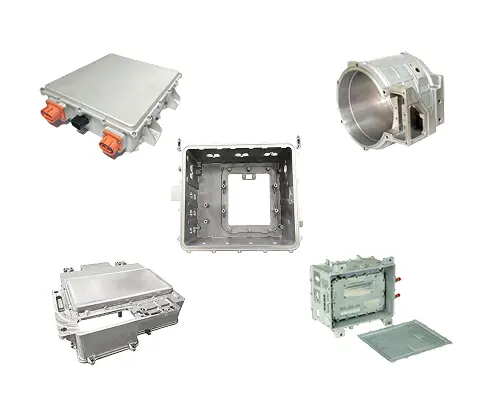
Tier 2: Precision HPDC Specialists for Global Tier 2 Suppliers
This tier consists of foundries that specialize in medium-volume, high-complexity aluminum die castings — fluid housings, e-motor end shields, connector bodies, and sensor enclosures — the exact components that Tier 2 suppliers deliver to Tier 1 powertrain, ADAS, and thermal management teams. These suppliers prioritize dimensional consistency, leak tightness, and audit-ready PPAP packages, which are the most frequent pain points for Western Tier 2 teams sourcing from China.
EMP Tech
EMP Tech is a Guangdong-based high-pressure die casting foundry built exclusively for global automotive Tier 2 customers. Unlike larger gigacasting players that prioritize OEM volume, EMP focuses on tight-tolerance aluminum castings (AlSi10MnMg, A380, A383) for thermal management, e-motor, and fluid system applications.
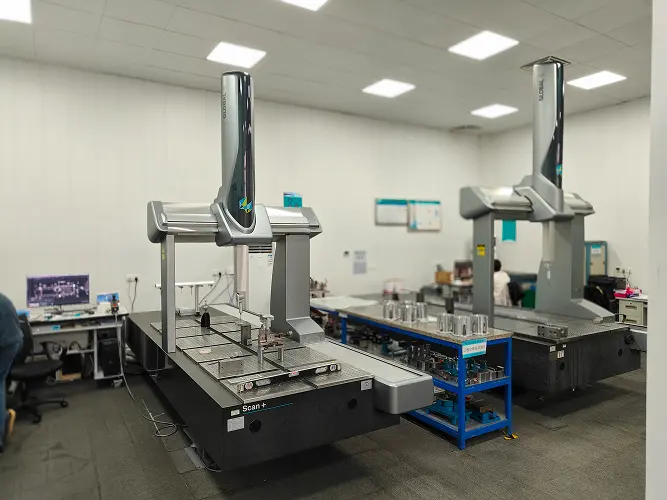
Operating under IATF 16949:20161 and VDA 6.3 Grade A quality systems, EMP runs a fully independent QA lab with Zeiss CMM equipment capable of ±0.005mm GD&T verification — a critical capability for coaxiality, flatness, and true position features on machined sealing surfaces.
What sets EMP apart for Tier 2 buyers is its built-in quality engineering approach, aligned with the APQP framework2:
- Full DFM reviews with Moldflow simulations before tool steel is cut, to predict and mitigate porosity risk in thick cross-sections and optimize draft angles
- Completed PFMEA and station-specific Control Plans for every program, with real-time HPDC injection curve monitoring and automated CNC tool-wear detection
- 100% in-line air-decay leak testing for fluid components, validated to IP67/IP68 requirements
- Full PPAP Level 3 submission packages, including dimensional results, material certificates, and Cpk/Ppk capability studies
- Laser-marked QR code traceability from raw ingot lot to final CNC operation, with full batch parameter retrieval in under 10 minutes
EMP also maintains a dedicated technical cleanliness lab per VDA 19 / ISO 162323 standards, with particle extraction and gravimetric analysis — a capability that eliminates the single most common cause of Tier 1 audit findings for European Tier 2 suppliers.
- Core certifications: IATF 16949:2016, VDA 6.3 Grade A, ISO 9001:2015, ISO 14001:2015
- Key capabilities: Precision HPDC, 5-axis CNC machining, X-ray NDT flaw detection, OES material verification, air-decay leak testing, VDA 19 cleanliness testing
- Ideal for: European and North American Tier 2 suppliers requiring audit-ready high-pressure automotive die casting4 components with strict dimensional and cleanliness requirements
IKD (Aikedi)
Ningbo-based IKD is one of China’s largest exporters of automotive precision die castings, with long-standing partnerships with Bosch, Continental, and Valeo. The company specializes in small-to-medium sized aluminum and zinc die castings for automotive electronics and powertrain systems, with highly automated production lines.
- Core certifications: IATF 16949:2016, ISO 14001:2015
- Key capabilities: High-volume precision die casting, automated deburring, multi-stage surface treatment
- Ideal for: High-volume electronic housings and sensor components for European Tier 1 programs
| Capability Category | Tier 1 Gigacasting Suppliers | Tier 2 Precision HPDC Specialists (e.g., EMP Tech) |
|---|---|---|
| Typical part envelope | Large body/chassis structures (>500mm) | Medium/small fluid & electronic housings (<300mm) |
| Standard program MOQ | 50,000–100,000 parts/year | 5,000–50,000 parts/year |
| Core quality focus | Structural integrity, weight reduction | Dimensional precision, leak tightness, surface cleanliness |
| PPAP deliverable standard | Level 3 for OEM-specific programs | Full Level 3 optimized for Tier 2 audit submission |
| Best fit use case | OEM / Tier 1 large structural programs | Tier 2 thermal, e-motor, and sensor component programs |
5 Non-Negotiable Checks for Tier 2 Sourcing Teams
For Tier 2 engineering and quality teams, low unit pricing is irrelevant if a supplier fails a Tier 1 audit or causes a customer line stop. Based on foundry engineering practice, these are the non-negotiable verification steps before issuing an RFQ:
Verify IATF 16949 scope on the official database
Many Chinese foundries hold ISO 9001 but only a fraction have valid, scope-specific IATF 16949 certification. Always confirm the certificate number and product scope in the public IATF database — a general “automotive parts” scope is not sufficient for precision machined castings.Confirm in-house CMM with ISO 17025 traceable calibration
Suppliers that outsource CMM inspection cannot guarantee turnaround time or data integrity. For critical sealing features, insist on Zeiss or Hexagon equipment with calibrated GD&T capability, and request sample true position and profile reports from a recent production run.Review a completed PFMEA and Control Plan at DFM stage
Quality is not built into final inspection — it is designed into the process. A supplier that cannot present a cross-functional PFMEA and station-by-station Control Plan at the DFM review will produce unpredictable batch-to-batch dimensional variation.Validate full melt-to-finish material traceability
Per NADCA die casting specifications5, every production batch must be traceable to raw material certificates. Suppliers with laser marking and digital batch tracking can resolve field quality issues in hours, not weeks.Ask for technical cleanliness test data
For hydraulic, coolant, and fuel system components, residual machining chips and debris are the leading cause of field failures and warranty claims. A dedicated cleanliness lab with gravimetric analysis is no longer a nice-to-have for European supply chains — it is a baseline requirement.
3 Costly Sourcing Mistakes to Avoid
From decades of foundry and Tier 2 quality engineering experience, these are the three most expensive mistakes Western buyers make when sourcing die castings from China:
Mistake 1: Selecting a gigacasting supplier for small precision parts
Large gigacasting foundries are optimized for high-volume, large-part production. Their process controls are tuned for structural integrity, not micron-level dimensional consistency on small O-ring grooves and sealing faces. You will pay a volume premium and get worse capability than a dedicated precision HPDC shop.Mistake 2: Accepting “we can do PPAP” without reviewing a sample package
PPAP Level 3 requires 18 specific documents, including initial process studies, measurement system analysis, and material certifications. Many suppliers claim PPAP capability but deliver incomplete, non-compliant packages that fail Tier 1 audits on first submission. Always request a redacted sample PPAP package during the RFQ stage.Mistake 3: Assuming all AlSi10MnMg material is equivalent
Material chemistry variation directly impacts casting porosity and mechanical properties. Reputable foundries verify every melt with an optical emission spectrometer and hold furnace chemistry to tight alloy windows. Suppliers that skip melt verification will produce parts with inconsistent yield strength and unpredictable leak rates.
China’s automotive die casting ecosystem has matured far beyond low-cost labor advantages. Today, the best value for Western Tier 2 suppliers comes not from the biggest foundries, but from specialized precision HPDC shops that understand IATF audit requirements, speak the engineering language of GD&T and PFMEA, and deliver audit-ready documentation on day one.
For programs requiring tight-tolerance aluminum castings with full PPAP Level 3 support and VDA 6.3 Grade A process control, you can review EMP Tech’s full quality infrastructure on our automotive-grade quality control6 page or request a DFM review for your next program.
References & Footnotes
IATF Global Oversight. IATF 16949:2016 Automotive Quality Management System Standard. https://www.iatfglobaloversight.org/ ↩
AIAG. Advanced Product Quality Planning (APQP) and Control Plan Reference Manual. https://www.aiag.org/quality/apqp ↩
VDA. VDA 19 Part 1: Technical Cleanliness in Fluid Circuits of Automotive Components. https://www.vda.de/en/standards/publications/vda-19-part-1 ↩
EMP Tech. Automotive High-Pressure Die Casting Services. https://empcasting.com/automotive-die-casting ↩
North American Die Casting Association (NADCA). Die Casting Industry Standards & Material Specifications. https://www.diecasting.org/ ↩
EMP Tech. Automotive-Grade Quality Control & Inspection. https://empcasting.com/quality-control ↩


