

Auditing an automotive die casting supplier1 has changed dramatically over the last few years. As a Tier 1 system integrator or OEM procurement manager, you can no longer rely on a simple facility tour and a generic ISO 9001 certificate. The shift toward complex electric vehicle (EV) architectures means that a foundry capable of pouring simple brackets a decade ago may completely fail when tasked with producing a thin-walled, leak-proof thermal management enclosure today.
If you source a flawed casting, the real pain doesn’t happen at the foundry—it happens on your assembly line when a misaligned bearing bore causes a motor to fail, or when residual machining chips short out a high-voltage board.
To mitigate secondary supply chain risks and avoid the dreaded "vendor blame game," you must interrogate your potential Tier 2 partners with gritty, engineering-focused questions. Based on decades of experience on the high-pressure die casting (HPDC) floor, here are the top 10 questions you must ask your next supplier.
Engineering & Tooling (The Foundation)
1. "Do you manufacture your tooling in-house, and how do you handle predictive DFM?"
Why it matters: 80% of casting defects are locked in the moment the H13 tool steel is cut. If a supplier outsources their mold-making, they lose control over the timeline and the thermodynamic design of the die.
What to listen for: They must perform Moldflow simulations to optimize gating systems and draft angles before production begins, strictly adhering to NADCA design guidelines2. In-house tooling means when T1 samples have dimensional deviations, they can modify the tool in days, not weeks.
2. "How do you manage internal porosity on thick mounting bosses?"
Why it matters: Molten aluminum shrinks as it cools. Thick sections freeze last, making them a magnet for micro-porosity. If a supplier promises "absolute zero porosity," they are lying about metallurgical physics.
What to listen for: The correct engineering answer is porosity management. They should explain how they use Vacuum HPDC to evacuate air from the cavity, and how they design overflow wells to intentionally pull trapped gas away from critical structural nodes and sealing faces.
Machining & Precision (The Execution)
3. "Do you perform CNC machining in-house, and how many setups are required for my part?"
Why it matters: The casting process only gives you a near-net shape. The critical geometric dimensioning and tolerancing (GD&T) required for EV motor controller housings3 depends entirely on the CNC phase.
What to listen for: Multiple setups on 3-axis machines will result in tolerance stack-up errors. You want to hear that they use single-setup 4-axis or 5-axis CNC machining to guarantee strict coaxiality between opposing bearing bores and true position for mounting features.
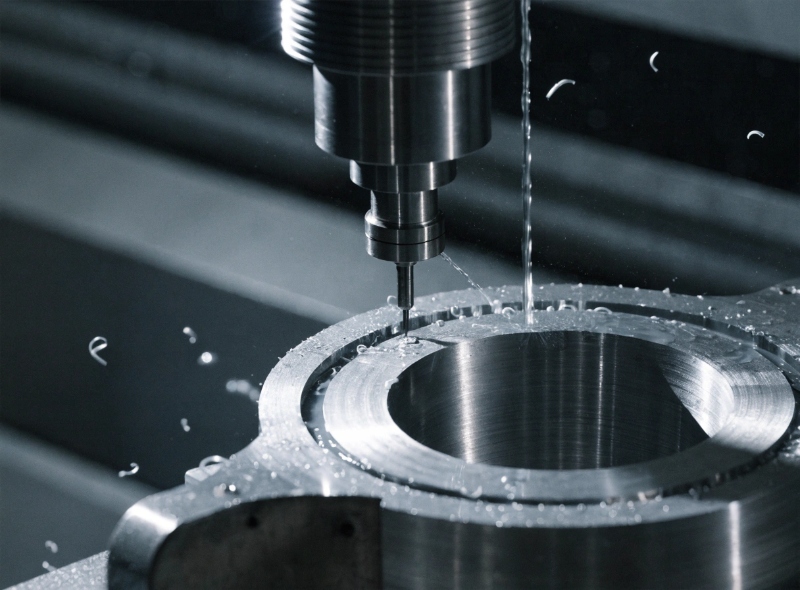
4. "How do you ensure flatness and surface roughness (Ra) in O-ring grooves?"
Why it matters: 90% of coolant leaks happen right at the machined O-ring groove. If the CNC tool mills away the dense outer "skin" of the casting and exposes a porous core, the O-ring will fail to seal against the rough surface.
What to listen for: They should discuss optimizing tool feed rates to maintain strict surface roughness (Ra) and utilizing custom, low-distortion fixturing to prevent the part from warping once the clamps are released.
Quality Control & Compliance (The Proof)
5. "How do you verify fluid-tight and gas-tight sealing?"
Why it matters: Visual inspections cannot detect micro-leaks. Relying on your assembly line to find a leaking water jacket is a catastrophic failure in quality control.
What to listen for: They must employ 100% automated inline air-decay leak testing for all fluid-cooled components before packaging.
6. "What is your approach to Technical Cleanliness?"
Why it matters: A single microscopic aluminum burr left inside a blind tapped hole can dislodge during vehicle vibration and short out an inverter board.
What to listen for: They must have dedicated ultrasonic washing and vacuum drying lines, backed by particle extraction laboratories that comply with strict VDA 19 technical cleanliness standards4 (or ISO 16232).
7. "How is your raw material chemistry verified?"
Why it matters: Using impure or off-spec aluminum ingots destroys the yield strength and thermal conductivity of the final part.
What to listen for: Before every melt, they should use a spectrometer to verify that the alloy chemistry (e.g., AlSi10MnMg, ADC12) strictly matches ASTM material specifications5.
8. "How do you inspect internal structural integrity?"
Why it matters: For load-bearing components like engine mount brackets or chassis nodes, internal cold shuts or severe voids will cause the part to snap under dynamic fatigue.
What to listen for: They must utilize in-house X-Ray flaw detection (non-destructive testing) to audit the internal cross-section of the castings.
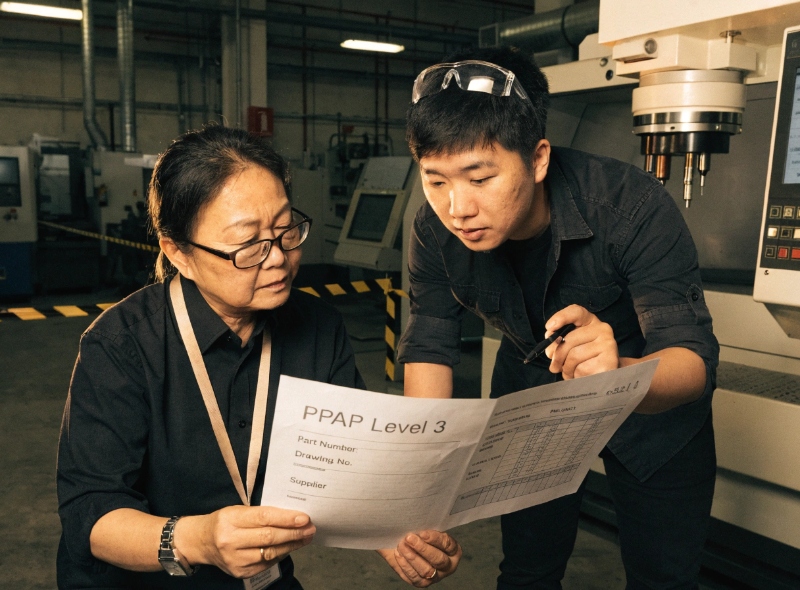
9. "Are you IATF 16949 certified, and do you support full PPAP Level 3?"
Why it matters: Automotive OEMs demand objective data and absolute traceability.
What to listen for: They must operate under the IATF 16949 quality management system6. They should provide capability studies (Cpk/Ppk), raw quality control and inspection7 data from Zeiss CMMs, and ensure every part is laser-marked with a QR code tracing it back to the specific melting furnace and CNC operator.
10. "How do you handle thermal warpage on large-format parts?"
Why it matters: Large parts like battery trays naturally warp as they cool.
What to listen for: Dynamic mold temperature control (conformal cooling) and the use of specialized, low-stress CNC fixtures to machine the part without introducing new physical distortions.
Supplier Audit Reference Matrix
Use this quick-reference matrix during your next supplier audit to separate marketing fluff from engineering reality.
| Audit Category | The "Red Flag" Answer | The Engineering Reality You Need |
|---|---|---|
| Porosity | "We guarantee 100% zero porosity." | "We use Vacuum HPDC and Moldflow to push unavoidable porosity into overflow wells." |
| Machining | "We outsource CNC to a local partner." | "We maintain single-source accountability with in-house 5-axis CNC centers." |
| Leak Testing | "Our workers do a visual water-submersion test." | "100% automated inline air-decay testing based on your CAD pressure specs." |
| Cleanliness | "We blow the parts off with compressed air." | "Ultrasonic washing and gravimetric analysis per VDA 19 standards." |
Securing Your Tier 2 Supply Chain
At EMP Tech, we know that surviving an OEM audit requires more than just pouring metal. It requires a relentless focus on thermodynamics, machining precision, and raw metrology data. As a dedicated Tier 2 manufacturing partner, we help global Tier 1 integrators mitigate risks and keep their assembly lines running smoothly.
Are you evaluating suppliers for a critical powertrain or EV structural component? Upload your 3D CAD (STEP/IGES) via our contact form today. Our engineering team will deliver a ruthless, objective DFM review and a pragmatic manufacturing quote within 24 hours—before you spend a single dollar on tooling.
References & Footnotes
EMP Tech. Automotive Aluminum Die Casting Solutions & Capabilities. ↩
North American Die Casting Association (NADCA). Engineering & Design Standards. ↩
EMP Tech. EV Motor Controller Housing Engineering Specifications. ↩
Verband der Automobilindustrie (VDA). VDA 19.1: Inspection of Technical Cleanliness. ↩
ASTM International. Standard Specifications for Aluminum-Alloy Die Castings. ↩
International Automotive Task Force. IATF 16949:2016 Quality Management System Requirements. ↩
EMP Tech. Automotive-Grade Quality Control & Inspection Laboratory. ↩


