

The electric vehicle (EV) revolution is accelerating, and with it comes a demand for innovative manufacturing processes that can meet the unique challenges of EV design. To maximize battery range, ensure safety, and optimize performance, EV components must be lightweight, structurally robust, and thermally efficient. This is where EV parts die casting, particularly with aluminum, has become an indispensable technology.
As a leading manufacturer of automotive aluminum parts, we see firsthand how high-pressure die casting (HPDC) is shaping the future of mobility. This guide explores the critical role of die casting in the production of modern electric vehicles.
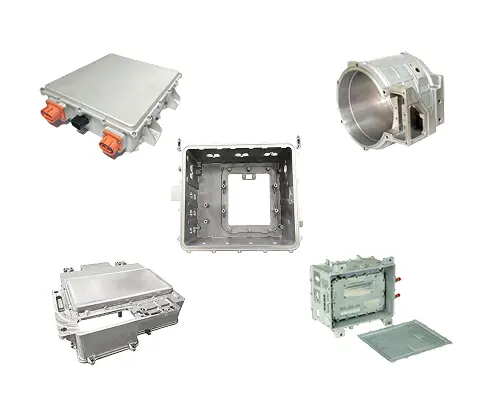
An intricate aluminum EV motor housing, a perfect example of precision die casting.
Why is Die Casting Critical for Electric Vehicles?
Unlike internal combustion engine (ICE) vehicles, EVs have a different set of engineering priorities. The heavy battery pack necessitates aggressive lightweighting in other areas, and the high-power electronics require sophisticated thermal management. Die casting directly addresses these needs.
- Lightweighting & Range Extension: Every kilogram saved on an EV’s body and components translates directly to increased battery range. Aluminum is nearly three times lighter than steel, and die casting allows for the creation of thin-walled yet strong parts, maximizing weight reduction.
- Complex Geometries & Part Consolidation: EVs require intricate housings for batteries, motors, and electronics. Die casting excels at producing complex, near-net-shape parts in a single piece. This reduces the need for multiple components and assembly steps, lowering costs and improving structural integrity.
- Excellent Thermal Conductivity: Batteries and power electronics generate significant heat. Aluminum’s superb thermal conductivity allows die-cast parts like battery enclosures and inverter housings to act as effective heat sinks, dissipating heat and ensuring optimal operating temperatures.
- Strength and Durability: Advanced aluminum alloys used in die casting offer an exceptional strength-to-weight ratio. This is crucial for structural components and for protecting the vehicle’s most vital and sensitive element: the battery pack.
- Cost-Effectiveness at Scale: For high-volume production, die casting offers a rapid cycle time and low per-unit cost, making it an economically viable solution for the booming EV market.
Key EV Components Made with Die Casting
From the chassis to the powertrain, die-cast aluminum parts are found throughout an electric vehicle. Their unique properties make them the ideal choice for a wide range of critical applications.
Die-cast components are integral to every system in a modern EV.
Here’s a breakdown of common EV parts produced using die casting:
| Component | Primary Function | Why Die Casting is Ideal |
|---|---|---|
| Battery Enclosure (Tray) | Protects battery modules from impact, seals against environmental factors, and manages heat. | Allows for complex, sealed structures with integrated cooling channels. High strength protects the cells. |
| Motor Housing | Encloses the electric motor, provides structural support, and dissipates heat. | Complex shapes with tight tolerances. Excellent thermal conductivity is essential for motor cooling. |
| Inverter & Converter Housings | Protects power electronics, shields from electromagnetic interference (EMI), and manages heat. | Provides EMI shielding and acts as a heat sink. Can be cast into intricate shapes to save space. |
| Structural Components | Shock towers, subframes, A-pillars, and other chassis parts form the vehicle’s skeleton. | Enables part consolidation (e.g., Giga Casting), reduces weight, and improves torsional rigidity. |
| Gearbox Housings | Encases the reduction gear system in an EV. | High dimensional accuracy and strength are required to handle torque and ensure quiet operation. |
| ECU Housings | Protects the Electronic Control Units that manage vehicle functions. | Lightweight, durable, and provides necessary EMI shielding for sensitive electronics. |
The Rise of Giga Casting: A Revolution in EV Manufacturing
A major evolution in EV parts die casting is the adoption of "Giga Casting" or "Mega Casting." This process utilizes massive die-casting machines with clamping forces exceeding 6,000 tons to produce huge single-piece components, such as the entire front or rear underbody of a vehicle.
Benefits of Giga Casting:
- Massive Part Consolidation: A single giga casting can replace 70 or more individual stamped and welded parts.
- Simplified Assembly: Drastically reduces the number of robots, factory floor space, and time required for vehicle assembly.
- Reduced Weight: Eliminates joints, fasteners, and adhesives, leading to a lighter and more efficient vehicle structure.
- Improved Structural Integrity: A single, solid piece offers superior rigidity and crash performance compared to a multi-part assembly.
Giga casting consolidates dozens of parts into one, simplifying manufacturing and reducing weight.
Choosing the Right Die Casting Partner for Your EV Project
The success of your EV components hinges on the expertise of your manufacturing partner. When selecting a die-casting supplier, consider the following:
- Experience in Automotive (IATF 16949): Look for a supplier with a proven track record in the demanding automotive sector and IATF 16949 certification, which ensures the highest quality and process standards.
- Advanced Technology and Capabilities: Your partner should have modern high-pressure die casting (HPDC) machines, including large-tonnage presses for structural parts, and in-house capabilities like CNC machining, finishing, and assembly.
- Material and Simulation Expertise: Deep knowledge of aluminum alloys for EV-specific applications (e.g., high thermal conductivity, high strength) is critical. The ability to perform simulation analysis like FEA and mold flow helps optimize part design before production begins.
- Robust Quality Control: Rigorous quality assurance, including X-ray inspection, CT scanning, and coordinate-measuring machines (CMM), is non-negotiable for safety-critical EV components.
Frequently Asked Questions (FAQ)
Q: What is EV parts die casting?
A: EV parts die casting is a manufacturing process where molten aluminum alloy is injected under high pressure into a steel mold (or die) to create complex components for electric vehicles. It’s used for parts like battery housings, motor housings, and large structural components.
Q: What are the main advantages of using aluminum die casting for EV components?
A: The main advantages are significant weight reduction (improving range), the ability to create complex parts with excellent thermal management properties, high strength for safety, and cost-effectiveness for high-volume production.
Q: Is die casting a sustainable manufacturing process for EVs?
A: Yes. Aluminum is infinitely recyclable without losing its properties. Using recycled aluminum for die casting requires up to 95% less energy than producing primary aluminum. This, combined with creating lighter, more efficient vehicles, contributes to the overall sustainability goals of the EV industry.
Q: What is the difference between giga casting and traditional die casting?
A: Giga casting is a form of high-pressure die casting done on a massive scale. While traditional die casting creates smaller individual components, giga casting uses exceptionally large machines to produce entire sections of a car’s body as a single piece, revolutionizing vehicle assembly and design.
Partner with the Experts in Automotive Die Casting
The road to an electric future is being paved—and cast—with aluminum. The precision, strength, and lightweight properties achieved through die casting are fundamental to building the next generation of electric vehicles.
If you are developing EV components and require a manufacturing partner with deep expertise in automotive aluminum die casting, from intricate housings to large structural parts, we are here to help. Contact us today to discuss your project requirements and discover how our advanced capabilities can accelerate your path to production.


