

When specifying or auditing die casting processes for automotive or industrial components, understanding the limitations and advantages of different casting technologies is crucial. One fundamental industry rule is that aluminum alloys are NOT suitable for hot chamber die casting machines. But why is this the case? Let’s break it down from both a technical and quality control perspective.
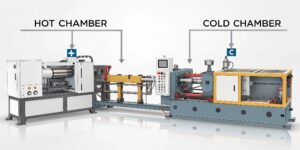
Understanding Hot Chamber vs Cold Chamber Die Casting
Hot chamber die casting machines have the injection system (the gooseneck) submerged directly in the molten metal. In contrast, cold chamber die casting machines require the molten metal to be ladled into the injection chamber for each shot.
Table: Key Differences Between Die Casting Methods
| Feature | Hot Chamber Die Casting | Cold Chamber Die Casting |
|---|---|---|
| Molten Metal Contact | Injection parts submerged | No direct submersion, metal ladled |
| Cycle Speed | Fast, automated cycles | Slower, more labor involved |
| Usual Metals | Zinc, Magnesium, Lead, Tin | Aluminum, Brass, Copper, Magnesium |
| Alloy Temp Range | Low melting points (~400ºC) | High melting points (up to 700ºC) |
The Core Reason: Aluminum’s Effect on Machine Components
1. High Melting Point vs. Gooseneck Durability
- Aluminum alloys require melting temperatures usually in the range of 660–700ºC (1220–1290ºF).
- The hot chamber gooseneck system—typically made of standard steel or iron alloys—is immersed directly in this molten metal.
2. Chemical Reactivity with Iron-Based Components
- At these high temperatures, molten aluminum aggressively reacts with the iron in the injection system.
- This reaction creates a phenomenon known as soldering or alloying, which literally causes the aluminum to “weld” to and erode the iron components.
- Over time, this leads to rapid wear, blockages, leaks, and catastrophic machine failure.
- In contrast, zinc and magnesium alloys (used in hot chamber) are far less aggressive and operate at lower temperatures, so machine parts have a much longer life.
Why Cold Chamber Die Casting is Required for Aluminum
- In cold chamber machines, the molten aluminum only briefly contacts the steel shot sleeve and plunger, which are specially designed to withstand this exposure and are replaced regularly as part of preventative maintenance.
- There is no permanent submersion, so the risk of soldering and erosion is dramatically reduced.
- This makes cold chamber die casting the global standard for aluminum, brass, and copper alloys.
Quality and Production Implications for Automotive and Industrial Parts
For anyone evaluating suppliers or setting up new production lines:
- Hot chamber machines are inherently unsuited to high-volume aluminum die casting due to maintenance costs, machine downtime, and the risk of in-process contamination.
- Using aluminum with a hot chamber process is unsustainable both in terms of part quality and factory economics.
Professional Insight: As an engineer who’s optimized aluminum die casting for more than 20 years, I’ve seen the costly consequences when hot chamber processes are mistakenly attempted with aluminum. Tool life plummets, equipment failures spike, and the resulting product often shows contamination and surface defects—failures that no Tier 1 or OEM customer will accept.
Summary Table: Suitable Die Casting Methods for Common Metals
| Metal/Alloy | Hot Chamber? | Cold Chamber? |
|---|---|---|
| Zinc | ✅ Yes | ✅ Yes |
| Magnesium | ✅ Yes (with limits) | ✅ Yes |
| Lead/Tin | ✅ Yes | ✅ Yes |
| Aluminum | ❌ No | ✅ Yes |
| Brass/Copper | ❌ No | ✅ Yes |
Ensure your aluminum die-cast components are produced on the correct technology to avoid quality losses and costly downtime.
Have more questions on die casting processes, alloy selection, or optimizing your next EV or industrial project?
Contact me at [email protected] for expert advice and a robust, audit-ready manufacturing solution.


