

As the Engineering Director and Quality Head at EMP Tech, I understand that for Tier 1 EV system integrators, the battery housing is not merely a structural component; it is the primary fortress safeguarding the most critical and expensive part of the vehicle: the battery pack.
A leak in the battery housing—whether coolant or external water ingress—is catastrophic. It leads to immediate thermal runaway and total system failure. Given the complex geometries, large surface areas, and stringent sealing requirements (typically IP67 or IP69K) of modern EV battery trays, achieving zero leakage is the ultimate manufacturing challenge in high-pressure die casting (HPDC).
Here is the engineering reality: you cannot simply "inspect" quality into a casting. Preventing leakage requires a holistic, data-driven approach starting from mold flow simulation through to final machining and rigorous NDT (Non-Destructive Testing).
Based on our experience supplying major European and North American OEMs, here is the EMP Tech methodology for manufacturing leak-free aluminum battery housings.
1. Process Genesis: Moldflow and Vacuum Integrity
The root cause of leakage is porosity—specifically, interconnected porosity that creates a path for fluids. This typically arises from two sources: entrapped gas (dieseling) and solidification shrinkage.
Validating the Die Casting Process
We do not start production until the Cavity Filling and Solidification Simulation is perfected.
- Venting Optimization: We utilize advanced simulation software to predict gas entrapment zones. We engineer a robust vacuum system into the die (VHPDC – Vacuum High-Pressure Die Casting). Our standard practice is to evacuate the die cavity to below 50 millibars before injection, drastically reducing the partial pressure of gases and minimizing porosity.
- Rheocasting Application (For Structural Integrity): For complex, large-scale battery trays requiring superior elongation and pressure tightness, we employ semi-solid rheocasting. This process introduces less heat into the die and creates a globular microstructure, significantly reducing shrinkage porosity compared to conventional HPDC.
2. The EMP Tech VHPDC Cell: Real-Time Process Control
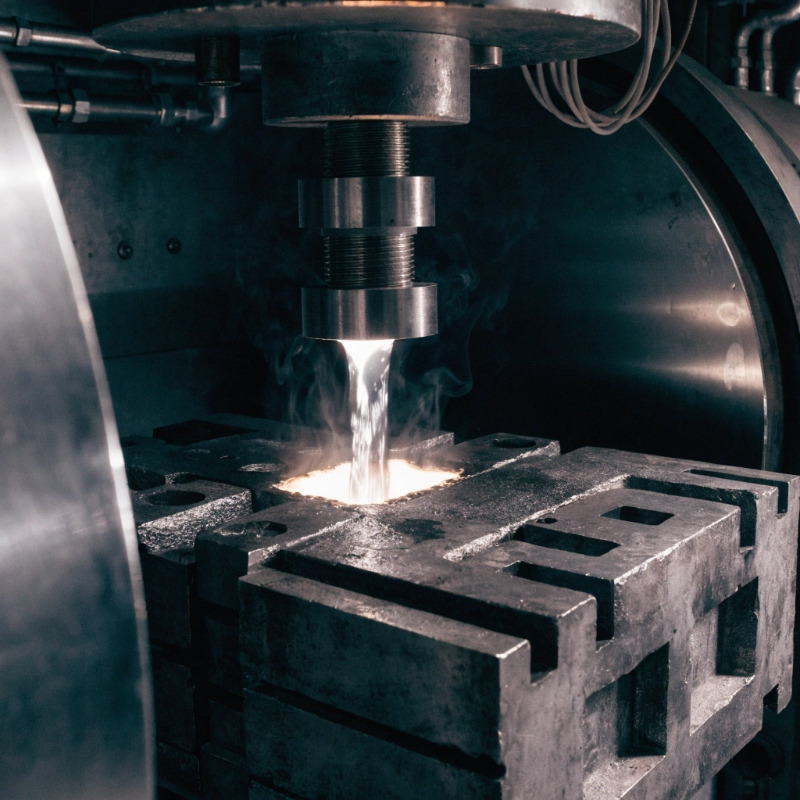
A stable process is a leak-free process. Our 13 large-scale die casting cells (ranging from 350T to 3050T) are equipped with real-time monitoring systems.
We monitor over 100 parameters per shot, but for pressure tightness, the critical parameters are:
| Parameter | Control Standard (EMP Tech) | Impact on Leakage |
|---|---|---|
| Vacuum Level | < 50 mbar | Ensures minimal air entrapment, reducing distributed porosity. |
| Slow Shot Velocity | Precise control (< 0.2 m/s) | Prevents premature metal turbulence in the shot sleeve. |
| Fast Shot Velocity | 6.0 – 8.5 m/s (Dependent on part) | Ensures rapid filling before premature solidification. |
| Intensification Pressure | > 900 bar (on metal) | Crucial during the final solidification phase to feed shrinkage and close micro-pores. |
| Casting Temperature | $\pm$ 5°C of alloy specification | Prevents cold shuts (lack of fusion) and excessive oxide inclusions. |
3. Machining Strategy: Single-Setup Precision
The battery tray sealing surface is the interface to the vehicle chassis or the battery cover. Any distortion during or after machining compromises the seal.
- 4/5-Axis CNC Capabilities: With over 150 CNC machines, we prioritize "Single-setup machining." We fixture the raw casting in a manner that allows access to the maximum number of faces in one operation.
- Minimizing Chatter: We utilize custom-designed, hydraulic fixtures that support the casting at critical points, absorbing vibration and preventing chatter marks on the sealing face, which are common leak paths.
- Tool Wear Monitoring: Our CNCs use in-process probing and automated tool wear compensation. A dull tool generates heat and creates burrs, leading to poor surface finish on sealing areas.
4. Quality Validation: The "Three Pillars" of Leak Testing
At EMP Tech, we do not rely on a single test method. We employ a triple-layered validation strategy to guarantee that no porous parts escape the factory.
Pillar 1: In-Line Pressure Decay Testing
Every single battery housing (100%) undergoes a pressure decay test immediately after the pressure tightness machining operation.
- The Process: Fixtures seal all cooling channel inlets/outlets and the main tray perimeter. We pressurize the cavity with dry air or helium and measure the pressure drop over a defined stabilizing and testing time.
- Our Standard: We adhere to stringent customer specifications, typically capable of detecting a pressure drop equivalent to a leak rate of 0.1 sccm (standard cubic centimeters per minute) depending on the specific OEM requirements.
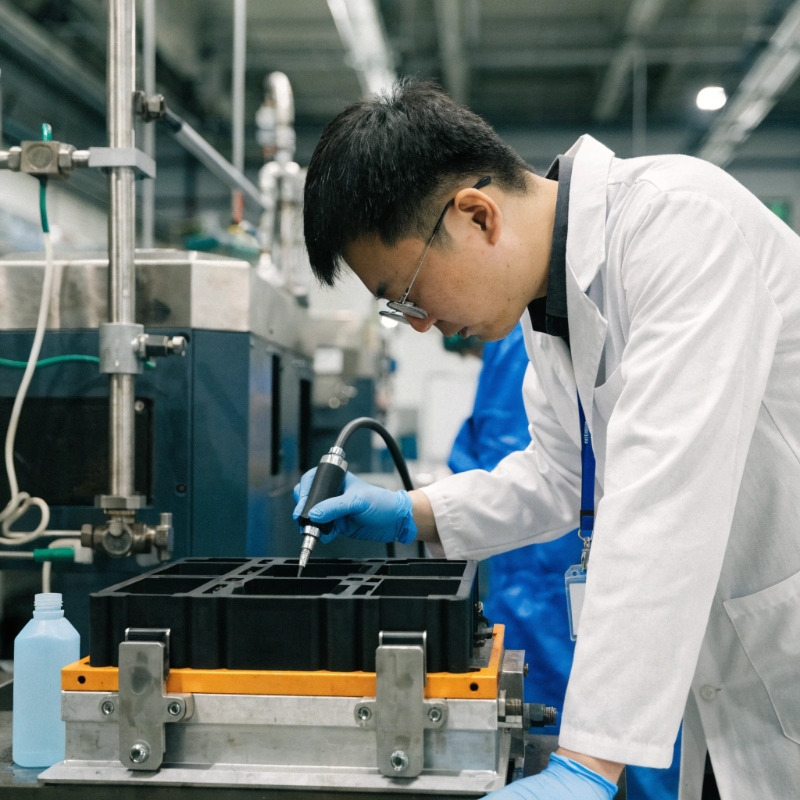
Pillar 2: Offline Helium Mass Spectrometry (Helium Sniffing)
For critical cooling channel circuits within complex castings, air testing may not be sensitive enough.
- The Process: We place the casting in a vacuum chamber and pressurize the internal circuits with helium. A mass spectrometer sniffer probe scans the entire surface, particularly the areas identified by Moldflow as high-risk.
- When used: This is used for process capability validation during PPAP and for periodic audits of production parts to ensure the robustness of the in-line air testing.
Pillar 3: X-Ray NDT and Metallographic Analysis
To understand why a failure occurred, we look inside the material.
- Automated X-Ray: We utilize real-time X-ray imaging, increasingly augmented by AI-assisted defect recognition, to scan high-risk areas for internal porosity, inclusions, or cold shuts.
- Sectioning: We routinely section castings at the sealing rail and critical structural nodes to measure the actual density and porosity percentage. This confirms that the VHPDC parameters are effectively managing the porosity distribution away from critical sealing areas.
By integrating advanced simulation, controlled VHPDC processing, precision machining, and redundant testing methodologies, EMP Tech provides a robust manufacturing shield for our EV customers. We do not just make castings; we deliver guaranteed sealing integrity.


