

EV structural components impose stricter process demands than traditional powertrain castings. Motor housings, inverter cases, battery trays and suspension mounts must combine low mass, high stiffness, effective heat dissipation and reliable sealing under continuous thermal cycling. For Tier 2 suppliers, the real exposure lies in secondary supply-chain risk: dimensional drift after machining, porosity intersecting functional surfaces, and incomplete PPAP packages that fail Tier 1 or OEM audits.
We address these requirements through vacuum-assisted high-pressure die casting (HPDC) paired with single-setup 5-axis machining. The objective is assembly-ready geometry and documentation that survive customer quality gates without rework loops.
Alloy Selection and Metallurgical Controls for Structural EV Parts
Most current aluminum structural die casting programs for electric vehicles rely on AlSi10MnMg or closely related secondary alloys. Critical process windows we hold:
- Iron content kept below 0.15 % to limit sludge and intermetallic formation
- Strontium modification verified by thermal analysis at the start of each shift
- Hydrogen level targeted below 0.15 ml/100 g via rotary degassing
Alloy response to T5 versus T6 heat treatment must be validated against the final GD&T stack. Solution treatment improves strength but increases the risk of distortion on large open structures such as battery trays; residual-stress mapping on first articles determines the final sequence.
| Parameter | Typical Target Value | Process Lever |
|---|---|---|
| Average wall thickness (battery tray) | 2.8–3.5 mm | Gate design + intensification pressure |
| Local reinforcement at mounts | 6–8 mm | Core and rib layout |
| Post-CNC thermal interface flatness | ≤ 0.05 mm | Single-setup machining |
| O-ring groove surface finish | Ra ≤ 0.8 μm | Dedicated finishing tools |
| Air-decay leak rate | ≤ 5 sccm at 1.5 bar | 100 % online testing |
Lightweighting Through Controlled Thin-Wall Casting
Mass reduction is achieved by thinning walls while preserving stiffness through optimized rib and boss geometry. The practical limit is governed by flow length and solidification shrinkage. On large battery trays we routinely run average wall thickness of 3.2 mm with local thickening only where structural or fastening loads require it.
Shop-floor observation: thin sections adjacent to thick bosses release residual stress at different rates during material removal. Fixture design must constrain the part in the same orientation used in final assembly; otherwise spring-back appears only after the part leaves the CNC cell. Residual-stress measurements on first-article castings are used to lock machining stock and fixture strategy before series release.
Vacuum assistance does not eliminate gas porosity. It relocates it. Mold-flow simulation drives overflow and vent placement so remaining porosity sits in non-critical ribs rather than sealing planes or load paths.
Thermal Management Geometry and Surface Requirements
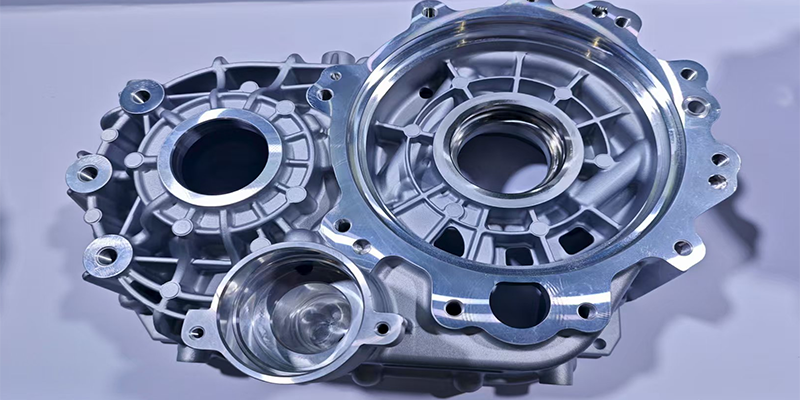
Motor housings and inverter cases must extract heat efficiently. Cast-in cooling channels or large flat surfaces for cold-plate contact demand precise core positioning and post-machining flatness.
Key controls:
- Core-pin temperature and coating management to prevent soldering in long cooling galleries
- Thermal interface surface flatness held to ≤ 0.05 mm after CNC
- Surface cleanliness to VDA 19 limits before thermal interface material application
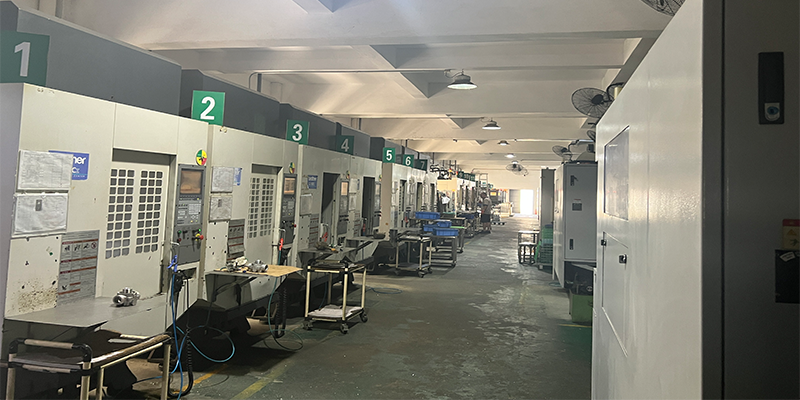
Single-setup 5-axis machining eliminates the datum shifts that appear when critical features are cut in multiple fixturings. The geometric relationship between stator bore, mounting faces and cooling surfaces remains intact.
Sealing Integrity Without False Claims
IP67-level sealing performance is a functional requirement verified by test, not a casting claim. We never state that a raw casting will “pass IP67.” Process design focuses on keeping porosity away from O-ring grooves and gasket faces, followed by 100 % air-decay leak testing.
Practical measures:
- Overflow volume set at 15–25 % of casting volume for effective gas evacuation
- O-ring groove Ra controlled to ≤ 0.8 μm through dedicated CNC parameters
- Vacuum impregnation applied only as a corrective action on non-critical zones
When porosity repeatedly intersects sealing surfaces, the response is mold modification—relocating overflows or adjusting vent lands—rather than permanent reliance on resin.
Documentation and Audit Readiness for Tier 1 Customers
Tier 2 suppliers face constant pressure to deliver complete, traceable PPAP Level 3 packages that survive Tier 1 and OEM audits. Standard data sets we generate include:
- Full dimensional layouts from Zeiss CMM equipment1
- X-ray or CT porosity maps of critical zones
- Process capability (Cpk) for all special characteristics
- Material certificates, heat-treatment records and VDA 19 cleanliness reports
- Serial-number-correlated 100 % air-decay leak-test results
These data are taken from the same measurement systems used in series production, so the submitted package matches actual process performance rather than idealized first-article results.
Process Integration That Reduces Supply-Chain Risk
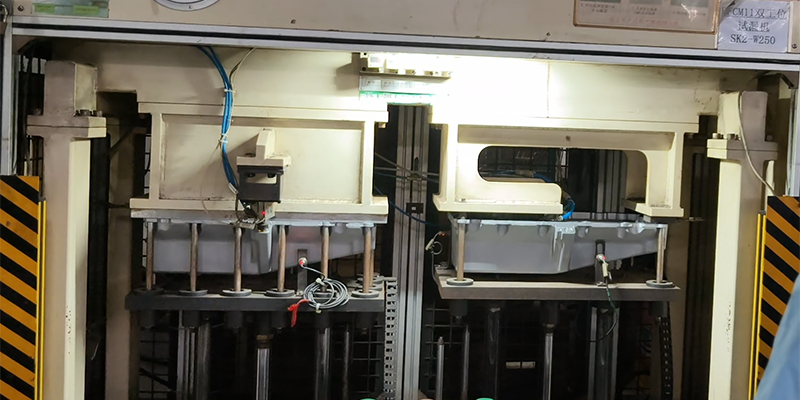
Keeping both vacuum HPDC and single-setup machining under one roof shortens the feedback loop between casting defects and machining strategy. Dimensional drift or porosity location issues are identified and corrected before the tool is released for volume production.
For high-volume EV programs the combination of controlled alloy chemistry, residual-stress management and single-setup machining reduces the incidence of late-stage dimensional or leak failures that typically surface only after customer approval.
Whether the component is a high-pressure die cast aluminum2 motor housing, inverter case or large structural battery tray, the engineering priority remains consistent: locate residual porosity away from functional surfaces, control residual stress so machining stock is predictable, and deliver complete process data that supports Tier 1 audit success.
References & Footnotes
EMP Tech. Automotive-Grade Quality Control & Inspection. Zeiss CMM programs and process-capability data supporting PPAP Level 3 submissions. ↩
EMP Tech. Automotive Die Casting Solutions. Vacuum HPDC and single-setup machining capabilities for structural EV components. ↩


