

Sourcing the main drive motor housing for an electric vehicle powertrain is one of the highest-risk procurement decisions a Tier 1 system integrator will make. Unlike traditional ICE brackets or simple covers, an EV motor housing is a highly complex convergence of structural rigidity, active thermal management, and extreme geometric tolerancing.
If your chosen automotive die casting partner1 fails to control the thermodynamic variables during the shot, or uses outdated fixturing during CNC machining, the pain isn’t felt in the foundry. It is felt on your assembly line when a stator cracks during press-fitting, or when severe NVH (Noise, Vibration, and Harshness) issues force a total teardown of the drive unit.
To protect your assembly line and pass rigorous OEM audits, you must look past a foundry’s machine tonnage and evaluate their actual engineering execution. Here are the core capabilities you must verify when auditing an EV motor housing manufacturer.
1. Single-Setup CNC Machining for Absolute Coaxiality
The rotor inside an EV drive unit spins at upward of 15,000 to 20,000 RPM. At these speeds, the coaxiality between the front and rear bearing bores must be absolute. Misaligned bearings will cause immediate gear whine, excessive wear, and catastrophic NVH failures.
The Engineering Reality: You cannot achieve micron-level concentricity if the housing is moved between multiple 3-axis CNC machines. Every time a part is unclamped, moved, and re-clamped, tolerance stack-up errors occur.
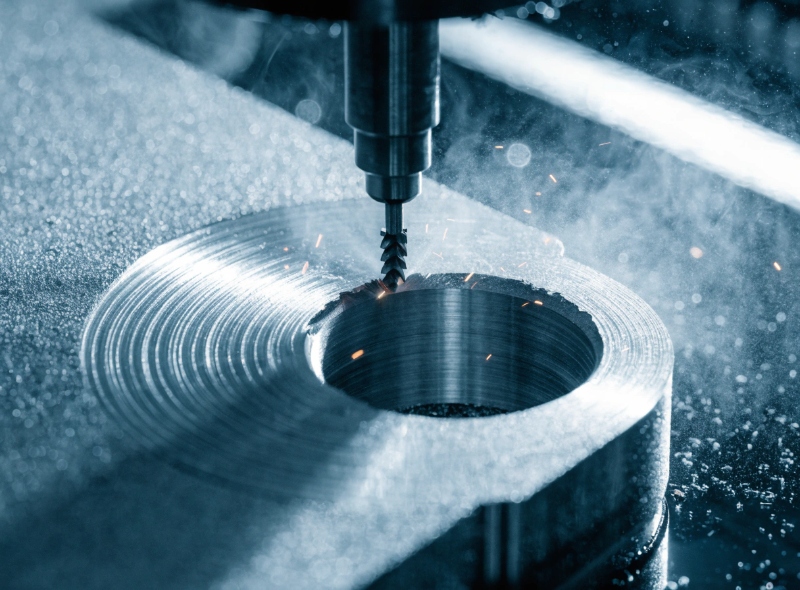
The Capability to Check: Your supplier must utilize 4-axis or 5-axis CNC machining centers capable of "single-setup machining." Milling all critical bearing bores and stator mating faces in one continuous operation is the only reliable way to guarantee strict true position and coaxiality.
2. Advanced Coring for Liquid Cooling Jackets
Thermal management dictates the continuous power output of an EV motor. Drive motor housings require complex, integrated water jackets to circulate coolant around the stator.
The Engineering Reality: Casting deep, intricate water jackets requires massive steel core pulls (slider mechanisms). If the draft angles are incorrect, or if the thermal gradients are poorly managed, the aluminum will shrink onto the cores, causing galling or cold shuts.
The Capability to Check: The foundry must conduct predictive Moldflow analysis prior to cutting steel, adhering strictly to NADCA design guidelines2. Furthermore, visual inspection of a water jacket is useless. The supplier must validate every casting using 100% automated inline air-decay leak testing before the part ever reaches the shipping dock.
3. Controlling Stator Press-Fit Tolerances
During Tier 1 assembly, the heavy electromagnetic stator is typically shrink-fitted or press-fitted into the inner diameter (ID) of the aluminum housing.
The Engineering Reality: Raw aluminum castings naturally hold residual stress and warp as they cool. If the housing’s ID is machined slightly too small, the housing will crack under the hoop stress of the press-fit. If it is too large, the stator will slip under peak torque.
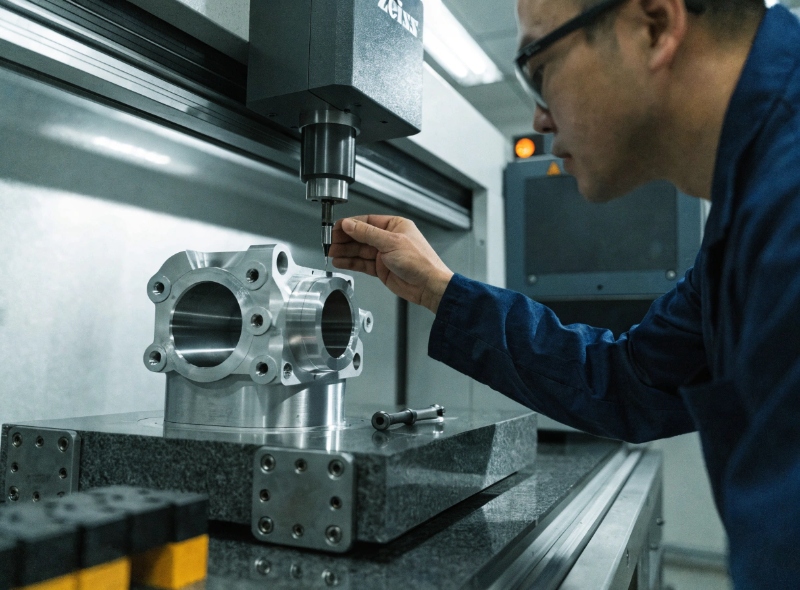
The Capability to Check: Ask about their custom CNC fixturing. If a warped casting is clamped too tightly, the CNC will cut a perfect circle, but the moment the clamps are released, the housing springs back into an oval. Suppliers must use specialized low-distortion fixturing and rely on rigid quality control and inspection3 via Zeiss CMMs to verify the circularity and cylindricity of the stator bore.
4. Porosity Management via Vacuum HPDC
Thick mounting flanges and structural mounting points cool slower than the 2.0mm thin walls of the main housing body. These thermal hot spots are magnets for micro-porosity (shrinkage voids).
The Engineering Reality: If a supplier claims they can deliver an "absolutely zero-porosity" motor housing, they are ignoring metallurgical physics. Porosity will always exist in high-pressure die casting. The key is controlling where it happens.
The Capability to Check: The foundry must utilize Vacuum High-Pressure Die Casting (VHPDC) to evacuate air from the cavity milliseconds before injection. More importantly, they must use thermodynamic modeling to design overflow wells that intentionally pull trapped gases out of critical areas—especially away from CNC-machined O-ring sealing grooves where exposed pores would cause coolant leaks.
Capability Audit Matrix for EV Motor Housings
Use this pragmatic matrix to separate reliable engineering partners from basic foundries during your next audit.
| Audit Metric | The "Red Flag" Approach | The Engineering Reality You Need |
|---|---|---|
| Bearing Coaxiality | Multiple setups on 3-axis CNC machines. | Single-setup 5-axis machining with custom low-stress fixturing. |
| Coolant Sealing | Visual water-submersion tests. | 100% automated air-decay leak testing based on CAD pressure specs. |
| Cleanliness | Blowing out blind tapped holes with compressed air. | Ultrasonic washing and gravimetric analysis per VDA 19 technical cleanliness4 standards. |
| Traceability | Batch-level paper tracking. | Laser-etched QR codes linked to spectrometer melt data and CNC operator logs per IATF 16949 standards5. |
Securing Your Tier 2 Manufacturing Partner
At EMP Tech, we understand that manufacturing EV motor housings and EV motor controller housings6 is an unforgiving process. We do not rely on guesswork. By keeping mold design, Vacuum HPDC, 5-axis CNC machining, and CMM metrology under one roof, we provide Tier 1 integrators with single-source accountability.
If you are developing a new powertrain architecture and need to mitigate supply chain risks before cutting expensive H13 steel, upload your 3D CAD (STEP/IGES) via our contact form today. Our engineering team will deliver a ruthless, objective DFM review and a pragmatic manufacturing quote within 24 hours.
References & Footnotes
EMP Tech. Automotive Aluminum Die Casting Solutions & Capabilities. ↩
North American Die Casting Association (NADCA). Engineering & Design Standards. ↩
EMP Tech. Automotive-Grade Quality Control & Inspection Laboratory. ↩
Verband der Automobilindustrie (VDA). VDA 19.1: Inspection of Technical Cleanliness. ↩
International Automotive Task Force. IATF 16949:2016 Quality Management System Requirements. ↩
EMP Tech. EV Motor Controller Housing Engineering Specifications. ↩


